Marian Pahars: The Journey of the Latvian Premier League Pioneer
Marian Pahars remains a significant figure in Baltic football history, remembered not only for his clinical finishing but for breaking barriers as the first Latvian player to compete in the English Premier League. From his early days in Ukraine and Latvia to the high-pressure environment of English football, Pahars' career was a blend of explosive brilliance and frustrating physical setbacks.
Early Beginnings and Rise at Skonto
Born in Chornobai, Ukraine, to Latvian parents, Pahars grew up as a fan of Spartak Moscow. His path toward professional football began at age eight when he was discovered by Jurijs Andrejevs, a coach from Skonto. Andrejevs became a pivotal mentor, shaping the trajectory of Pahars' development.
Pahars began his professional journey at 18 with Pardaugava Riga, later moving to Skonto Metāls before breaking into the Skonto first team in 1995. Initially deployed as a midfielder on the wings, he eventually transitioned into a striker's role, where his natural scoring ability flourished.
His impact was immediate. In 1995, he achieved a remarkable goal ratio, scoring eight goals in just nine games. He followed this with 12 goals in 28 appearances the next season, earning him a regular spot on the Latvia national team and the nickname the "Latvian Michael Owen" during his peak.
By the 1998 season, Pahars had become a dominant force, netting 19 goals in 26 games. This form attracted interest from several European clubs, leading to trials with Salernitana in Italy, Werder Bremen in Germany, and Casino Salzburg in Austria. However, it was a recommendation from Gary Johnson, the manager of the Latvian national team, that led him to Southampton manager Dave Jones.
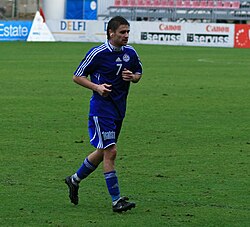
The Southampton Years: Triumph and Adversity
Pahars made a stunning first impression during a reserve match against Oxford United on February 10, 1999, where he scored a perfect hat-trick—scoring once with a header and once with each foot—in a 7–1 victory.
Southampton secured his signature for approximately £800,000. Despite initial hurdles regarding work permits and objections from the Professional Footballers' Association, Pahars officially joined the "Saints" in March 1999, making history as the first Latvian in the Premier League.
His debut came on April 5, 1999, against Coventry City. Shortly after, he scored a vital equalizer against Blackburn Rovers at The Dell. In a high-stakes final game of the season, Pahars scored twice in a 2–0 win over Everton, a result that directly secured Southampton's survival in the top flight.
Tactical Shifts and Peak Performance
During the 1999–00 season, Pahars finished as the club's top scorer with 13 goals in 33 appearances. Under new manager Glenn Hoddle, he was moved to a wider position to utilize his pace and dribbling to create opportunities for teammates. While this tactical shift led to some inconsistency in his scoring, he remained a constant threat.
The 2001–02 season saw Pahars reach his scoring peak at Southampton. He scored the winning goal in the Saints' first-ever victory at the new St Mary's Stadium against Charlton Athletic on November 24, 2001. He ended the season with 16 goals across the League and FA Cup. Together with strike partner James Beattie, who scored 14, they formed the second-most productive strike partnership in the Premiership.
The Battle with Injuries
The latter half of his Southampton career was marred by severe injuries. A hernia operation in the summer of 2002 hindered his pre-season, and a serious ankle injury in November 2002 sidelined him for most of the season. This pattern continued into the 2003–04 season, though he managed a brief return to form, scoring a notable goal against local rivals Portsmouth in December 2003.
The 2004–05 season was particularly devastating; a heavy tackle during a pre-season match against Swindon Town caused a recurrence of his ankle injury, ruling him out for the entire campaign. During his absence, Southampton was relegated from the Premier League after 28 years. After a final, injury-plagued season in 2005–06, the club announced his contract would not be renewed in May 2006.
Later Career and Retirement
In July 2006, Pahars moved to Cyprus to join Anorthosis Famagusta under manager Temuri Ketsbaia. However, persistent injuries continued to plague him, leading to his release in January 2008.
Pahars returned to his roots in 2008, rejoining Skonto for one season to help the club in the national championship. He eventually concluded his professional playing career with a brief spell at Jūrmala, appearing in two national championship games.
Key Facts
- Premier League Pioneer: First Latvian player to play in the English Premier League.
- Southampton Record: Made 156 appearances and scored 45 goals for the Saints.
- Clinical Start: Scored a perfect hat-trick (left foot, right foot, header) during his Southampton trial.
- Survival Hero: Scored two goals against Everton in 1999 to keep Southampton in the Premier League.
- Peak Partnership: Formed the second-best strike rate in the Premiership alongside James Beattie in 2001–02.
| Club | Key Achievement/Stat | Notable Period |
|---|---|---|
| Skonto | 19 goals in 26 games (1998) | Early Career |
| Southampton | 45 goals in 156 appearances | 1999–2006 |
| Anorthosis Famagusta | Move to Cypriot League | 2006–2008 |
| Skonto / Jūrmala | Return to Latvia | 2008–End |
Frequently Asked Questions
Why was Marian Pahars called the "Latvian Michael Owen"?
He earned this nickname during his prime at Skonto due to his exceptional pace, agility, and clinical finishing ability as a striker.
What is a "perfect hat-trick" in football?
A perfect hat-trick occurs when a player scores three goals in a single match: one with the right foot, one with the left foot, and one with the head.
How did Pahars help Southampton avoid relegation in 1999?
In the final game of the season, Pahars scored both goals in a 2–0 victory over Everton, which guaranteed the club's place in the Premiership for the following year.
What caused the decline of Pahars' career at Southampton?
His career was severely impacted by recurring injuries, most notably a series of ankle injuries and a hernia operation, which led to multiple long-term absences from the squad.
Which clubs did Pahars play for after leaving Southampton?
After leaving Southampton in 2006, he played for Anorthosis Famagusta in Cyprus, returned to Skonto in Latvia, and finished his career at Jūrmala.