Maotianshan Shale: A Window into the Cambrian Explosion
The Maotianshan Shale represents one of the most significant geological discoveries in the history of paleontology. Located in Chengjiang County, Yunnan Province, China, these Early Cambrian sedimentary deposits provide an unparalleled glimpse into the "Cambrian explosion"—the rapid diversification of animal life approximately 518 million years ago.
These deposits are classified as Konservat Lagerstätten, a technical term for sedimentary deposits that exhibit exceptional preservation of fossilized organisms, including non-mineralized soft tissues that rarely survive the fossilization process. Along with the Burgess Shale in Canada, the Maotianshan Shale is considered a primary window into the origin of complex life, particularly the early evolution of chordates (the phylum including vertebrates).
Due to its immense scientific value, a 512-hectare (1,270-acre) area known as the Chengjiang Fossil Site was designated as a UNESCO World Heritage Site in 2012.
Key Facts
- Age: Early Cambrian (Cambrian Stage 3), approximately ≤ 518 million years ago.
- Location: Chengjiang County, Yunnan Province, China.
- Preservation: Exceptional soft-tissue preservation as aluminosilicate films.
- Scale: The Yuanshan Member covers multiple 10,000 square kilometers.
- Diversity: Over 185 described species, with nearly half being arthropods.
- Significance: Critical for understanding the origin of chordates and early animal body plans.
Geological Composition and Environment
The fossils are found within the Yuanshan Member of the Qiongzhusi Formation (also referred to as the Chiungchussu or Heilinpu Formation). The stratigraphic section consists of mudstone and shale approximately 50 meters (160 ft) thick. The fossils themselves are often concentrated in thin layers less than an inch thick.
Evidence suggests that the region was once a shallow tropical sea with a muddy bottom. The organisms were primarily benthic (bottom-dwelling) and were likely buried rapidly by periodic turbidity currents—underwater landslides of sediment. This rapid burial prevented decay and post-mortem transport, allowing soft body parts to be preserved as aluminosilicate films, often enriched with oxidized iron.
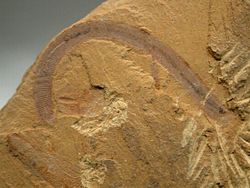
The Chengjiang Biota
The biological assembly found in the Maotianshan Shale, known as the Chengjiang biota, is remarkably diverse. As of June 2006, approximately 185 species had been described. One of the most striking aspects of this fauna is the prevalence of soft-bodied organisms; only about 3% of the known species possessed hard shells.
Dominant Groups and Phyla
- Arthropods: Nearly half of the described species. Unlike later arthropods, many lacked mineral-reinforced exoskeletons. Even the five species of trilobites found here exhibit rare preservation of legs and antennae.
- Porifera and Priapulida: Well-represented with 15 species of sponges and 16 species of priapulid worms.
- Other Phyla: The site contains representatives from Brachiopoda, Chaetognatha, Cnidaria, Ctenophora, Echinodermata, Hyolitha, Nematomorpha, Phoronida, and Chordata.
- Enigmatic Taxa: The fossil Wiwaxia is identified as a possible mollusc.
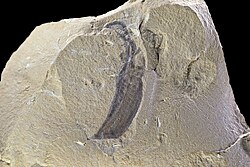
Summary of Maotianshan Shale Characteristics
| Feature | Details |
|---|---|
| Stratigraphic Range | Cambrian Stage 3 (Qiongzhusian age) |
| Primary Lithology | Shale and Mudstone |
| Thickness | 50 meters (160 ft) |
| Paleoenvironment | Shallow tropical sea / Deltaic environment |
| Preservation Mode | Aluminosilicate films (soft-tissue preservation) |
| Key Site | Maotianshan Hill, Yunnan, China |
Frequently Asked Questions
What makes the Maotianshan Shale different from typical fossil sites?
Unlike most fossil sites that only preserve hard parts like shells or bones, the Maotianshan Shale is a Konservat Lagerstätte. This means it preserves non-mineralized soft tissues, providing a much more complete picture of early animal anatomy.
How were the fossils so well preserved?
The organisms were likely buried quickly by turbidity currents in a shallow sea. This rapid burial, combined with specific chemical conditions, turned soft tissues into thin aluminosilicate films, preventing them from decomposing.
Why is this site important for the study of humans and vertebrates?
The site is critical for studying the origin of chordates. Because it preserves the earliest ancestors of the vertebrate lineage, it helps scientists understand how the basic body plan of chordates first emerged.
What is the relationship between the Chengjiang and Burgess Shale biotas?
Both are world-class examples of Cambrian soft-tissue preservation. While the Burgess Shale is located in Canada, the Chengjiang biota is generally older, offering an even earlier look at the diversification of life during the Cambrian explosion.