Manuel Roxas: The Presidency and the Birth of the Third Republic
The transition of the Philippines from a Commonwealth to a fully sovereign nation was a period of immense turmoil and hope. At the center of this transformation was Manuel Roxas, a leader tasked with the monumental challenge of rebuilding a nation shattered by World War II. Serving as both the final president of the Commonwealth and the first president of the Third Republic, Roxas navigated the complex waters of post-war diplomacy, economic collapse, and internal insurgency.
His presidency was defined by a strategic, albeit controversial, reliance on the United States to fund national reconstruction, while simultaneously attempting to stabilize a society fractured by war and class struggle.
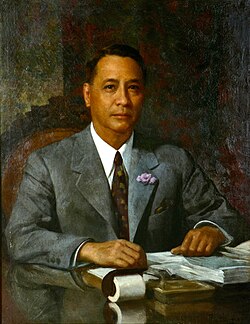
Key Facts
- Dual Role: Served as the last President of the Commonwealth (May 28 – July 4, 1946) and the first President of the Third Republic (1946–1948).
- Economic Crisis: Inherited a nation that had lost approximately two-thirds of its material wealth, with GDP down 38.7% compared to 1937.
- US Relations: Secured billions in aid through the Bell Trade Act in exchange for "parity rights" for US citizens.
- Internal Conflict: His administration faced a violent uprising from the Hukbalahap (Huks), a peasant-led guerrilla movement.
- Territorial Gain: Successfully transferred the administration of the Turtle and Mangsee Islands from the United Kingdom to the Philippines.
The Transition to Independence
Before his formal inauguration, president-elect Roxas visited the United States to negotiate the terms of independence. He advocated for the continued presence of US military bases, arguing they were essential for common protection. This led to a draft agreement on May 10, 1946, allowing the US to maintain bases for 99 years, though Roxas successfully negotiated a reduction in the number of Army bases in favor of naval and air installations.
On May 28, 1946, Roxas was inaugurated as the last president of the Commonwealth amidst the ruins of the Legislative Building. His vision focused on national reconstruction, social justice for the working class, and maintaining close ties with the US and the newly formed United Nations.
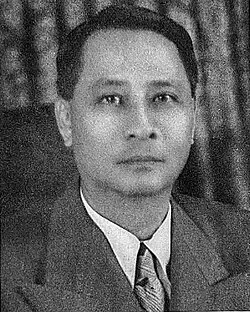
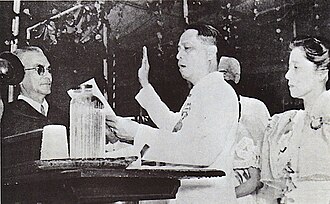
The culmination of this transition occurred on July 4, 1946, at Luneta Park. In a ceremony attended by 300,000 people, the US flag was lowered and the Philippine national flag was raised, marking the official birth of the Third Republic. Roxas took his oath as the first president of the new republic before Chief Justice Manuel Moran.
Economic Reconstruction and the Bell Trade Act
The Philippines emerged from World War II as one of the most devastated countries globally. Manila was comparable to the ruined cities of Europe, and an estimated two million people had perished. With the national economy in near bankruptcy and export trade nonexistent, Roxas sought immediate foreign assistance.
To secure funding, Roxas urged Congress to accept the Bell Trade Act (or Philippine Trade Act). This agreement provided tariff-free access to American markets and approximately $2 billion in reconstruction aid. However, this came at a high cost: the Philippine peso was pegged to the US dollar, and US corporations were granted parity rights—the legal right to exploit Philippine minerals and forests on equal footing with Filipino citizens.
To further stabilize the economy, the administration established the Philippine Rehabilitation Finance Corporation to build housing and provide loans, and proposed the creation of the Central Bank of the Philippines. Despite these efforts, the administration was plagued by reports of massive graft, with much of the US aid allegedly stolen by corrupt officials.
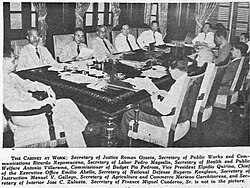
Economic Indicators (1947-1948)
| Metric | Value/Detail |
|---|---|
| Population (1948) | ≈ 19.23 million |
| GDP (1947, 1985 constant prices) | Php 85,269 million |
| GDP Growth Rate (1947–48) | 39.5% |
| Per Capita Income (1947) | Php 4,434 |
| Exchange Rate | 1 US$ = Php 2.00 |
Domestic Strife and the Huk Rebellion
Roxas's domestic policy was marked by a sharp divide between the ruling class and the peasantry. While he implemented the Rice Share Tenancy Act of 1933 and Republic Act No. 34 (the Tenant Act) to regulate share-tenancy, these measures failed to quell unrest in Central Luzon.
The Hukbalahap (Huks), a communist-led peasant army that fought the Japanese, sought land reform and the punishment of wartime collaborators. When the Democratic Alliance—a party including Huk leader Luis Taruc—won seats in Congress, Roxas expelled them, claiming their election was illegal. This act, combined with a series of police ambushes on Huk leaders, sparked a civil war.
In a contrasting move, Roxas granted full amnesty on January 28, 1948, to Filipino collaborators who had served under the Japanese puppet government, including former President José P. Laurel. This decision was intended to unify the nation but instead fueled Huk grievances, as they viewed the administration as a continuation of the collaborationist regime.
Foreign Policy and Geopolitics
The Roxas administration's foreign policy was heavily influenced by the emerging Cold War. The US viewed the Philippines as a critical strategic point to project power into Asia and prevent the spread of Communism, especially as the Kuomintang lost ground in the Chinese Civil War.
This geopolitical importance allowed Roxas to secure military aid, including $17.7 million in military assistance and $25 million for reconstruction. Beyond the US, the Philippines expanded its territory by taking over the administration of the Turtle and Mangsee Islands from the United Kingdom in October 1947.
Frequently Asked Questions
What were the parity rights granted under the Bell Trade Act?
Parity rights were constitutional amendments that gave United States citizens and corporations the same rights as Filipino citizens to explore, develop, and utilize natural resources and other public utilities within the Philippines.
How did Manuel Roxas handle the Hukbalahap movement?
Roxas initially attempted peace talks, but after the ambush of Huk leaders and the expulsion of the Democratic Alliance from Congress, he outlawed the movement on March 6, 1948, leading to an escalation of the civil war.
Why did Roxas grant amnesty to wartime collaborators?
The Amnesty Proclamation of 1948 was designed to heal national divisions and foster unity during the difficult reconstruction period, though it excluded those who committed common crimes like murder or rape.
What was the economic state of the Philippines upon independence?
The country was near bankruptcy, having lost two-thirds of its material wealth. GDP had dropped by 38.7% compared to pre-war levels, and critical infrastructure, including 80% of school buildings, had been destroyed.
What was the significance of the Treaty of General Relations?
Ratified on August 5, 1946, this treaty formally recognized Philippine independence, settled property rights between the two nations, and allowed the US to maintain military bases for mutual protection.