Madrid Arena: A Versatile Hub for Sports and Events
The Madrid Arena stands as a testament to the city's ambition and architectural versatility. Originally conceived as part of the infrastructure for the Madrid 2012 Olympic bid, this multi-purpose facility was designed to bring world-class sporting events to the heart of the Spanish capital. Since its inception, it has evolved from a planned Olympic basketball venue into a flexible space capable of hosting a diverse array of international competitions.
Construction and Architectural Design
Construction of the arena began in 2002, with the first phase completed that same year and further expansions following in 2003. The facility is engineered for maximum flexibility, distributed across three distinct levels: the access floor, the intermediate floor, and the low floor.
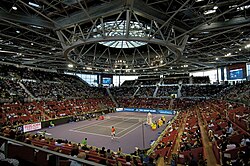
One of the arena's most innovative features is its central court, which utilizes three retractable bleachers. This design allows the surface area to be modified quickly to accommodate different types of events, ensuring the venue remains functional for various sports and performances.
The exterior is equally impressive, featuring a facade composed of a double curve of glass that is lightweight and offers variable transparency. Topping the structure is a massive dome covering 11,000 m, supported by a complex three-dimensional structure resting on 181 piles. For environmental comfort, the dome includes a skylight that can be opened to allow natural light into the interior.
Capacity and Facilities
The Madrid Arena is a sprawling complex totaling 30,000 m. Its seating capacity varies depending on the configuration of the event. For basketball games, the arena can hold up to 10,248 spectators, while boxing events can accommodate a maximum of 12,000 people.
In addition to the main pavilion, the site includes a Satellite Pavilion covering 2,100 m. This secondary space served as the home for the men's Mutua Madrileña Masters Madrid tennis tournament until the opening of the Caja Mágica.
Management and Sporting History
The facility is owned by the City Council of Madrid. Its daily operations and management are handled by Madrid Destino, the municipal company that took over the responsibilities of the now-defunct Madridec.
Over the years, the arena has hosted prestigious athletic organizations and events. From 2005 to 2010, the basketball club CB Estudiantes played its home matches here under a five-year contract that included an option for an additional five years. Furthermore, the arena played a pivotal role in international basketball by hosting all the games of the second round of the Eurobasket 2007.
Key Facts
- Origin: Built in 2002 for the Madrid 2012 Olympic bid.
- Total Area: 30,000 m with an 11,000 m dome.
- Structural Support: The dome is supported by 181 piles.
- Max Capacity: 12,000 for boxing; 10,248 for basketball.
- Management: Owned by the City Council of Madrid and managed by Madrid Destino.
- Notable Events: Eurobasket 2007 (second round) and Mutua Madrileña Masters Madrid (Satellite Pavilion).
| Feature | Detail |
|---|---|
| Total Surface Area | 30,000 m |
| Dome Area | 11,000 m |
| Satellite Pavilion Area | 2,100 m |
| Basketball Capacity | 10,248 seats |
| Boxing Capacity | 12,000 seats |
| Structural Foundation | 181 piles |
Frequently Asked Questions
Why was the Madrid Arena originally built?
The arena was constructed in 2002 as part of the planned facilities for the Madrid 2012 Olympic bid, specifically intended to house basketball competitions.
Who currently manages the facility?
The arena is owned by the City Council of Madrid and is managed by the municipal company Madrid Destino, which replaced Madridec.
How does the arena adapt to different sporting events?
The central court is equipped with three retractable bleachers, allowing the surface and seating configuration to change based on the requirements of the event.
Which professional basketball team used the arena as their home?
CB Estudiantes played their matches at the Madrid Arena from 2005 to 2010.
What is the purpose of the Satellite Pavilion?
The Satellite Pavilion is a 2,100 m space that previously hosted the men's Mutua Madrileña Masters Madrid tennis tournament before the Caja Mágica was opened.