Ancient MacedoniaAlexander the GreatPhilip II of MacedonHellenistic eraAntigonid dynasty

Macedonia: The Rise and Fall of an Ancient Hegemon

Macedonia: The Rise and Fall of an Ancient Hegemon From its legendary foundations in the 7th century BC to its eventual absorption by Rome in 168 BC, the Kingdom of Macedonia evolved from...

Macedonia: The Rise and Fall of an Ancient Hegemon

From its legendary foundations in the 7th century BC to its eventual absorption by Rome in 168 BC, the Kingdom of Macedonia evolved from a peripheral state into the dominant power of the ancient Greek world. Known for its formidable military innovations and the sweeping conquests of Alexander the Great, Macedonia bridged the gap between the Classical Greek city-states and the vast, multicultural empires of the Hellenistic age.

The kingdom's trajectory was marked by a transition from a hereditary monarchy often viewed as "barbaric" by southern Greeks to a sophisticated center of culture, philosophy, and political power. Its capitals, first Aigai and later Pella, served as the heart of a state that would eventually stretch across three continents.
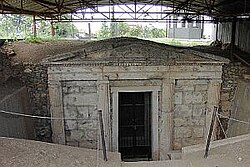
The entrance to one of the royal tombs at Vergina, a UNESCO World Heritage Site

Key Facts

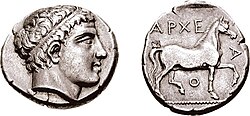
A Macedonian didrachm minted during the reign of Archelaus I of Macedon (r. 413–399 BC)
  • Timeline: Approximately 7th century BC to 168 BC.
  • Capitals: Aigai (until 399 BC) and Pella (399–168 BC).
  • Peak Territory: Reached approximately 5,200,000 km² under Alexander the Great in 323 BC.
  • Government: A hereditary monarchy led by a Basileus (King).
  • Key Figures: Philip II, Alexander the Great, and the Antigonid kings.
  • Languages: Ancient Macedonian, Attic, and Koine Greek.

The Evolution of the Macedonian State
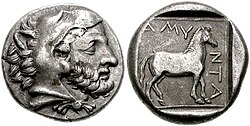
A silver stater of Amyntas III of Macedon (r. 393–370 BC)

Early History and Persian Influence

The origins of Macedonia are shrouded in legend, with traditional accounts attributing its foundation to Caranus or Perdiccas I around the 7th century BC. In its early stages, the kingdom struggled for autonomy, becoming a vassal of the Persian Empire between 512/511 and 493 BC, and was later fully incorporated into the Achaemenid Empire from 492 to 479 BC.
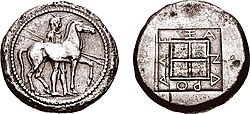
A silver octadrachm of Alexander I of Macedon (r. 498–454 BC), minted c. 465–460 BC, showing an equestrian figure wearing a chlamys (short cloak) and petasos (head cap) while holding two spears and leading a horse

The Rise of Macedon under Philip II

The turning point for Macedonia came with the ascension of Philip II in 359 BC. Philip transformed the Macedonian army into the most effective fighting force in Greece, utilizing the sarissa (a long pike) and professionalizing his troops. By 338–337 BC, he founded the Hellenic League, effectively bringing the Greek city-states under Macedonian hegemony.
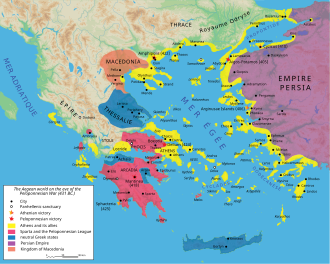
Macedon (orange) during the Peloponnesian War around 431 BC, with Athens and the Delian League (yellow), Sparta and Peloponnesian League (red), independent states (blue), and the Persian Achaemenid Empire (purple)

Alexander the Great and the Global Empire

Upon Philip II's death in 336 BC, his son Alexander the Great inherited the throne. Alexander launched an unprecedented campaign that dismantled the Persian Empire and extended Macedonian influence as far as India. By 323 BC, his empire spanned millions of square kilometers, facilitating the spread of Greek culture, language, and thought—a process known as Hellenization.
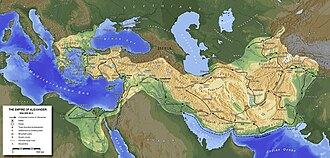
Alexander's empire and his route

The Hellenistic Era and the Diadochi

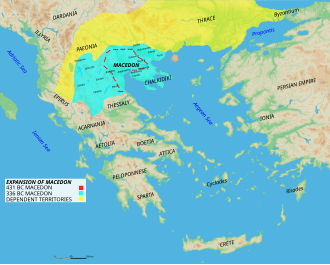
Map of the Kingdom of Macedon at the death of Philip II in 336 BC (light blue), with the original territory that existed in 431 BC (red outline), and dependent states (yellow)

The sudden death of Alexander in 323 BC led to the Partition of Babylon, where his generals, known as the Diadochi (Successors), divided the empire. This sparked decades of conflict (322–272 BC) as various factions fought for control. Eventually, the Antigonid dynasty emerged as the primary rulers of the Macedonian homeland.
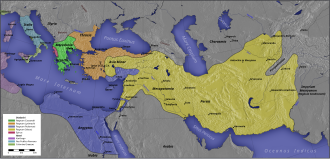
Kingdoms of the Diadochi c. 301 BC, after the Battle of Ipsus Other

The Antigonid Dynasty and the Roman Conflict

The later period of the kingdom was defined by the Antigonid kings, such as Antigonus III Doson and Philip V. While they maintained control over Macedonia and several dependent states, they faced the rising power of the Roman Republic. The Macedonian Wars (214–148 BC) culminated in the Battle of Pydna in 168 BC, which effectively ended Macedonian independence.
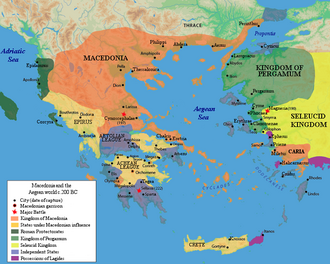
The Kingdom of Macedonia (orange) under Philip V (r. 221–179 BC), with Macedonian dependent states (dark yellow), the Seleucid Empire (bright yellow), Roman protectorates (dark green), the Kingdom of Pergamon (light green), independent states (light purple), and possessions of the Ptolemaic Empire (violet purple)

Society, Culture, and Institutions

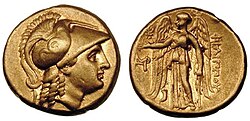
A golden stater of Philip III Arrhidaeus (r. 323–317 BC) bearing images of Athena (left) and Nike (right)

Governance and Power

Macedonia was a hereditary monarchy where the Basileus held supreme authority, though he often consulted a Synedrion (legislative council). The royal court was supported by a sophisticated system of royal pages, elite bodyguards, and "Companions"—trusted friends and advisors who played key roles in both administration and war.

Military Innovation

The Macedonian military was the engine of its success. From the early infantry to the specialized thorakites (soldiers wearing chainmail armor and carrying thureos shields), the army evolved to meet diverse threats across different terrains.
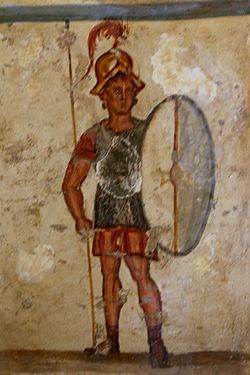
Fresco of an ancient Macedonian soldier (thorakites) wearing chainmail armor and bearing a thureos shield, 3rd century BC, İstanbul Archaeology Museums

Arts and Intellectual Life

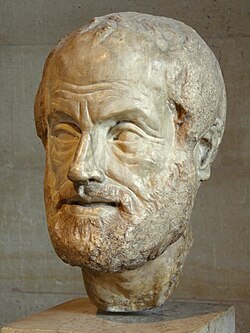
Macedonian culture blended local traditions with broader Greek influences. The kingdom became a patron of philosophy—most notably through Aristotle, who tutored Alexander—and developed a rich tradition of visual arts, seen in the elaborate mosaics of Pella and the royal tombs of Vergina.
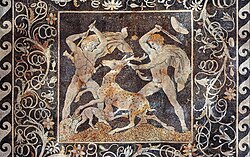
The Stag Hunt Mosaic, c. 300 BC, from Pella; the figure on the right is possibly Alexander the Great due to the date of the mosaic along with the depicted upsweep of his centrally-parted hair (anastole); the figure on the left wielding a double-edged axe (associated with Hephaistos) is perhaps Hephaestion, one of Alexander's loyal companions.

Summary of the Macedonian Kingdom

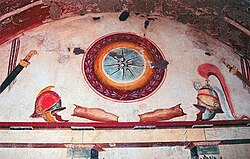
Paintings of Hellenistic-era military arms and armor from a tomb in ancient Mieza (modern-day Lefkadia), Imathia, Central Macedonia, Greece, 2nd century BC
Overview of the Kingdom of Macedonia
Category Details
Period c. 7th century – 168 BC
Government Hereditary Monarchy (Basileus)
Primary Currency Tetradrachm
Major Capitals Aigai, Pella
Religion Greek polytheism / Hellenistic religion
End of Independence Battle of Pydna (168 BC)

Frequently Asked Questions

The Temple of Apollo at Corinth, built c. 540 BC, with the Acrocorinth (i.e. the acropolis of Corinth that once held a Macedonian garrison)[159] seen in the background
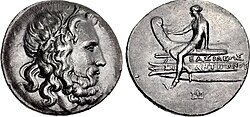
A tetradrachm minted during the reign of Antigonus III Doson (r. 229–221 BC), possibly at Amphipolis, bearing the portrait image of Poseidon on the obverse and on the reverse a scene depicting Apollo sitting on the prow of a ship
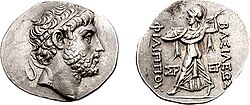
A tetradrachm of Philip V of Macedon (r. 221–179 BC), with the king's portrait on the obverse and Athena Alkidemos brandishing a thunderbolt on the reverse
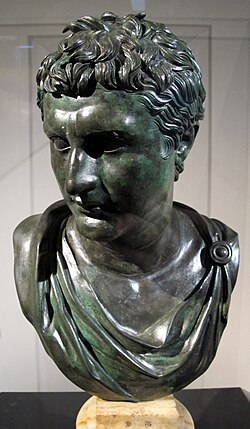
Bronze bust of Eumenes II of Pergamon, a Roman copy of a Hellenistic Greek original, from the Villa of the Papyri in Herculaneum
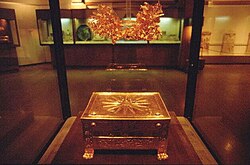
The Vergina Sun, the 16-ray star covering the royal burial larnax of Philip II of Macedon (r. 359–336 BC), discovered in the tomb of Vergina, formerly ancient Aigai
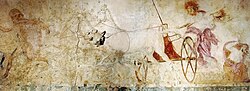
Hades abducting Persephone, fresco in the small Macedonian royal tomb at Vergina, Macedonia, Greece, c. 340 BC
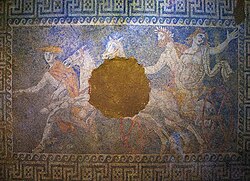
A mosaic of the Kasta Tomb in Amphipolis depicting the abduction of Persephone by Pluto, 4th century BC
The Lion of Amphipolis in Amphipolis, northern Greece, a 4th-century BC marble tomb sculpture[272] erected in honor of Laomedon of Mytilene, a general who served under Alexander the Great
Alexander (left), wearing a kausia and fighting an Asiatic lion with his friend Craterus (detail); late 4th-century BC mosaic,[292] Pella Museum.
Portrait bust of Aristotle, an Imperial Roman (1st or 2nd century AD) copy of a lost bronze sculpture made by Lysippos
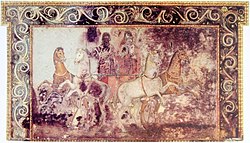
A fresco showing Hades and Persephone riding in a chariot, from the tomb of Queen Eurydice I of Macedon at Vergina, Greece, 4th century BC
A banquet scene from a Macedonian tomb of Agios Athanasios, Thessaloniki, 4th century BC; shown are six men reclining on couches, with food arranged on nearby tables, a male servant in attendance, and female musicians providing entertainment.[311]
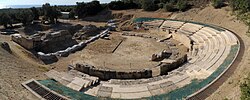
Ruins of the ancient theatre in Maroneia, Rhodope, East Macedonia and Thrace, Greece
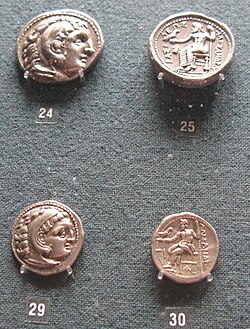
Tetradrachms (above) and drachms (below) issued during the reign of Alexander the Great, now in the Numismatic Museum of Athens
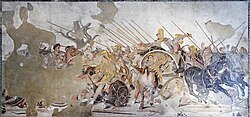
The Alexander Mosaic, a Roman mosaic from Pompeii, Italy, c. 100 BC

Who was the last king of Macedonia?

The last king of the independent Macedonian monarchy was Perseus, who reigned from 179 to 168 BC.

What was the significance of the Vergina Sun?

The Vergina Sun is a 16-ray star symbol that covered the royal burial larnax of Philip II of Macedon, serving as a prominent emblem of the Macedonian royal house.

How did the Macedonian army differ from other Greek forces?

Unlike the traditional hoplite phalanxes of the southern city-states, the Macedonian army under Philip II and Alexander utilized the sarissa (a much longer pike) and integrated specialized cavalry and siege engineering more effectively.

What happened to the empire after Alexander the Great died?

Following the Partition of Babylon in 323 BC, the empire was split among Alexander's generals (the Diadochi), leading to the creation of several successor states, including the Seleucid Empire and the Ptolemaic Kingdom.

What languages were spoken in ancient Macedonia?

The population spoke Ancient Macedonian, as well as Attic and Koine Greek, the latter of which became the lingua franca of the Hellenistic world.