M15-Class Monitors: The Heavy-Hitting Vessels of the War Emergency Programme
During the height of the First World War, the British Royal Navy required specialized vessels capable of delivering massive firepower while maintaining a relatively small footprint. This need led to the creation of the M15-class monitors. A monitor is a type of small, shallow-draft vessel designed specifically to mount heavy guns for shore bombardment.
Ordered in March 1915 as part of the War Emergency Programme—a rapid ship construction initiative—fourteen of these vessels were commissioned to provide critical fire support. To expedite production, the Navy utilized existing hardware, mounting 9.2-inch Mk VI gun turrets salvaged from Edgar-class cruisers, as well as Mk X turrets originally intended for the Drake-class and Cressy-class cruisers.
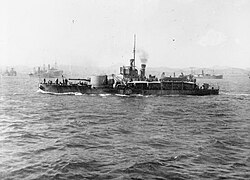
Key Facts
- Quantity: 14 ships ordered in March 1915.
- Primary Armament: Originally equipped with a single 9.2-inch (23 cm) gun.
- Displacement: Each vessel displaced 540 long tons (550 t).
- Origin: Part of the War Emergency Programme of ship construction.
- Turret Sources: Salvaged from Edgar-class and stock for Drake and Cressy-class cruisers.
Technical Specifications and Propulsion
The M15-class was characterized by its compact size and varied propulsion systems. While the displacement remained consistent across the class at 540 long tons, the engines differed between individual hulls to test various technologies.
Most of the class utilized 4-cylinder semi-diesel engines driving four shafts. However, some vessels were equipped with different systems: HMS M21 and HMS M22 used Triple Expansion steam engines with two shafts, and HMS M24 utilized Campbell 4-cylinder paraffin engines.
Armament Evolution
While the class began with the powerful 9.2-inch gun, several ships were later refitted with smaller armaments to suit changing operational needs. Some vessels, such as HMS M21, M23, M24, M25, and M26, were later fitted with 7.5-inch (19 cm) guns, while HMS M27 and M28 were downgraded to 6-inch (15 cm) guns.
Service History and Fates
The service lives of the M15-class varied wildly, from combat losses to long-term conversions. Several ships met violent ends during the war: HMS M15 was sunk by the submarine UC-38 in November 1917, HMS M28 was lost during the Battle of Imbros in January 1918, and HMS M21 was sunk off Dover in October 1918.
Other vessels had more diverse post-war careers. HMS M22 was converted into a minelayer and renamed HMS Medea before becoming a training ship. HMS M23 served as a Royal Naval Volunteer Reserve (RNVR) drillship under the name Claverhouse until 1959. HMS M24 was sold for conversion into a mercantile oil tanker named Satoe.
| Ship | Main Gun (Original) | Propulsion | Fate |
|---|---|---|---|
| HMS M15 | 9.2 in | Semi-diesel | Sunk by UC-38 (1917) |
| HMS M16 | 9.2 in | Semi-diesel | Sold 1920 |
| HMS M17 | 9.2 in | Semi-diesel | Sold 1920 |
| HMS M18 | 9.2 in | Semi-diesel | Sold 1920 |
| HMS M19 | 9.2 in | Semi-diesel | Sold 1920 |
| HMS M20 | 9.2 in | Semi-diesel | Sold 1920 |
| HMS M21 | 9.2 in | Steam | Sunk off Dover (1918) |
| HMS M22 | 9.2 in | Steam | Wrecked 1939 |
| HMS M23 | 9.2 in | Semi-diesel | Sold 1959 |
| HMS M24 | 9.2 in | Paraffin | Sold 1920 |
| HMS M25 | 9.2 in | Semi-diesel | Scuttled 1919 |
| HMS M26 | 9.2 in | Semi-diesel | Sold 1920 |
| HMS M27 | 9.2 in | Semi-diesel | Scuttled 1919 |
| HMS M28 | 9.2 in | Semi-diesel | Sunk at Battle of Imbros (1918) |
Frequently Asked Questions
What was the primary purpose of the M15-class monitors?
They were designed as shallow-draft vessels capable of mounting heavy cruiser guns to provide shore bombardment support during World War I.
Where did the guns for these ships come from?
The ships used 9.2-inch Mk VI turrets removed from Edgar-class cruisers, as well as Mk X turrets that were in stock for the Drake and Cressy-class cruisers.
Did all M15-class ships use the same engines?
No. While most used 4-cylinder semi-diesel engines, HMS M21 and M22 used Triple Expansion steam engines, and HMS M24 used Campbell 4-cylinder paraffin engines.
Which M15-class ship had the longest service life?
HMS M23, which became a Royal Naval Volunteer Reserve drillship renamed Claverhouse, remained in service until it was sold in 1959.
How many M15-class ships were lost in combat?
Three ships were lost in combat: HMS M15 (sunk by UC-38), HMS M21 (sunk off Dover), and HMS M28 (sunk during the Battle of Imbros).