The World of Lupines: A Guide to the Genus Lupinus
Whether they are known as lupin, lupine, or the regionally named bluebonnet, these striking plants belong to the Fabaceae (legume) family. While they may look similar to the fodder crop lucerne, the genus Lupinus is a distinct and diverse group of plants with a rich history of both ecological importance and human utility. From ornamental garden favorites to essential food sources, lupines play a significant role in various ecosystems across the globe.
Most species within this genus are herbaceous perennials—plants that live for several years and have non-woody stems—typically growing between 0.3 and 1.5 metres tall. However, the genus shows incredible variety: some species are annuals, others are shrubs reaching up to 3 metres, and a rare exception in Mexico, the chamis de monte (Lupinus jaimehintonianus), can grow as a tree up to 8 metres tall.
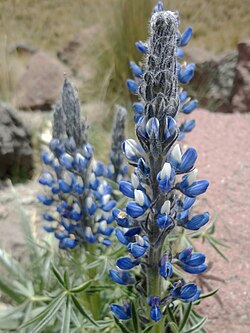
Botanical Characteristics and Diversity
Lupines are easily recognized by their unique flower structure. They produce flowers in dense or open clusters on an erect spike. Each flower, measuring 1–2 centimetres in length, features a classic pea-like shape consisting of an upper standard (or banner), two lateral wings, and two lower petals that are fused into a structure called a keel. This distinctive shape is what inspired names like "bluebonnets" and "quaker bonnets."
The genus is remarkably diverse, with species counts estimated to fall anywhere between 200 and 500. One scientific authority places the number at approximately 267 species worldwide. Their primary centers of diversity are located in North and South America, though smaller populations exist in the Mediterranean and North Africa.
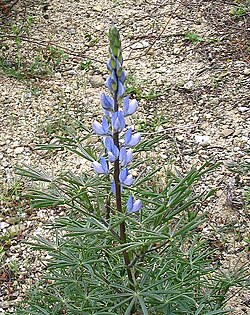
Taxonomy: Understanding the Complexity
Classifying lupines has historically been a challenge for botanists. Because the plants are highly variable, many taxa (groups of organisms) are not clearly distinct from one another. In some parts of America, certain groups are described as "complexes" rather than individual species. Currently, the genus is organized into two recognized subgenera: Platycarpos and Lupinus.
Subgenus Platycarpos
Distributed primarily throughout the Andes and Cordillera regions of North, Central, and South America, species in this subgenus exhibit specific biological traits. They often feature a waxen coating on their stems and leaves, and their branching pattern is typically monopodial (growing from a single main stem). Their seeds are generally small, containing an underdeveloped embryo and a minimal amount of endosperm (the nutrient-rich tissue that surrounds the embryo). This subgenus includes several hundred species, many of which are cross-pollinated.
Subgenus Lupinus
This subgenus contains well-known species such as Lupinus albus (white lupine) and Lupinus angustifolius (blue lupin). These species are widely recognized for their role in both ornamental gardening and agricultural applications.
Ecological Importance
Lupines are vital to local ecosystems, particularly as a primary food source for various lepidopterans (the group of insects that includes butterflies and moths). Several butterfly species rely heavily on lupines for their larval stages. For example, the larvae of the Mission blue butterfly are limited to specific Lupinus species, and the Karner blue butterfly is known to utilize Lupinus perennis.
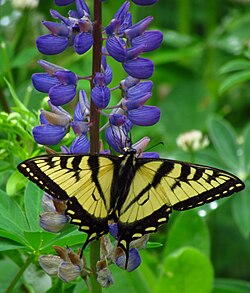
Human Uses: From Food to Soil Improvement
Humans have utilized lupines for millennia. In the Mediterranean, various species have been used as food for over 3,000 years, while in the Andes, they have been a staple for as long as 6,000 years. The Andean lupin, or tarwi (Lupinus mutabilis), was a significant food source in the Incan Empire. Because these seeds contain bitter alkaloids (natural chemical compounds), they must be processed—often by soaking them in running water—to make them safe and palatable for consumption.
Beyond nutrition, lupines have been used to improve soil quality. In the late 18th century, they were introduced to northern Europe for this purpose. In modern agriculture, Western Australia has become a global leader in the production of sweet lupin crops, following significant research conducted in the mid-20th century.
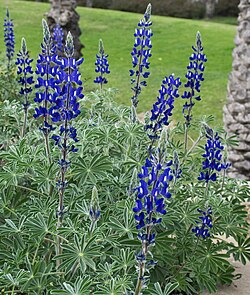
However, the genus is not without its challenges. While beneficial in many areas, lupines can become invasive. In Iceland, for instance, the plant has become an ecological concern since the start of the 21st century.
Key Facts
- Diversity: Contains between 200 and 500 species.
- Flower Shape: Features a standard, two wings, and a fused keel.
- Primary Regions: Most diverse in the Americas, with presence in the Mediterranean and North Africa.
- Food History: Used for up to 6,000 years in the Andes and 3,000 years in the Mediterranean.
- Ecological Role: Essential host plant for many butterfly and moth larvae.
- Invasive Potential: Can cause ecological issues, such as in Iceland.
| Feature | Subgenus Platycarpos | Subgenus Lupinus |
|---|---|---|
| Primary Distribution | Americas (Andes and Cordillera) | Global (Americas, Mediterranean, N. Africa) |
| Key Characteristics | Waxen coating, monopodial branching, small seeds | Includes common ornamental and food species |
| Examples | L. mutabilis, L. polyphyllus | L. albus, L. angustifolius |
Frequently Asked Questions
Are all lupine species edible?
No. While some species like Lupinus mutabilis (tarwi) are widely used as food, many species contain bitter alkaloids that must be carefully removed through soaking or processing before they are safe to eat.
How many species of lupine exist?
The exact number is debated due to taxonomic complexity. Estimates generally range from 200 to 500 species, with one authority identifying approximately 267 species.
Why are lupines important for butterflies?
Lupines serve as critical larval food plants. Many species of butterflies and moths, such as the Karner blue and the Mission blue, rely specifically on lupines to feed their larvae.
Can lupines be considered a weed?
In certain environments, yes. While they are often cultivated for beauty or food, they can become invasive species, as seen in the ecological challenges faced by Iceland since the early 2000s.
What makes a lupine flower unique?
Lupine flowers have a distinct "pea-like" structure consisting of three main parts: a large upper petal called a standard, two side petals called wings, and two bottom petals fused into a keel.