Loop Parkway: The History and Evolution of a Long Island Landmark
The Loop Parkway, originally known as the Long Beach Loop Causeway, stands as a testament to the ambitious urban planning of the early 20th century. Conceived as a vital link in the Long Island Parkway System, it was designed to streamline travel between the mainland and the coast, replacing congested local roads with scenic, efficient thoroughfares.
The Vision of Robert Moses
In 1924, Robert Moses and the Long Island State Park Commission (LISPC) developed a comprehensive plan for a parkway system. The primary goal was to alleviate traffic on "unattractive" local roads while connecting several newly constructed parks, including Sunken Meadow, Bethpage, and Jones Beach State Parks. By 1927, this network was linked to the boroughs of Brooklyn and Queens, and the opening of the Ocean Parkway and Jones Beach State Park in 1929 further integrated the region via the Jones Beach Causeway.
Construction and Engineering
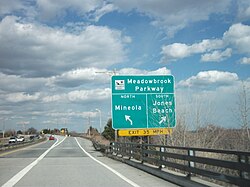
Construction on the Long Beach Loop Causeway and the Meadowbrook State Parkway began in May 1933. The project was funded by a $5,050,000 loan from the Reconstruction Finance Corporation in Washington D.C., which the LISPC intended to repay over 25 years.
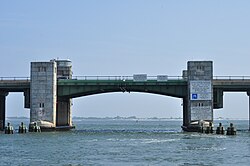
The engineering of these roadways was a massive undertaking. A trumpet interchange on Jones Island served as the connection point for the two highways. To create the necessary landmass, engineers used 10,100,000 cubic yards of hydraulic fill—a process of pumping a slurry of sand and water to create new land. Additionally, a new channel was constructed to facilitate boat traffic heading toward South Oyster Bay.
The Loop Causeway itself spanned 2.5 miles, featuring a 44-foot-wide roadway constructed from macadam pavement (a durable surface made of crushed stone and binder). This infrastructure provided a critical connection between mainland Long Island, Jones Beach, and Long Beach.
A Rapid Completion
While the project was initially expected to be finished by January 1, 1935, construction was completed six months early in October 1934. The grand opening on October 27, 1934, was marked by significant fanfare, including parades in Rockville Centre and Freeport. The celebrations were attended by New York City Mayor Fiorello LaGuardia and Robert Moses, who was a candidate for Governor of New York at the time.
The Era of Tolls and Their Removal
To facilitate the repayment of the federal loan, tolls were implemented on both the Meadowbrook and Long Beach Loop Causeways. On January 2, 1935, a toll of 25 cents (approximately $6 in 2025 currency) went into effect. On the first day of operation, the LISPC reported that 300 vehicles used the highway.
For decades, these tolls remained a point of contention. In 1975, while the Southern State Parkway saw a toll increase to 25 cents, the Loop Parkway maintained its existing rate. Despite attempts by Democratic members of the New York State Legislature to rescind toll hikes, Robert Moses's influence over the state ensured that only his authority could determine toll adjustments.
The tide turned in 1978 under Governor Hugh Carey. To secure support for the 1978 state budget, Governor Carey proposed that the state take over the roads maintained by the Jones Beach Parkway Authority. By forgoing $24 million in accumulated debt and deciding that the $3.8 million in annual toll revenue was non-essential, the state passed a bill on March 31, 1978, to eliminate tolls on the Loop Parkway. This decision was heavily influenced by Long Beach Supervisor Hannah Komanoff.
Key Facts
- Original Name: Long Beach Loop Causeway.
- Funding: $5,050,000 loan from the Reconstruction Finance Corporation.
- Engineering: Used 10,100,000 cubic yards of hydraulic fill.
- Dimensions: 2.5 miles long and 44 feet wide.
- Completion Date: October 27, 1934 (six months ahead of schedule).
- Toll History: 25-cent toll introduced in 1935; removed on March 31, 1978.
| Feature | Detail |
|---|---|
| Lead Planner | Robert Moses |
| Pavement Type | Macadam |
| Total Fill Used | 10.1 Million Cubic Yards |
| Opening Date | October 27, 1934 |
| Toll Removal Date | March 31, 1978 |
Frequently Asked Questions
Who was responsible for the design of the Loop Parkway?
The parkway was conceived by Robert Moses and the Long Island State Park Commission (LISPC) as part of a broader effort to connect state parks and reduce congestion on local roads.
How was the land for the parkway created?
The parkway was built using 10,100,000 cubic yards of hydraulic fill, which is a method of creating land by pumping a mixture of water and sediment into a designated area.
When were the tolls removed from the Loop Parkway?
Tolls were officially eliminated on March 31, 1978, after the state of New York took over the roadway from the Jones Beach Parkway Authority.
What was the original cost of the loan used for construction?
The Reconstruction Finance Corporation provided a loan of $5,050,000 in 1933 to fund the construction of both the Meadowbrook State Parkway and the Long Beach Loop Causeway.
How long did it take to build the parkway?
Construction began in May 1933 and was completed in October 1934, finishing six months ahead of the original January 1, 1935, deadline.