Longworth House Office Building: A Pillar of the Capitol Complex
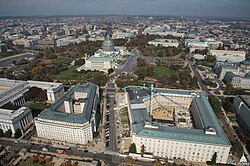
The Longworth House Office Building serves as a critical hub for the United States House of Representatives, providing essential workspace and meeting facilities. Born out of a necessity to alleviate severe overcrowding in the earlier Cannon House Office Building, the Longworth Building was designed to maintain the dignity and architectural harmony of the surrounding Capitol Complex.
Key Facts
- Authorized: January 1929 with a budget of $8.4 million.
- Construction Period: Foundations completed in December 1930; occupied in April 1933.
- Architectural Lead: David Lynn, Architect of the Capitol.
- Design Firm: The Allied Architects of Washington Inc.
- Notable Feature: An assembly room seating 450 people.
Construction and Design
Plans for a second office building for the House of Representatives began in 1925. The primary driver was the overcrowding of the Cannon House Office Building, which had been completed in 1908. This pressure led to a dual approach: the renovation of the Cannon Building and the creation of the Longworth Building.
Under the guidance of David Lynn, the Architect of the Capitol, the design was entrusted to The Allied Architects of Washington Inc. The team—consisting of principal architects Frank Upman, Gilbert LaCoste Rodier, Nathan C. Wyeth, and Louis Justemente—developed two schemes aimed at creating a simple yet dignified structure that complemented the existing Capitol architecture.
In January 1929, Congress authorized $8.4 million for the acquisition and clearing of the site, as well as the construction of the facility. The project progressed steadily, with foundations finished by December 1930 and the building officially accepted for occupancy in April 1933.
Site History
Before the Longworth Building rose, the site was occupied by two other structures. The Butler Building, which served as the headquarters for the United States Public Health Service, and the Richards Building, the headquarters of the United States Coast and Geodetic Survey, were both demolished to make way for the new office complex.
Later History and Notable Uses
Beyond providing office space, the Longworth Building has hosted significant legislative activities. Its large assembly room, capable of seating 450 people, was designated as the meeting room for the House Ways and Means Committee in 1938. Furthermore, during 1949 and 1950, this room served as the primary meeting space for the House of Representatives while the main chamber in the United States Capitol underwent remodeling.
The building also housed unique amenities, such as the House Beauty Shop. This salon, which served Members of Congress, their spouses, and employees, operated in the Longworth Building until the 1960s, when the Beauty Shop Committee relocated it to the Cannon House Office Building.
The Legacy of "Gucci Gulch"
The building is also known for a piece of political folklore. Prior to the passing of the Tax Reform Act of 1986, the polished hallway outside room 1100 became known as "Gucci Gulch." According to reports from The Washington Post, the area earned this nickname due to the high-priced footwear worn by tax lobbyists who frequently camped out there during the intense 1986 tax debates.
Building Summary
| Category | Details |
|---|---|
| Authorization Date | January 1929 |
| Construction Cost | $8.4 million |
| Occupancy Date | April 1933 |
| Principal Architects | Upman, Rodier, Wyeth, and Justemente |
| Assembly Room Capacity | 450 people |
Frequently Asked Questions
Why was the Longworth Building constructed?
It was built to address severe overcrowding in the Cannon House Office Building, which had been the sole office building for the House of Representatives since 1908.
Who were the architects responsible for the building?
The building was designed by The Allied Architects of Washington Inc., with principal architects Frank Upman, Gilbert LaCoste Rodier, Nathan C. Wyeth, and Louis Justemente, under the direction of Architect of the Capitol David Lynn.
What buildings previously stood on the Longworth site?
The site was previously occupied by the Butler Building (U.S. Public Health Service headquarters) and the Richards Building (U.S. Coast and Geodetic Survey headquarters).
What is "Gucci Gulch"?
"Gucci Gulch" was a nickname given to the hallway outside room 1100 in the Longworth Building, named for the expensive shoes worn by tax lobbyists during the 1986 tax reform debates.
Did the House of Representatives ever meet in the Longworth Building?
Yes, the House of Representatives used the Longworth Building's large assembly room as their primary meeting room in 1949 and 1950 while the Capitol chamber was being remodeled.