Long-tailed Widowbird: The Science of Extreme Sexual Selection
The long-tailed widowbird (Euplectes progne) is a medium-sized member of the weaver family, Ploceidae. Found across various regions of Africa, this species is renowned among biologists not just for its striking appearance, but as a living laboratory for studying evolutionary biology. While common in its native territories, the bird is most famous for the dramatic physical differences between males and females, a phenomenon known as sexual dimorphism.
In the wild, these birds inhabit swampy grasslands, where the males engage in elaborate displays to attract mates. Their most defining characteristic is the extraordinary length of the male's tail during the breeding season, which serves as a primary focus for research into how certain traits evolve even when they appear to hinder survival.

Key Facts
- Scientific Name: Euplectes progne
- Conservation Status: Least Concern (IUCN 3.1)
- Distinctive Feature: Breeding males possess tails up to 0.5 meters (20 inches) long.
- Distribution: Found in Angola, Botswana, DR Congo, Kenya, Lesotho, South Africa, Eswatini, and Zambia.
- Diet: Primarily seeds, supplemented by arthropods like beetles, cicadas, and spiders.
- Key Research: A classic example of female choice in sexual selection.
Physical Description and Dimorphism
The long-tailed widowbird exhibits some of the most extreme differences in appearance between genders in the avian world.
Breeding Males
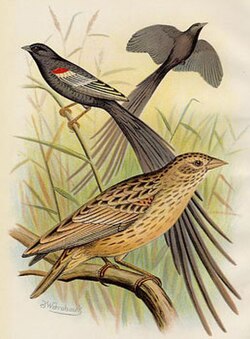
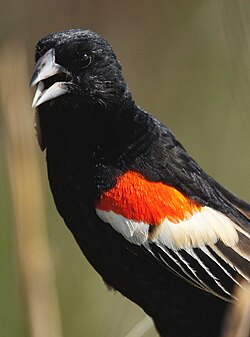
Adult breeding males are almost entirely black. They are distinguished by epaulets (bright orange and white shoulder patches) and a bluish-white bill. Their most striking feature is the tail, which consists of twelve feathers; six to eight of these can reach approximately half a meter in length. During flight displays, the male expands his tail vertically into a deep keel, flying slowly 0.5 to 2 meters above his territory to attract females.
Females and Non-breeding Males
Females are far more inconspicuous, featuring tawny and black streaked feathers with pale patches on the chest, breast, and back. Their tails are narrow and pointed, and their bills are horn-colored. Non-breeding males and immature birds closely resemble the females, although non-breeding males are slightly larger and retain the wing morphology of the breeding class.
Size and Weight Comparison
| Trait | Male (Breeding) | Female |
|---|---|---|
| Length | Up to 71 cm (including tail) | Starts at 15 cm |
| Weight | 33–46 g | 25–39 g |
| Wingspan | 127–147 mm | Not specified |
| Plumage | Black with orange/white epaulets | Tawny and black streaked |
Distribution and Habitat
The species is divided into three geographically isolated populations: the Kenyan highlands, the region encompassing Angola, southern DR Congo, and Zambia, and the southern African population. The southern group is most prevalent in the central highveld of South Africa, extending into Lesotho, Eswatini, and southeastern Botswana.
These birds prefer swampy grasslands and can be found at elevations as high as 2,750 meters in the Drakensberg Mountains. During the non-breeding season, they congregate in large flocks, often roosting in reed beds.
Diet and Breeding Behavior
The long-tailed widowbird is primarily a granivore, feeding on various seeds such as twisted-leaf bristle grass, common paspalum, and wheat. They supplement this diet by foraging for insects, including aphids and beetles, and spiders.
Breeding occurs between February and July, peaking in March and April. Males defend specific grassland territories. Females survey these territories before selecting a mate and weaving a large, dome-shaped nest lined with seedheads. These nests are typically positioned 0.5 to 1 meter off the ground in high grass. Females usually lay one to three pale bluish-green eggs streaked with brown.
The Science of Sexual Selection
The long-tailed widowbird is a cornerstone of behavioral ecology due to the "cost" of the male's tail. According to the theories of Charles Darwin, such elaborate ornaments exist either for male-male combat or because they are preferred by females.
The Andersson Experiment
To test the theory of female choice, researcher Malte Andersson conducted a controlled experiment. He manipulated the tail lengths of males: some had their tails shortened, some remained at natural lengths, and others had feathers added to create "supernormal" tails (elongated by 20 to 30 cm).
The results were definitive: males with the longest tails were the most successful in attracting mates, followed by those with natural tails, and lastly those with shortened tails. Because the shortened-tail males remained active in courtship and did not abandon their territories, the study proved that the tail's length was a direct preference of the females, rather than a tool for male competition.
The Role of Epaulets
While the tail is clearly driven by female choice, the function of the orange-red epaulets is slightly different. Researchers suggest these may be used in threat displays and male-to-male contests, similar to the behavior of the red-winged blackbird. This suggests that different ornaments on the same bird can be driven by different evolutionary pressures.
Frequently Asked Questions
Why do male long-tailed widowbirds have such long tails if it hinders flight?
The long tail is a result of sexual selection. Despite the physical cost and the fact that it makes flight difficult in wet weather, females strongly prefer males with longer tails, meaning those males are more likely to reproduce and pass on the trait.
What is the difference between the three subspecies?
The subspecies are geographically differentiated: E. p. delamerei is found in central Kenya, E. p. delacouri in Angola, southern DR Congo, and Zambia, and E. p. progne from southeast Botswana to east South Africa.
How do females build their nests?
Females weave large, dome-shaped structures using high grass and line the interior with seedheads. These nests are typically placed in the upper third of the grass, about 0.5 to 1 meter above the ground.
Is the long-tailed widowbird an endangered species?
No, it is classified as Least Concern by the IUCN. It has a very large range and a stable population trend, meaning it does not meet the criteria for being vulnerable.
What do long-tailed widowbirds eat?
Their diet consists mainly of seeds from various grasses (such as Kikuyu grass and rooigras) and is supplemented by arthropods, including spiders, beetles, and cicadas.