London Gatwick Airport
London Gatwick Airport (IATA: LGW, ICAO: EGKK) is one of the United Kingdom's primary public aviation hubs. Located in Crawley, West Sussex, it serves as a critical gateway to London and a major operational base for numerous international and domestic carriers. Since its official opening on May 30, 1958, Gatwick has evolved from a regional airfield into a global aviation center.
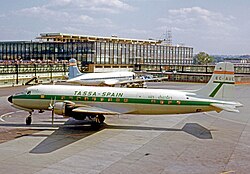
The airport is situated at an elevation of 203 feet (62 meters) above mean sea level (AMSL). While the modern facility opened in the late 1950s, the site's aviation roots date back to November 1928.
Key Facts
- Total Passengers (2024): 43,242,000
- Aircraft Movements (2024): 265,358
- Primary Hub For: British Airways
- Major Operating Bases: easyJet UK, Jet2.com, TUI Airways, Wizz Air UK, and Norse Atlantic UK
- Terminal Gates: 115
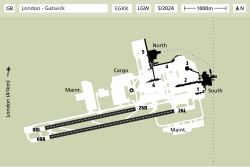
- Runways: Two asphalt runways (08L/26R and 08R/26L)
Infrastructure and Facilities
Gatwick operates with a dual-terminal system designed to handle high volumes of passenger traffic efficiently. The airport's layout includes specialized zones for check-in, security, and boarding, connected by a dedicated shuttle system.
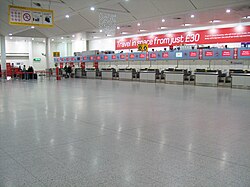
South Terminal
The South Terminal serves as a primary entry point for many passengers, featuring extensive check-in areas and direct access to ground transportation.
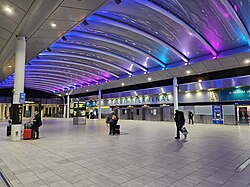
North Terminal
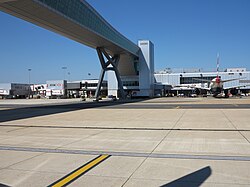
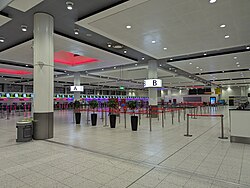
The North Terminal is characterized by its modern apron pier bridges and organized check-in zones (A and B), facilitating the movement of passengers to their aircraft.

Runway Specifications
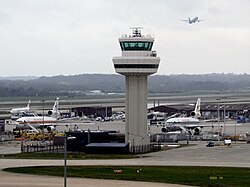
The airport utilizes two asphalt runways to manage its heavy flight schedule. The primary runway (08R/26L) measures 3,316 meters (10,879 feet), while the secondary runway (08L/26R) measures 2,565 meters (8,415 feet).
Airlines and Global Connectivity
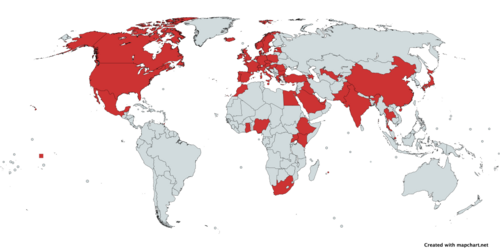
Gatwick is a diverse hub connecting London to a vast array of global destinations. It hosts a mix of full-service carriers and low-cost airlines, ranging from long-haul flights to China and the United States to short-haul hops across Europe.
Major international carriers include Emirates (Dubai), Qatar Airways (Doha), Air China (Beijing and Shanghai), and Singapore Airlines (Singapore). Regional connectivity is heavily supported by easyJet and Ryanair.
Busiest International Routes (2024/25)
The most frequented international destinations from Gatwick are predominantly in Spain and Ireland, with Malaga and Barcelona topping the list.
Busiest Domestic Routes (2023/24)
Within the UK, Edinburgh and Glasgow remain the most popular destinations for passengers departing from Gatwick.
Airport Statistics and Traffic Trends
Gatwick's traffic has seen significant fluctuations over the last two decades, most notably the sharp decline during 2020-2021 followed by a strong recovery. By 2024, passenger numbers returned to over 43 million.
| Year | Total Passengers | Aircraft Movements | Freight (Tonnes) |
|---|---|---|---|
| 2000 | 32,068,540 | 260,859 | 318,905 |
| 2010 | 31,375,290 | 240,500 | 104,032 |
| 2019 | 46,574,786 | 282,896 | 110,358 |
| 2021 | 6,260,072 | 52,000 | 11,623 |
| 2024 | 43,242,000 | 265,358 | 103,961 |
Ground Transportation
Access to the airport is provided via a comprehensive network of road and rail links. The Gatwick Airport railway station is a central hub for passengers traveling to and from central London.
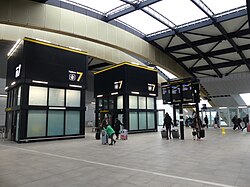
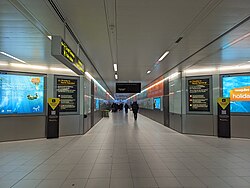
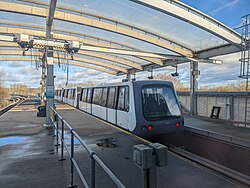
For passengers moving between the North and South terminals, a dedicated terminal shuttle provides frequent and efficient transit.
Frequently Asked Questions
Which airlines use Gatwick as an operating base?
Several airlines use Gatwick as a base, including easyJet UK, Jet2.com, TUI Airways, Norse Atlantic UK, Vueling, and Wizz Air UK.
What are the busiest international destinations from Gatwick?
Based on 2024/25 data, the busiest international routes are to Malaga, Spain; Barcelona, Spain; and Dublin, Republic of Ireland.
How many runways does Gatwick Airport have?
Gatwick has two asphalt runways: 08L/26R (2,565m) and 08R/26L (3,316m).
How do passengers travel between the North and South terminals?
Passengers can use the Gatwick Airport terminal shuttle, which connects the two terminals.
When did the current Gatwick Airport officially open?
The airport officially opened on May 30, 1958, although the site was built as early as November 1928.