Logrunners and Chowchillas: The Unique Ground-Birds of Australasia
In the dense, humid forests of Australia and New Guinea lives a specialized group of passerine birds known as the Orthonychidae. This family, which includes the logrunners and the larger chowchilla, has evolved a fascinating lifestyle tailored to the forest floor. Their name, derived from the Ancient Greek words orthos (straight) and onyx (claw), hints at their physical adaptations for a life spent largely on the ground.
These birds are characterized by their semi-terrestrial habits and a unique anatomical feature: stiffened tails. Unlike most songbirds, logrunners use their tails as a brace, leaning back on them to stabilize their bodies while they dig through leaf litter and soil in search of food.
Key Facts
- Endemic Range: Found exclusively in Australia and New Guinea.
- Diet: Strictly carnivorous, feeding on insects, larvae, and occasionally small lizards.
- Unique Anatomy: Use spiny, stiffened tails for support while foraging.
- Breeding: Lay unusual tubular-shaped white eggs in domed ground nests.
- Social Structure: Monogamous pairs where males defend territory but do not feed the young.
Species and Distribution
The family Orthonychidae consists of the genus Orthonyx, which is divided into three recognized species. While they share similar behaviors, they differ significantly in size and appearance.
The Australian Logrunner (Orthonyx temminckii)
Found in southeast Queensland and northeastern New South Wales, this bird is strictly terrestrial. Males feature pure white chins, throats, and breasts, while females display a bright reddish-orange hue in these areas. Their wings are short and rounded, indicating they are weak fliers.
The Papuan Logrunner (Orthonyx novaeguineae)
Once considered part of the Australian population, this species is now recognized as distinct and is native to the tropical montane forests of New Guinea and Indonesia.
The Chowchilla (Orthonyx spaldingii)
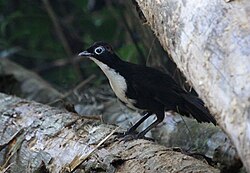
The chowchilla is the largest member of the family, measuring 26 to 28 cm in length. It is distinguished by its jet-black or dark brown plumage, a black head, and a blue-gray eye ring. In males, the throat is white, whereas females possess an orange-rufous throat.
| Common Name | Scientific Name | Primary Distribution | Approx. Length |
|---|---|---|---|
| Australian Logrunner | Orthonyx temminckii | Eastern Australia | 17–20 cm |
| Papuan Logrunner | Orthonyx novaeguineae | New Guinea / Indonesia | 17–20 cm |
| Chowchilla | Orthonyx spaldingii | Northeastern Queensland | 26–28 cm |
Behavior and Ecology
Logrunners are specialized carnivores. They spend their days digging in the soil of wet forests to uncover insects and larvae. The larger chowchilla expands this diet to include small lizards. Because they are weak fliers, they rely heavily on their terrestrial agility and the support of their spiny tails to navigate the forest floor.
Social Structure and Breeding
The social dynamics of logrunners are unusual. While they are monogamous, male offspring often remain on their parents' territory for over a year after fledging. However, this is not a cooperative breeding system in terms of childcare; only the female feeds the young. The larger males focus their energy on territorial defense and protecting the female from predators.
Breeding typically occurs during the southern winter (June to September). Their nests are domed structures made of sticks, built on the ground beneath trees. These nests feature specialized coverings to protect the eggs from the heavy rainfall common on the eastern Australian coast. The eggs themselves are pure white and uniquely tubular in shape.
Interestingly, while the incubation period is among the longest for any songbird, the young become independent very quickly—usually within two to two and a half weeks. This rapid independence is likely an evolutionary adaptation to reduce the risk of predation in their specific habitat.
Taxonomy and Lifespan
The fossil record for Orthonychidae is limited but provides insight into their history. Three prehistoric species have been identified, including Orthonyx hypsilophus and Orthonyx kaldowinyeri. The latter, found in the Riversleigh deposits, is the oldest and smallest known species, dating back to the Middle or Late Miocene.
In the wild, these birds benefit from the stable, warm environment of the rainforest. Banding data for the chowchilla indicates an average lifespan of about five years, though some individuals have been recorded living up to seventeen years.
Frequently Asked Questions
What makes the logrunner's tail unique?
The logrunner possesses a stiffened, spiny tail that it uses as a tripod or brace to support its weight while digging in the soil for food.
How do logrunners differ from chowchillas?
Chowchillas are significantly larger (26–28 cm) with jet-black plumage, while logrunners are smaller (17–20 cm) with olive, gray, and mottled black plumage.
What is unusual about their eggs?
Unlike the oval eggs of most birds, logrunners lay pure white eggs that are tubular in shape.
Do the fathers help raise the chicks?
No. While the males are monogamous and protect the territory and the female, only the female is responsible for feeding the young.
Where can these birds be found in the wild?
They are endemic to the humid lowland and montane forests of eastern Australia, New Guinea, and Indonesia.