Logistics Management: Principles, Evolution, and Modern E-commerce Integration
Logistics is the critical engine of supply chain management, responsible for the efficient forward and reverse flow of goods, services, and information. From the point of origin to the point of consumption, logistics ensures that customer needs are met with precision. While often associated with trucks and warehouses, logistics management encompasses both physical resources—such as materials, equipment, and foodstuffs—and intangible assets, including time and data.
A professional in this field, known as a logistician, works to hold the entire supply chain together. It is important to distinguish logistics from internal production planning; while logistics manages the movement of products between facilities, it does not cover the material flow within a single production or assembly plant.
![A warehouse in New Jersey, USA, a U.S. East Coast epicenter for logistics and warehouse construction outside Philadelphia, where trucks deliver slabs of granite[1]](/images/c8/d9/c8d977d93b39bdfc71d657a9331b0337465a3726fd3a83aba35ba026ef07a814.jpg)
Key Facts
- Scope: Covers both forward flow (delivery) and reverse flow (returns/recycling) of goods and information.
- B2B Growth: Business-to-business e-commerce is projected to reach USD 32.8 trillion by 2025.
- Cross-Border Trade: Approximately 44% of the B2B e-commerce market consists of international sales.
- The Seven R's: The gold standard of logistics is delivering the right product, in the right quantity, at the right time, in the right condition, to the right place, for the right customer, using the right resources.
- Professional Body: The Chartered Institute of Logistics and Transport (CILT), established in 1919, is a leading global professional institution for the sector.
The Evolution and Nomenclature of Logistics
The term "logistics" entered the English language around 1846, derived from the French logistique. It was popularized by Antoine-Henri Jomini, a Swiss military officer, in his work Summary of the Art of War. Jomini traced the etymology to the French word logis (lodgings), referring to the roles of the maréchal des logis and major-général des logis.
Historically, logistics was rooted in military necessity. The Roman army, for example, preferred mules over donkeys for transporting cargo to maintain their supply lines.
![The Punjab Regiment using mules for transporting cargo in Burma during World War II. Animals have been used for logistical transport throughout history; the Roman army preferred mules over donkeys for cargo transport.[22]](/images/de/5d/de5decce05d3566d7cef99fa455cacea56f6f0c24c4c5fe1f3a9eff32de7328c.jpg)
Types of Logistics
Military Logistics
Military logistics focuses on the survival and operational readiness of armed forces. This involves maintaining supply lines for food, armaments, ammunition, and spare parts, as well as the strategic transportation of troops.
Civil and Business Logistics
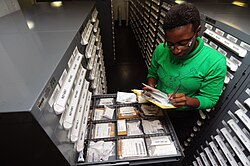
Civil logistics manages the acquisition, movement, and storage of raw materials, semi-finished goods, and finished products. This extends to essential public services such as mail delivery, garbage collection, and after-sales support.

Modern E-commerce and Digital Transformation
Between 2024 and 2025, e-commerce logistics infrastructure underwent significant development to support the surge in international digital trade. Unlike traditional B2B bulk shipping, e-logistics often manages smaller packages (typically valued under USD 100) delivered in bursts to diverse global locations.
Large platforms like Alibaba and Amazon Business have democratized international trade by providing integrated logistics services—including warehousing and last-mile delivery (the final step of the delivery process to the end user)—to small and medium enterprises (SMEs). For instance, Alibaba serves 48 million SMEs across 190 countries.

Technological Integration
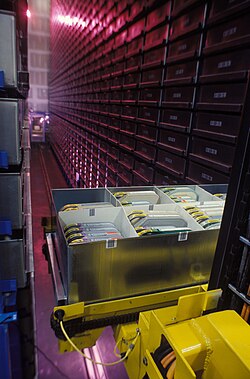
The industry is seeing a convergence of physical logistics and financial infrastructure. Virtual card usage in B2B cross-border transactions is forecast to increase by over 250% by 2028. Furthermore, the adoption of automation—such as warehouse robots and algorithm-driven inventory location—has minimized processing times, enabling same-day delivery for some cross-border shipments.
Distribution Networks and Warehouse Management
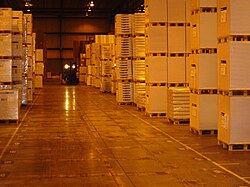
A distribution network relies on various nodes to function. These include factories for assembly and depots (standard warehouses) for high-level inventory storage.
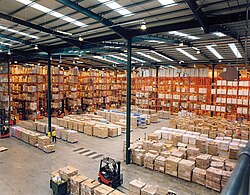
Effective warehouse management involves specific strategies for organization and retrieval:
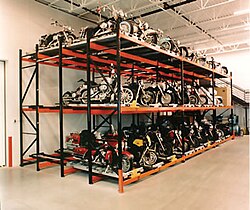
- LIFO Rack Systems: Last-In, First-Out systems, often used for bulky items like motorcycles.
- Picking Logic: Choosing between order picking (individual orders) and batch picking (multiple orders at once).
- Network Levels: Ranging from direct store delivery (zero level) to complex networks with central and peripheral warehouses.
Handling and Transport
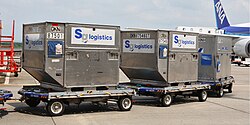
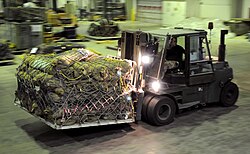
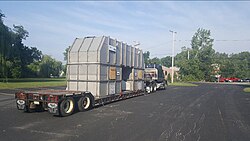
The movement of goods relies on unit loads for protection and efficiency, and specialized equipment like forklift trucks for loading pallets onto aircraft or trucks.
Logistics Summary Table
| Domain | Primary Focus | Key Examples/Tools |
|---|---|---|
| Military | Troop movement & armament supply | Supply lines, ammunition transport |
| Civil/Business | Raw materials & finished goods | Warehousing, public utilities |
| E-commerce | Small parcel, high-frequency delivery | Last-mile delivery, B2B platforms |
| Infrastructure | Storage and movement nodes | Depots, LIFO racks, AS/RS |
Frequently Asked Questions
What is the difference between logistics and supply chain management?
Logistics is a specific component of supply chain management. While supply chain management covers the entire network of entities, logistics specifically deals with the efficient forward and reverse flow and storage of goods and information from origin to consumption.
What are the "Seven R's" of logistics?
The Seven R's are a framework for logistics success: delivering the right product, in the right quantity, at the right time, in the right condition, to the right place, to the right customer, with the right financial resources.
How has e-commerce changed traditional logistics?
E-commerce has shifted the focus from steady, bulk B2B shipping to "burst" demand and small-parcel delivery. It has also integrated financial tools like virtual cards and automated warehouse robotics to enable faster, cross-border trade for smaller businesses.
What is a LIFO rack system?
LIFO stands for "Last-In, First-Out." It is a storage system where the last item placed into the rack is the first one to be removed, which is useful for certain types of inventory like motorcycles.
What is the role of CILT in the logistics industry?
The Chartered Institute of Logistics and Transport (CILT) is a professional body that provides qualifications and degrees in logistics management, helping to standardize professional practices globally.