Local Election Results: People Power Party Secures Major Victories
The recent local elections have concluded, delivering a significant shift in the political landscape. The People Power Party (PPP) emerged as a dominant force, securing a substantial number of seats across regional and municipal levels. This election involved a massive mobilization of voters, with a total turnout of 50.9% from a registered voter base of over 44 million.
The results encompass the election of 17 regional heads, 824 regional councilors, 226 municipal mayors, and 2,926 municipal councilors. The data reveals a clear trend of political realignment in several key provinces and cities.
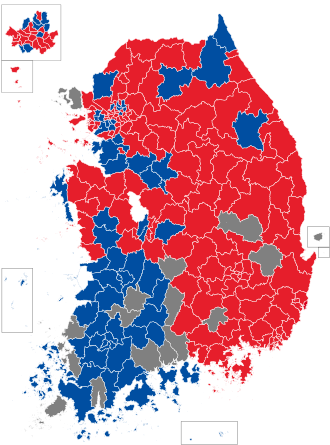
Key Facts
- The People Power Party won 540 regional seats and 145 municipal mayors.
- The Democratic Party secured 322 regional seats and 63 municipal mayors.
- Total voter turnout for the election was 50.9%.
- The People Power Party saw a significant increase in regional seats, gaining 403 compared to the previous election.
- The Democratic Party experienced a decrease in regional seats, losing 330.
Comprehensive Election Summary
The following table provides a high-level overview of the seat distribution and vote shares for the primary political parties involved in the regional elections.
| Party | Total Votes | Vote Share (%) | Total Seats Won |
|---|---|---|---|
| People Power Party | 11,989,460 | 53.97 | 12 (Heads) / 540 (Councilors) |
| Democratic Party | 9,762,313 | 43.95 | 5 (Heads) / 322 (Councilors) |
| Other Parties | 251,926 | 1.13 | 0 |
Regional Performance and Major Cities
The election results varied significantly by geography. The People Power Party maintained strongholds in several major metropolitan areas, while the Democratic Party held onto key territories in the southern regions.
Major Metropolitan Results
In Seoul, the People Power Party secured a decisive victory with 2,608,277 votes (59.05%), compared to 1,733,183 votes (39.24%) for the Democratic Party. Similarly, in Busan, the PPP maintained its hold with 66.37% of the vote, while in Daegu, the party achieved an even higher margin of 78.75%.
In contrast, the Democratic Party demonstrated strength in Gwangju, capturing 74.92% of the vote, and in North Jeolla, where they secured 82.12%. This highlights the distinct regional political divides present in the current electoral cycle.
Provincial Shifts and Gains
The People Power Party achieved notable gains in several provinces, including Daejeon, Ulsan, and Gangwon, where they successfully transitioned from Democratic control. In Gyeonggi, the race was exceptionally close, with the Democratic Party's Kim Dong-yeon holding the position with 49.07% of the vote, narrowly defeating the PPP candidate.
Municipal Leadership
The election for municipal mayors—the leaders of local cities and towns—showed a widespread preference for the People Power Party. Out of 226 total mayoral seats, the PPP won 145, while the Democratic Party won 63. The Progressive Party secured one mayoral seat.
Frequently Asked Questions
What was the overall voter turnout?
The total turnout for the election was 50.9% of the 44,303,449 registered voters.
Which party won the most regional seats?
The People Power Party won the majority of regional seats, totaling 540 councilors and 12 regional heads.
How did the Democratic Party perform in Seoul?
The Democratic Party received 1,733,183 votes in Seoul, which accounted for 39.24% of the total votes cast in that city.
Did any new parties gain seats?
While several new parties participated, including the Basic Income Party and the Green Party Korea, they did not secure regional head or councilor seats in this election cycle.
What was the result in Gyeonggi province?
The Democratic Party held Gyeonggi, with candidate Kim Dong-yeon winning 49.07% of the vote against 48.91% for the People Power Party candidate.