Limit Texas Hold 'em Starting Hand Rankings
In the world of Limit Texas Hold 'em, the value of your starting hand is the foundation of your strategy. Unlike No-Limit play, where betting flexibility can change the utility of a hand, Limit play relies more heavily on the mathematical strength and probability of the two cards you are dealt. Over the years, theorists and professional players have developed various systems to categorize these hands to help players make consistent, profitable decisions.
Key Facts
- Limit-Specific: These ranking systems are designed specifically for Limit Texas Hold 'em and do not apply to No-Limit games.
- Table Size: Most hand strength assumptions are based on a table of nine or ten players.
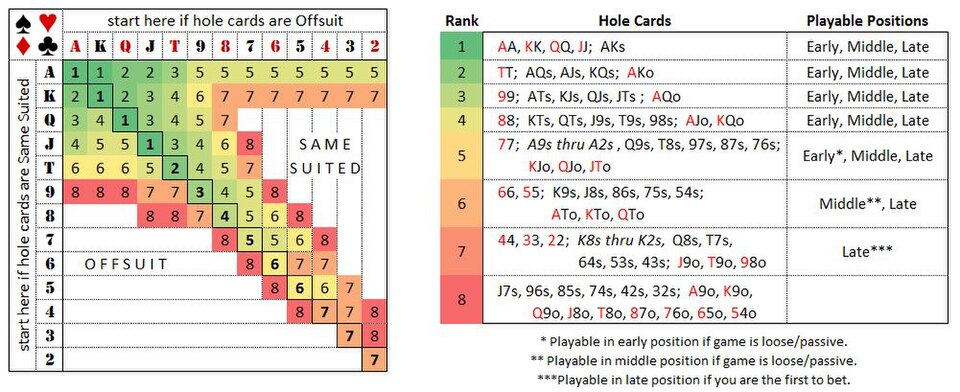
- Sklansky Groups: Hands are categorized by number; lower numbers indicate stronger hands.
- Chen Formula: A point-based system used to calculate the "power rating" of any given starting hand.
- Expected Value: Real-world online play data shows a clear correlation between specific hand tiers and their actual betting value.
Sklansky Hand Groups
Developed by David Sklansky and Mason Malmuth, this system assigns starting hands to specific groups. The core philosophy is that all hands within a single group can generally be played using the same strategy. In this system, the lower the group number, the stronger the hand. Hands that are too weak to be categorized are left without a number.
The Chen Formula
The Chen Formula, created by Bill Chen, provides a mathematical approach to determine a hand's "power rating." Instead of relying on a static list, players can compute the value of their hand using the following point system:
High Card Values
- Ace: 10 points
- King: 8 points
- Queen: 7 points
- Jack: 6 points
- 10 through 2: Half of the card's face value (e.g., a 10 is 5 points, a 9 is 4.5 points).
Modifiers and Adjustments
- Pairs: Multiply the high card points by 2 (e.g., AA = 20, KK = 16). All pairs receive a minimum of 5 points, with 55 receiving an additional bonus point (total of 6).
- Suited Cards: Add 2 points.
- Closeness (Gappers): Subtract points based on the gap between cards: 1 point for 1-gappers (e.g., AQ, J9), 2 points for 2-gappers (e.g., J8, AJ), 4 points for 3-gappers (e.g., J7, 73), and 5 points for larger gaps (including A2, A3, and A4).
- Low-Card Bonus: Add 1 point if the hand is connected or a 1-gap and the highest card is lower than a Queen, as these hands can form all higher straights.
Professional and Statistical Perspectives
Different experts and data sets offer varying views on hand tiers. Phil Hellmuth, in his 2003 book Play Poker Like the Pros, categorizes hands into tiers ranging from the "Top 12 Hands" to "Suited Connectors" (cards of the same suit in sequential order).
Modern statistics derived from real online play provide an empirical look at Expected Value (the average amount a player can expect to win or lose with a specific hand). While top-tier hands like AA and KK show high positive values, some hands in the lower tiers actually result in a negative expected value.
| Source/Metric | Top Tier Hands | Mid Tier Examples | Low Tier/Marginal |
|---|---|---|---|
| Phil Hellmuth | AA, KK, AKs, QQ, AK | AJs, ATs, A9s, A8s | QJs, JTs, T9s, 98s |
| Online Play EV | AA, KK, QQ, JJ, AKs (2.32 - 0.78) | A9s, AJ, QTs, KQ (0.19 - 0.15) | 87s, QT, 44, JT (-0.02 to -0.03) |
Frequently Asked Questions
Do these rankings work for No-Limit Texas Hold 'em?
No. These specific rankings and formulas are designed for Limit Texas Hold 'em and do not apply to No-Limit play.
What is a "gapper" in the Chen Formula?
A gapper refers to the number of ranks missing between two cards. For example, a Jack and a 9 is a "1-gapper" because only the 10 is missing between them.
How does the Sklansky system identify the strongest hands?
The Sklansky system uses numbers to group hands; the lower the number assigned to the group, the stronger the starting hand.
Which hands have a negative expected value according to online play data?
Hands such as 87s, QT, Q8s, 44, A9, J8s, and 76s/JT have been shown to have a negative expected value ranging from -0.02 to -0.03.
Why do low connected cards get a bonus in the Chen Formula?
If the highest card in a connected or 1-gap hand is lower than a Queen, it is granted an extra point because it has the potential to form all higher straights.