Limestone: Composition, Formation, and Industrial Applications
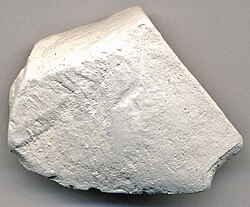
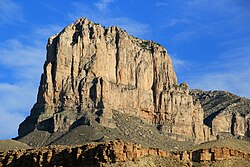
Limestone is a versatile sedimentary rock that plays a critical role in Earth's geological history and human civilization. Primarily composed of calcium carbonate, this rock is found in diverse environments, from the depths of ancient oceans to the towering cliffs of modern coastlines. Its unique chemical properties and structural variety make it essential for everything from monumental architecture to industrial chemical processes.
Key Facts
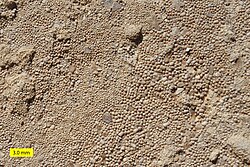
- Primary Composition: Mostly calcite and aragonite (forms of CaCO3).
- Hardness: Relatively soft, ranking between 2 and 4 on the Mohs scale.
- Strength: Dense varieties can reach a crushing strength of 180 MPa, significantly higher than standard concrete.
- Color: Typically white to gray, though organic matter can turn it black, and iron or manganese can create yellow or red hues.
- Porosity: Ranges from 0.1% in dense limestone to 40% in chalk.
Chemical Composition and Physical Properties
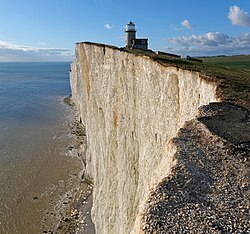
The primary minerals in limestone are calcite and aragonite. While both are crystal forms of calcium carbonate, they differ in structure. Some limestones contain dolomite (CaMg(CO3)2), though it is less common. Calcite is further categorized based on magnesium content: low-magnesium calcite contains less than 4% magnesium, while high-magnesium calcite exceeds this threshold.
Most limestone is chemically pure, with clastic sediments—such as clay minerals and fine-grained quartz—making up less than 10% of the rock. Organic matter is typically minimal, usually around 0.2% and rarely exceeding 1%.
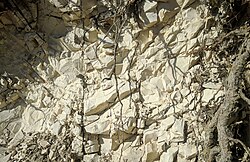
Density and Strength
The density of limestone varies between 1.5 and 2.7 g/cm, depending largely on its porosity. While it is considered a soft rock, its crushing strength in dense forms is impressive, often surpassing the 40 MPa typical of concrete.
The Microstructure of Limestone: Grains and Mud
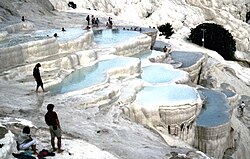
Limestone is often characterized by the relationship between its grains and the surrounding matrix. Most ancient carbonate rocks feature grains embedded in carbonate mud.
Micrite and Microspar
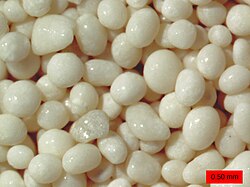
Carbonate mud consisting of crystals smaller than 5 μm is known as micrite. In its fresh state, micrite consists of small aragonite needles produced by algae, seawater precipitation, or the abrasion of grains. Over several million years, this converts to calcite. Further recrystallization leads to microspar, where grains range from 5 to 15 μm.
Sparite
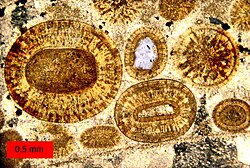
Larger calcite crystals (20 to 100 μm) are referred to as sparite (or sparry calcite). Unlike micrite, sparite appears as transparent or white crystals under a lens and lacks internal structure, distinguishing it from carbonate grains.
Formation and Diagenesis
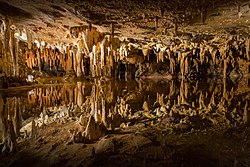
The transformation of loose sediment into solid rock occurs through diagenesis. During this process, sediments are compacted, and significant chemical changes occur, such as the conversion of aragonite into low-magnesium calcite.
Lithification and Pressure Solution
As sediments are buried deeper, they undergo mechanical and chemical compaction. Pressure solution dissolves minerals at the contact points between grains and redeposits them in pore spaces. This reduces porosity from as high as 80% to less than 10%.
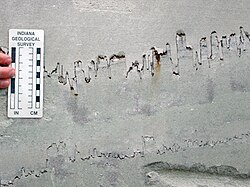
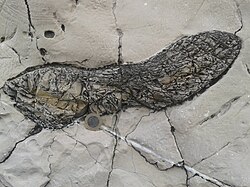
This process often creates stylolites—irregular, silica-rich surfaces that mark where significant portions of the limestone bed have dissolved. Once sediments reach depths greater than 1 km, burial cementation completes the lithification process.
Occurrence and Environmental Factors
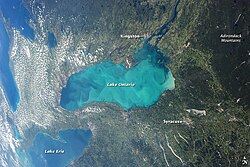
Limestone is rarely found in the deep ocean due to the lysocline. This is the depth (typically 4,000 to 7,000 meters) where calcium carbonate becomes highly soluble due to increased pressure and carbon dioxide concentrations from decaying organic matter. Below this calcite compensation depth, skeletal particles dissolve, and carbonate ooze transitions into silicic mud.
Organic Reefs
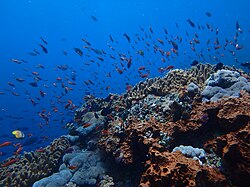
Organic reefs form in shallow, low-latitude waters. Throughout geologic time, different organisms have built these structures, including Archaeocyathids in the early Cambrian, sponges, corals, algae, and rudists. These reefs reached their peak extent during the middle Devonian, covering approximately 5,000,000 km2—ten times the area of modern reefs.
Human Uses and Safety
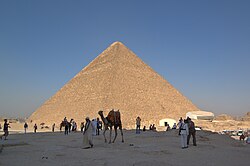
Limestone has been a cornerstone of human construction for millennia. From the Great Pyramid of Giza to the Megalithic Temples of Malta, its durability and workability make it an ideal building material.
Industrial and Modern Applications
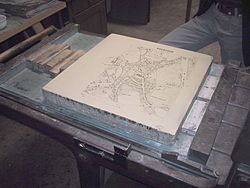
Beyond construction, limestone is used in lithography, the production of certain plastics, and as a soil amendment (liming). It is also used in flue gas desulfurization to reduce industrial emissions and as a pigment or filler in various products.
Occupational Health
In industrial settings, exposure to limestone dust is regulated. In the United States, OSHA sets a permissible exposure limit of 15 mg/m3 for total exposure and 5 mg/m3 for respiratory exposure over an 8-hour workday.

Summary of Limestone Characteristics
| Property/Type | Detail/Value | Notes |
|---|---|---|
| Main Minerals | Calcite, Aragonite | Calcium Carbonate (CaCO3) |
| Mohs Hardness | 2 to 4 | Relatively soft |
| Crushing Strength | Up to 180 MPa | Higher than standard concrete |
| Micrite | < 5 μm | Fine-grained carbonate mud |
| Sparite | 20 to 100 μm | Transparent calcite crystals |
| Lysocline Depth | 4,000 to 7,000 m | Limit of carbonate preservation |
Frequently Asked Questions
![The Megalithic Temples of Malta such as Ħaġar Qim are built entirely of limestone. They are among the oldest freestanding structures in existence.[101]](/images/4b/01/4b017771b1f6dacf1b74cc93c3ed6fb08a5add9c66959fb2284a61df9e8f0599.jpg)
![Plastic bag "made mainly from limestone"[clarification needed]](/images/19/88/19887a5ade21f575e92cef3a774c89ec9faae4851a3394ffe71eb414aa3e2338.jpg)
What is the difference between micrite and sparite?
Micrite is a very fine-grained carbonate mud with crystals smaller than 5 μm, whereas sparite consists of larger, transparent calcite crystals ranging from 20 to 100 μm.
How does limestone form in the ocean?
Limestone forms from the accumulation of organic calcareous material (like coral and shells) or the inorganic precipitation of calcium carbonate from seawater, which then undergoes diagenesis to become solid rock.
Why is limestone not found in the deepest parts of the ocean?
Due to high pressure and high CO2 concentrations, calcium carbonate dissolves at depths below the lysocline (4,000 to 7,000 meters), preventing the accumulation of limestone on the deep ocean floor.
What are stylolites in limestone?
Stylolites are irregular, jagged surfaces formed by pressure solution during burial. They represent areas where the rock has dissolved and silica-rich sediments have accumulated.
Is limestone stronger than concrete?
While limestone is softer in terms of scratch resistance (Mohs scale), dense limestone can have a crushing strength of up to 180 MPa, which is significantly higher than the typical 40 MPa of concrete.