Legislative Yuan: The Evolution of Taiwan's Parliamentary System
The Legislative Yuan serves as the highest legislative organ of the Republic of China (Taiwan). Its journey from a theoretical branch of government in mainland China to a modern, unicameral parliament in Taipei reflects the broader political transformation of the nation. Rooted in the political philosophy of Sun Yat-sen, the body has evolved through periods of authoritarian control, relocation, and eventual democratization.
Constitutional Theory and Origins
The foundation of the Legislative Yuan lies in Sun Yat-sen's Three Principles of the People. This political theory proposed a unique separation of powers divided into five branches (known as the Five-Power Constitution) rather than the traditional three. Under this framework, the Legislative Yuan was designed as the standing legislative body, elected by the National Assembly to handle lawmaking when the Assembly was not in session.
Originally, the system was envisioned as a tricameral parliament, where the Legislative Yuan, the National Assembly, and the Control Yuan shared parliamentary roles. However, constitutional amendments in the 1990s streamlined this process, removing parliamentary functions from the National Assembly and Control Yuan. This transition transformed the Legislative Yuan into a unicameral parliament, meaning it is the sole legislative chamber.
Establishment and the Move to Taiwan
The Legislative Yuan was first established in Nanjing following the Northern Expedition. Its early years were characterized by political tutelage—a period of guided governance under the Kuomintang (KMT). The first session consisted of 51 members with two-year terms, though by the fourth session, membership grew to 194 and terms were extended to 14 years due to the disruptions of the Second Sino-Japanese War (1937–1945).
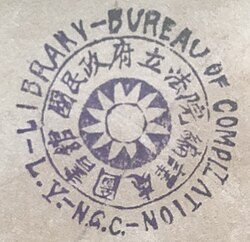
Following the adoption of the current Constitution on December 25, 1947, the first formal session convened in Nanjing on May 18, 1948, with 760 members. Sun Fo and Chen Li-fu were elected as president and vice president, respectively.
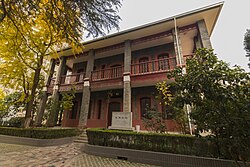
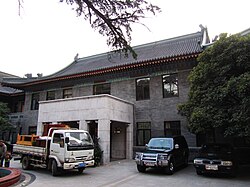
In 1949, as mainland China fell to the Communist Party, the entire government, including the Legislative Yuan, relocated to Taipei. By February 24, 1950, 380 members convened at Sun Yat-sen Hall in Taipei.
The Era of the "Non-reelected Congress"
Because new elections could not be held on the mainland, the Judicial Yuan ruled that existing members would remain in office until the mainland could be recovered. This created the "Non-reelected Congress," where KMT members from mainland districts held their seats for life. While new seats for Taiwan were gradually added starting in 1969, the mainland representatives maintained a majority for decades.
Despite the dominance of the KMT, the body became a venue for political dissent. Candidates began running as Tangwai ("outside the party") in the 1970s, and by 1985, the Democratic Progressive Party (DPP) began fielding candidates, challenging the one-party system.
The Path to Democratization
The transition to a fully representative democracy accelerated in the early 1990s. The "Non-reelected" members were forced to retire by December 31, 1991. By 1998, the body expanded to 225 members to incorporate representatives from the abolished provincial legislature of Taiwan Province.
The year 2000 marked a significant shift in power dynamics. Following the presidential election, the presidency and Executive Yuan were controlled by the DPP, while the Legislative Yuan remained largely under KMT control. This split led to frequent constitutional conflicts regarding the appointment of the premier and the president's power to call special sessions.
Modern Reforms and Current Structure
In August 2004, with 70% public support, the Legislative Yuan passed a sweeping package of amendments to modernize the electoral process. These changes, implemented in 2008, significantly altered the body's composition and function.
| Feature | Previous System | New System |
|---|---|---|
| Total Seats | 225 | 113 |
| Term Length | 3 Years | 4 Years |
| Voting System | Multi-member districts | Single-member district parallel voting |
| Seat Distribution | Various | 73 Plurality, 34 Party List, 6 Aboriginal |
Under the current system, every county is guaranteed at least one electoral district. To promote gender equality, half of the proportionally represented party-list seats must be held by women. Additionally, the National Assembly was abolished, and the Legislative Yuan gained the power to propose the impeachment of the president or vice president to the Council of Grand Justices.
Key Facts
- Theoretical Origin: Based on Sun Yat-sen's Five-Power Constitution.
- Structure: Transitioned from a tricameral role to a unicameral parliament.
- Relocation: Moved from Nanjing to Taipei in 1949.
- Current Size: 113 seats (since 2008).
- Term Length: 4 years, synchronized with presidential elections.
- Gender Quota: 50% of party-list seats are reserved for women.
Frequently Asked Questions
What is the "Non-reelected Congress"?
It refers to the period when legislators elected on mainland China continued to hold office indefinitely after the government moved to Taiwan in 1949, as new elections were impossible to hold on the mainland.
How is the current Legislative Yuan composed?
The body consists of 113 members: 73 elected via plurality in single-member districts, 34 from party lists, and 6 representing aboriginal populations.
What happened to the National Assembly?
The National Assembly was abolished as part of the 2004 constitutional amendments, and its primary functions were transferred to the Legislative Yuan.
How are constitutional amendments handled now?
Amendments require a three-fourths vote from a quorum of at least three-fourths of all members. After a 180-day period, they must be ratified by an absolute majority of all eligible voters.
What is the role of the Judicial Yuan in this history?
The Judicial Yuan provided critical legal interpretations, such as Interpretation No. 76 in 1957 and the later rulings that forced the retirement of the non-reelected members in 1991.