Le Jeu de la Guerre: Strategy and Mechanics of Debord's Wargame
Le Jeu de la Guerre is a strategic wargame designed by Debord that mirrors the complexities of military conflict. While it shares foundational similarities with chess, it introduces sophisticated layers of logistics and terrain that simulate the challenges of a real battlefield. The game focuses on the movement of troops and the critical importance of maintaining command and control over dispersed forces.
Debord aimed for high accuracy in his simulation, though he noted three specific variables that prevented 100% realism: the influence of troop morale, the cycles of day and night and climate conditions, and the inherent uncertainty regarding the enemy's exact positions and movements.
Key Facts
- Objective: Win by defeating all opponent troops or destroying both of their arsenals.
- Board Size: A 500-cell grid (25 columns by 20 rows).
- Turn Limit: Players can move up to 5 troops and perform 1 attack per turn.
- Combat Logic: Attacks succeed if the total offensive power minus the target's defensive power is greater than 2.
- Command Requirement: Pieces must be linked to an arsenal via lines of communication or be adjacent to a connected friendly piece to move.
The Game Board and Terrain
The board is a rectangular grid consisting of 25 columns (1-25) and 20 rows (A-T). It is split into North (Rows A-J) and South (Rows K-T) halves, each featuring identical terrain obstacles that impact movement and defense.
| Feature | Quantity | Effect | North Locations | South Locations |
|---|---|---|---|---|
| Mountains | 9 | Impassible | C10:C13, D10, E10, G10:I10 | N11:N16, P16:R16 |
| Pass | 1 | +2 Defense Bonus | F10 | O16 |
| Fort | 3 | +4 Defense Bonus | B8, I13, H21 | M3, L15, O23 |
| Arsenal | 2 | Communication Hub | D8, B15 | T3, T23 |
The Arsenal is the most critical structure on the board. Not only is its destruction a victory condition, but it also serves as the primary source of command for all troops.
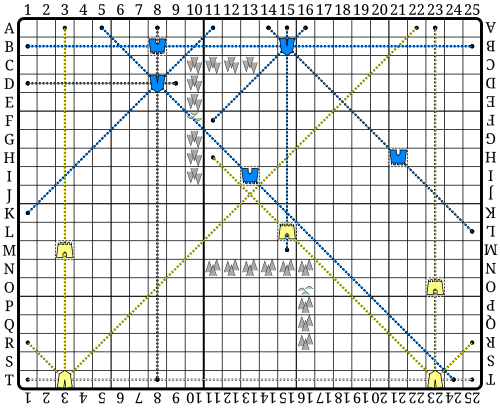
Troop Types and Capabilities
Each player begins the game with 15 pieces. These units vary in speed, range, and combat power, requiring players to balance their offensive and defensive deployments.
- Infantry: The standard foot soldier with a speed of 1 and a defense of 6.
- Cavalry: Faster mounted soldiers (speed 2) with higher defense (7).
- Artillery (Foot): High-range units (8) with a speed of 3.
- Artillery (Mounted): Balanced range (3) and speed (2) with high offense (5).
- Communications Repeaters: Specialized units (one foot, one mounted) used to extend the reach of command lines.
Lines of Communication and Command
In Le Jeu de la Guerre, a piece is only functional if it is "in communication." Lines of communication are straight lines (vertical, horizontal, and diagonal) that radiate from arsenals. These lines are blocked by mountain ranges or opposing enemy pieces.
To expand their reach, players use communication repeaters. When placed on an existing line of communication, a repeater acts as a secondary hub, radiating its own set of vertical, horizontal, and diagonal lines. This allows players to command troops in areas of the board that the primary arsenal cannot reach.
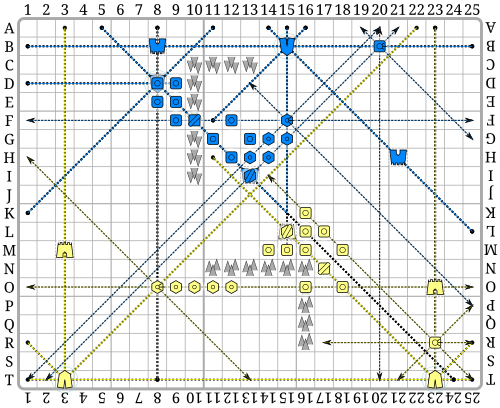
A piece is considered commanded if it sits on a line of communication or is adjacent (sharing a side or corner) to a friendly piece that is already connected. If a piece loses this connection, it becomes inert—meaning it cannot move—and any attack against a stranded piece results in its automatic destruction.
Frequently Asked Questions
How is combat calculated in Le Jeu de la Guerre?
Combat is determined by summing the offensive power of all attacking pieces in a straight line (vertical, horizontal, or diagonal) relative to the target square. The defender's total defensive power is then subtracted from this sum. If the resulting number is greater than 2, the attack is successful.
What happens if a piece is not in communication?
A piece without a link to an arsenal or a repeater becomes inert and immobile. Furthermore, any attack launched against a piece that is out of communication results in the automatic destruction of that piece.
What are the victory conditions?
A player wins the game by either eliminating all of the opponent's troops or by destroying both of the opponent's arsenals.
How do communication repeaters work?
Repeaters must be placed on an existing line of communication emanating from an arsenal. Once placed, they radiate their own lines of communication in all straight directions, effectively extending the player's command range across the board.
Do terrain features affect combat?
Yes. While mountains are impassible, other features provide defensive advantages. Occupying a Pass grants a +2 defense bonus, while occupying a Fort grants a +4 defense bonus.