Latin America and the Caribbean: A Comprehensive Regional Overview
Latin America and the Caribbean (LAC) is a vast geopolitical and cultural region encompassing the Americas south of the contiguous United States. Spanning from the northern reaches of Mexico and The Bahamas to the southern tips of Argentina and Chile, the region includes all countries and territories in the Americas except for the United States, Canada, and Greenland.
While often conflated with Latin America, the LAC designation is more inclusive. It incorporates Central America, South America, and the Caribbean, including nations where non-Latin languages—such as English and Dutch—are predominant, including Jamaica, Guyana, and Belize.
Key Facts
- Total Area: 21,951,000 km² (8,475,000 sq mi).
- Population: Approximately 670,230,000 (as of 2016).
- Composition: 33 independent countries and 19 dependencies.
- Primary Languages: Spanish, Portuguese, English, French, and Dutch.
- Time Zones: UTC−02:00 to UTC−08:00.
- UN M49 Code: 419.
Geography and Political Structure
The region is divided into several distinct subregions. The Caribbean includes the West Indies, comprising the Greater and Lesser Antilles and the Lucayan Archipelago. Central America (which includes Mexico under the UN geoscheme) serves as the land bridge to South America.
The political landscape of LAC is characterized by a complex history of stability and volatility. The region has faced several significant internal conflicts, most notably the Colombian conflict and the Mexican drug war. More recent instability is evident in the crisis in Venezuela and the gang warfare in Haiti. Other notable conflicts include internal strife in Peru, gang wars in Brazil and Honduras, the Mapuche conflict in Argentina and Chile, and insurgency in Paraguay.
Democratic Standing
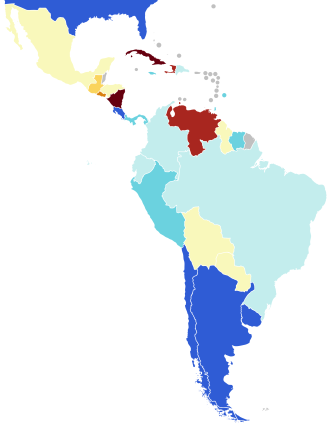
According to the 2024 V-Dem Democracy Report, there is a wide variance in democratic representation across the region. Costa Rica, Uruguay, Argentina, Chile, and Jamaica are identified as having the most representative democracies, while Nicaragua, Cuba, and Venezuela are ranked as the least democratic.
Cultural Landscape
Religion and Spirituality
Christianity is the dominant faith in the region, with Roman Catholicism being the largest denomination. This is complemented by Protestantism (including Jehovah's Witnesses and Mormonism) and Orthodoxy. The region is also known for its syncretism—the blending of different beliefs—resulting in folk Catholicism, African diaspora religions, and Native American shamanism.
Diverse minority faiths are present, particularly in Brazil, Central America, and the Caribbean. These include Judaism, Islam, Hinduism, the Baháʼí Faith (prominent in Belize, Bolivia, and Panama), Buddhism, and Shinto. Some Jewish and Muslim communities are descendants of those who practiced Crypto-Judaism or Crypto-Islam during the Reconquista. Additionally, there is a growing trend toward New Age spirituality, neo-paganism, and the worship of Pre-Columbian deities like Pachamama.
Music and Arts
The music of LAC is world-renowned for its uniqueness, born from the convergence of Indigenous, African, European, and Asian influences following the 15th-century conquests by Spain, Portugal, France, Britain, and the Netherlands. Since the 1950s, globalization has propelled this music onto the world stage, earning numerous international awards.
Sports and Athletics
Association football is the most prominent sport, with Brazil, Argentina, and Uruguay fielding some of the world's strongest teams. Other popular sports include baseball, tennis, volleyball, basketball, rugby union, cricket, cycling, and hockey.
The region is also a powerhouse in Mixed Martial Arts (MMA), particularly within the Ultimate Fighting Championship (UFC), with Brazil and Mexico standing out as primary contributors to the sport.
Regional Summary
| Category | Details |
|---|---|
| Total Countries | 33 Countries, 19 Dependencies |
| Land Mass | 21,951,000 km² |
| Population | 670,230,000 (2016) |
| Major Languages | Spanish, Portuguese, English, French, Dutch |
| Top Democratic Nations | Costa Rica, Uruguay, Argentina, Chile, Jamaica |
| Dominant Sport | Association Football |
Frequently Asked Questions
What is the difference between Latin America and LAC?
Latin America typically refers to countries where Romance languages (Spanish, Portuguese, French) are spoken. LAC (Latin America and the Caribbean) is a broader geopolitical term that includes these areas plus Caribbean nations where English or Dutch are the primary languages, such as Jamaica and Belize.
Which countries in the region are considered the most democratic?
Based on the 2024 V-Dem Democracy Report, the most representative democracies in the region are Costa Rica, Uruguay, Argentina, Chile, and Jamaica.
What are the primary religions practiced in the LAC region?
Roman Catholicism is the largest religion, followed by other forms of Christianity. The region also features significant syncretic beliefs, including African diaspora religions and Native American shamanism, alongside minority faiths like Islam, Judaism, and the Baháʼí Faith.
Which sports are most popular in Latin America and the Caribbean?
Association football is the most popular sport, especially in South America. Other widely followed sports include baseball, tennis, basketball, and Mixed Martial Arts (MMA), with Brazil and Mexico being particularly influential in the UFC.
How many countries and dependencies make up the LAC region?
The region consists of 33 independent countries and 19 dependencies.