Lark-like Brushrunner: The Unique Ovenbird of South America
The lark-like brushrunner (Coryphistera alaudina) is a distinctive member of the ovenbird family, Furnariidae. As its name suggests, this bird bears a striking resemblance to a lark, characterized by its terrestrial habits and a prominent erect crest. Found across several South American nations, it is a fascinating example of avian adaptation in open and semi-open landscapes.
Key Facts
- Scientific Name: Coryphistera alaudina
- Conservation Status: Least Concern (IUCN 3.1)
- Distribution: Argentina, Bolivia, Brazil, Paraguay, and Uruguay
- Diet: Primarily arthropods and snails
- Unique Behavior: Known to share nest construction with the monk parakeet
- Size: 15 to 17 cm in length; 27 to 42 g in weight
Taxonomy and Classification
The lark-like brushrunner belongs to the subfamily Furnariinae. It is the sole member of its genus, Coryphistera. Genetic research indicates that its closest relative is the firewood-gatherer (Anumbius annumbi), suggesting they may be sister species.
There are two recognized subspecies: the nominate C. a. alaudina and C. a. campicola. While they share many traits, C. a. campicola is distinguished by paler streaks on its underparts and more buff edging on its upperparts.
Physical Description
Adults of this species typically measure between 15 and 17 cm and weigh between 27 and 42 g. Both males and females share the same plumage. The bird is characterized by a dark brown crown and crest, with a pale dull brown back featuring darker streaks that widen toward the rump and uppertail coverts.
Their underparts are whitish with blurry rufous streaks on the breast and throat, though the center of the belly remains mostly unstreaked. The bill (maxilla and mandible) varies from brownish-pink to yellow-brown, and the legs range from dull orange to light brown. Juveniles are similar to adults but possess a shorter crest and less distinct streaking.
Distribution and Habitat
The lark-like brushrunner is distributed across a wide swath of South America. The nominate subspecies is the most widespread, inhabiting northern and eastern Argentina, southern Bolivia, northwestern Uruguay, and the southernmost Brazilian state of Rio Grande do Sul. The subspecies C. a. campicola is found specifically in western Paraguay and southeastern Bolivia.
These birds prefer open to semi-open environments, including:
- Arid lowland scrublands
- Arid Gran Chaco woodlands
- Savannas and pastures with trees
- Agricultural fields (to a lesser extent)
They are typically found at elevations ranging from sea level up to 500 meters (1,600 ft).
Behavior and Ecology
Movement and Social Structure
While mostly year-round residents, some populations in the southernmost parts of their range migrate north during the austral winter. They are social birds; during the breeding season, they forage in flocks of up to seven, while non-breeding flocks can reach 15 individuals. They also frequently join mixed-species feeding flocks.
Diet and Foraging
The lark-like brushrunner is primarily terrestrial. It feeds mainly on arthropods (invertebrates with jointed legs) and snails. To find food, the bird walks along the ground, scratching the soil or tossing aside mammal dung to expose hidden prey.
Breeding and Nesting
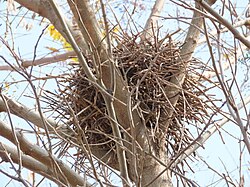
Breeding occurs during the austral spring and summer, typically from September to January. The species is believed to be monogamous, though some group dynamics suggest otherwise. They construct a large, globular nest—up to 100 cm across—made of woven thorny sticks and branches, usually placed in a tree branch 2 to 5 meters above the ground.
The nest features a tunnel leading to a grass-and-feather-lined chamber. Interestingly, these tunnels are sometimes decorated with objects like colored glass or butterfly chrysalids. In a rare example of interspecies cooperation, the lark-like brushrunner has been observed building the same nest simultaneously with the monk parakeet.
Vocalization
The song of the lark-like brushrunner is described as a high-pitched, tremulous, tinkling trill. Their general calls consist of various squeaky notes and low, buzzy trills.
Summary Table
| Feature | Details |
|---|---|
| Family | Furnariidae (Ovenbirds) |
| Average Length | 15–17 cm |
| Primary Habitat | Arid scrublands, savannas, and Gran Chaco woodlands |
| Diet | Arthropods and snails |
| Clutch Size | Typically 3–4 eggs (occasionally 5) |
| Conservation Status | Least Concern |
Frequently Asked Questions
What makes the lark-like brushrunner unique among ovenbirds?
It is unique for its lark-like appearance, including an erect crest and terrestrial foraging habits, and it is the only member of its genus, Coryphistera.
Where can the lark-like brushrunner be found?
It is found in Argentina, Bolivia, Brazil, Paraguay, and Uruguay, primarily in arid lowland scrublands and savannas.
Do lark-like brushrunners share nests with other birds?
Yes, they have been recorded building the same nest simultaneously with the monk parakeet, which is a rare instance of nest sharing between two different species.
What do lark-like brushrunners eat?
Their diet consists mainly of arthropods and snails, which they find by scratching the ground or searching through mammal dung.
Is the lark-like brushrunner an endangered species?
No, the IUCN classifies it as Least Concern due to its large range and stable population size.