Larissa: A Journey Through the History of Thessaly's Great City
Located in the heart of the fertile plains of Thessaly, Larissa is a city where antiquity and modernity converge. From its origins as a strategic fortress to its current status as a major Greek urban center, Larissa has served as a pivotal military and cultural hub for millennia. Known in antiquity for its exceptional horses and agricultural wealth, the city's trajectory reflects the broader shifts of power in the Mediterranean world.
Key Facts
- Etymology: The name Larissa is derived from a Pelasgian word meaning "fortress."
- Ancient Status: It was a prominent polis (city-state) and the headquarters of the Thessalian League.
- Strategic Importance: It served as a military base for the Ottoman Empire and currently hosts the Hellenic Air Force and NATO headquarters in Greece.
- Cultural Legacy: Home to two ancient theatres and the remains of the Basilica of St. Achillios.
- Modern Standing: The fourth largest city in Greece, leading the country in urban green coverage per square meter.
Ancient Foundations and the Classical Age
While Paleolithic settlements indicate early human presence, Larissa rose to prominence as a city-state during the Classical Era. It was governed for generations by the Aleuadai, an aristocratic family whose influence spanned the district of Pelasgiotis. The Aleuadai held the exclusive privilege of appointing the Tagus, the commander-in-chief of the combined Thessalian forces.
The city's identity was deeply tied to its geography. In the late fifth century BC, Larissa began minting its own coins, featuring the nymph Larissa (the city's namesake) and the horse, a symbol of the Thessalian plains.
![Silver drachma of Larissa (410-405 BC). Head of the nymph Larissa left, wearing pearl earring, her hair bound in sakkos / ΛΑΡΙΣΑ above, [IA] below (retrograde), bridled horse -symbol of the city- galloping right.](/images/c4/11/c41174d02d5dae5d6e3eb096f7b2b394446540f0440d2976c8e37aa5b7e4ccbc.jpg)
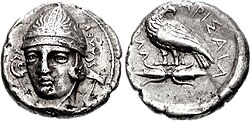
Larissa's intellectual and political reach was significant. It is believed to be the place where the philosopher Gorgias of Leontini and the physician Hippocrates passed away. The city also produced Meno, a general who participated in the expedition of 401 BC to help Cyrus the Younger challenge the Persian throne—an event later detailed in Xenophon's Anabasis and Plato's dialogue Meno.
Politically, Larissa's democratic constitution led it to align with Athens during the Peloponnesian War. However, the city eventually fell under the control of the Thebans and was later annexed by Philip II of Macedon in 344 BC. By 196 BC, following the defeat of Philip V at the Battle of Cynoscephalae, Larissa became an ally of Rome.
Architectural and Cultural Heritage
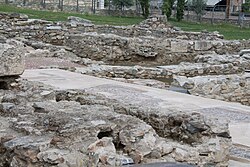
The city's physical landscape preserves its long history. The first ancient theatre, constructed in the late third century BC under Antigonus II Gonatas, remained in use for six centuries.
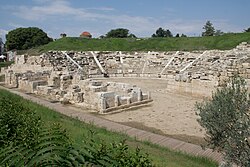
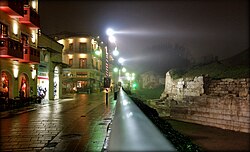
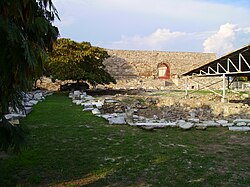
Beyond the first theatre, the city also contains the ruins of a second ancient theatre and the remains of the Basilica of St. Achillios, a significant religious site destroyed during the Ottoman era.
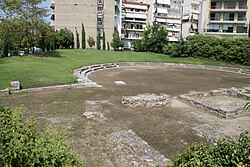
From the Middle Ages to Ottoman Rule
The transition through the Middle Ages was marked by volatility. After being sacked by the Ostrogoths in the late 5th century, the city was rebuilt by Emperor Justinian I. By the 8th century, it became the metropolis of the theme of Hellas. It faced numerous sieges, including a capture by Tsar Samuel of Bulgaria in 986, who took the relics of Saint Achilleios to Prespa.
The Ottoman Empire established permanent control of the city in 1423 under Turahan Bey, renaming it Yeni-şehir i-Fenari ("new citadel"). As a primary military base, the city became predominantly Muslim, featuring numerous mosques, medreses (educational institutions), and bedestens (covered markets).
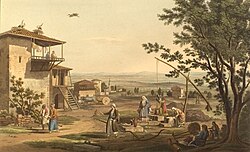
During the 17th and 18th centuries, Larissa was a thriving trade center. However, the late 19th century brought challenges, including a devastating fire in 1882 and public health crises caused by poor drainage and river flooding.
The Modern Greek Era
Larissa was incorporated into the Kingdom of Greece in 1881. This transition saw a significant emigration of the Turkish population and a period of urban reconstruction. The city's 20th-century history was marked by the Greco-Turkish War of 1897 and the tragedies of the Axis Occupation, during which the local Jewish community—present since the 2nd century BC—suffered heavy losses.
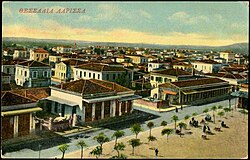
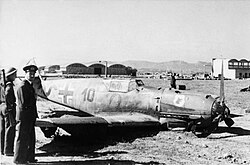
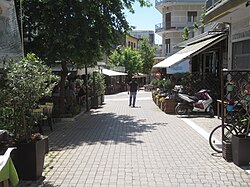
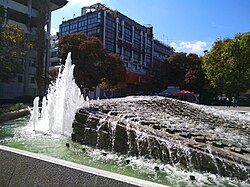
In the post-WWII era, Larissa expanded rapidly. Today, it is a center for education and medicine, hosting a School of Medicine and the country's third-largest Institute of Technology. It is also recognized for its high quality of life, boasting the highest percentage of restaurants and tavernas per capita in Greece.
Summary of Larissa's Historical Evolution
| Era | Key Characteristic/Event | Significant Figure/Entity |
|---|---|---|
| Classical Age | City-state (Polis) and minting of local coins | Aleuadai Family |
| Hellenistic/Roman | Ally of Rome; Headquarters of Thessalian League | Philip V of Macedon |
| Byzantine | Metropolis of the theme of Hellas | Justinian I |
| Ottoman | Military base known as Yeni-şehir i-Fenari | Turahan Bey |
| Modern | Incorporation into Greece (1881) and urban expansion | General Skarlatos Soutsos |
Frequently Asked Questions
What does the name Larissa mean?
The name is of Pelasgian origin and translates to "fortress."
Who were the Aleuadai?
The Aleuadai were a powerful aristocratic family that governed Larissa and the district of Pelasgiotis for many generations before 369 BC, holding the right to appoint the Tagus.
What symbols appeared on ancient Larissa coins?
The coins typically featured the nymph Larissa on the obverse and a horse—symbolizing the plains of Thessaly—on the reverse.
When did Larissa become part of modern Greece?
Larissa was incorporated into the Kingdom of Greece in 1881 during the prime ministry of Alexandros Koumoundouros.
What is the city's current strategic importance?
Today, Larissa serves as the headquarters for the Hellenic Air Force and NATO in Greece, while also being a major regional center for medicine and technology.