Lake Oswego History: From Industrial Iron Hub to Elite Suburb
The story of Lake Oswego is one of dramatic transformation. Once the ancestral home of the Clackamas people and later a gritty industrial center aiming to become the "Pittsburgh of the West," the city has evolved into one of Oregon's most affluent residential communities. This journey from wilderness to iron works, and finally to a scenic suburb, reflects the broader economic and social shifts of the Pacific Northwest.
Early Settlement and the Clackamas People
Long before the arrival of European settlers, the land that now comprises Lake Oswego was occupied by the Clackamas people. However, the population was decimated by diseases introduced by European traders and explorers. In the years preceding the mass migration of the Oregon Trail, the region between the Willamette and Tualatin Rivers was sparsely populated by a few pioneer homesteads and farms.
The mid-19th century brought a surge of settlers, incentivized by the Donation Land Claim Act of 1850 and the Homestead Act. In 1847, Albert Alonzo Durham founded the town of Oswego, naming it after his home of Oswego, New York. Durham established the town's first industry by building a sawmill on Sucker Creek, known today as Oswego Creek. By 1855, the federal government forcibly relocated the remaining Clackamas people to the Grand Ronde Indian Reservation in Yamhill County.
The Rise and Fall of the Iron Industry
In the early days of Oregon's development, the Willamette River served as the primary artery for trade between Portland and Oregon City. Because land travel was hindered by dense forests and muddy roads, river landings were essential. Durham is believed to have developed a landing around 1850 in what is now George Rogers Park to facilitate the transport of lumber.
The city's trajectory changed in 1865 with the incorporation of the Oregon Iron Company, following the discovery of iron ore in the Tualatin Valley. The company constructed the first blast furnace on the West Coast, utilizing an arched design common in northwestern Connecticut. The ambition was bold: to transform Oswego into a major industrial powerhouse.
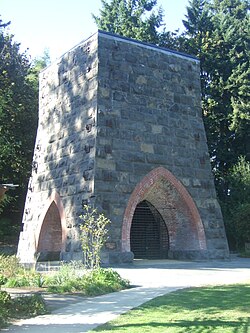
The industry underwent several ownership changes, becoming the Oswego Iron Company in 1878, and later the Oregon Iron and Steel Company in 1882 under financiers Simeon Gannett Reed and Henry Villard. At its peak, the industry employed approximately 300 men and produced 12,305 tons of pig iron (crude iron cast into blocks) by 1890. This economic boom supported a thriving town center featuring a bank, an opera house, three churches, and nine saloons.
The Impact of the Railroad
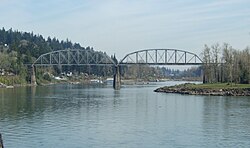
The arrival of the Portland and Willamette Valley Railway in 1886 provided a direct 7-mile link to Portland. While the railroad encouraged residential growth, it simultaneously signaled the end of the local iron industry. The expanded freight system allowed cheaper, higher-quality iron from the Great Lakes region to flood the local market, rendering Oswego's production obsolete.
Transition to a Residential Haven
As the iron industry declined, the Oregon Iron and Steel Company pivoted toward land development and power generation. Starting in 1905, the company built a power plant on Oswego Creek to supply electricity to local residents. With the industrial demand for water decreasing, the recreational appeal of the lake became a primary draw for new residents.
The town officially incorporated as Oswego in 1910. Transportation was revolutionized in 1914 when the Southern Pacific Railroad electrified the line, introducing the Red Electric service. This clean, quiet transit system peaked in 1920 with 64 daily trains to Portland. Although passenger service ended by 1929 and the line was abandoned in 1984, the route is now preserved for tourists via the Willamette Shore Trolley.
During the 1930s and 1940s, developers like Paul Murphy further refined the city's image. Murphy established the Oswego Lake Country Club and promoted a "live where you play" lifestyle, encouraging the construction of high-end homes and the development of the city's first western water system.
Modern Era and Social Dynamics
In 1960, the city was renamed "Lake Oswego" following the annexation of part of Lake Grove. While the city grew in prestige, it also faced criticism regarding its social exclusivity. Historian James W. Loewen and other critics have noted the city's reputation as an "elite white suburb," leading to various derogatory nicknames over the years.
These tensions surfaced prominently in August 2020, when a resident received an anonymous letter requesting the removal of a "Black Lives Matter" sign on the grounds that it lowered property values. This incident prompted a response from then-Mayor Kent Studebaker and inspired a high school student to produce a documentary titled Lake No Negro, exploring the city's history of racial exclusion.
Key Facts
- Founded: 1847 by Albert Alonzo Durham.
- Industrial Peak: Produced 12,305 tons of pig iron by 1890.
- Firsts: Home to the first blast furnace on the West Coast.
- Transit: The "Red Electric" peaked in 1920 with 64 daily trains to Portland.
- Renaming: Officially became "Lake Oswego" in 1960.
| Year/Period | Event | Significance |
|---|---|---|
| 1847 | Town of Oswego founded | Establishment of first sawmill on Sucker Creek. |
| 1865 | Oregon Iron Company incorporated | Start of the West Coast's first blast furnace. |
| 1886 | Railroad arrival | Linked Oswego to Portland; eventually led to iron industry decline. |
| 1910 | Incorporation | Oswego officially becomes an incorporated town. |
| 1914 | Red Electric service | Electrified rail provided rapid transit to Portland. |
| 1960 | Renamed Lake Oswego | Occurred during the annexation of part of Lake Grove. |
Frequently Asked Questions
Who founded the town of Oswego?
Albert Alonzo Durham founded the town in 1847, naming it after Oswego, New York, and establishing the town's first sawmill.
What was the "Pittsburgh of the West"?
This was the ambition of the Oregon Iron Company, which sought to make Oswego a major center for iron production after building the first blast furnace on the West Coast.
What was the Red Electric?
The Red Electric was an electrified railroad service operated by the Southern Pacific Railroad that provided clean and quiet transit between Oswego and Portland, peaking in 1920.
Why did the local iron industry fail?
The arrival of the railroad allowed for the import of cheaper, higher-quality iron from the Great Lakes region, which undercut the local production in Oswego.
When did the city become Lake Oswego?
The city officially changed its name from Oswego to Lake Oswego in 1960 after annexing a portion of neighboring Lake Grove.