Ladysmith (uMnambithi)
Located in the heart of KwaZulu-Natal, South Africa, Ladysmith—officially renamed uMnambithi in March 2024—is a town of profound historical significance and cultural diversity. Serving as the seat for both the Alfred Duma Local Municipality and the Uthukela District Municipality, it is strategically positioned 230 kilometers northwest of Durban and 365 kilometers southeast of Johannesburg.
The town is a hub for several key industries, including textiles, tyre production, and food processing, blending its industrial utility with a rich legacy as a site of pivotal military conflict.
Key Facts
- Official Name: uMnambithi (since 2024).
- Established: 1850.
- Location: KwaZulu-Natal, South Africa.
- Population: 64,855 (2011 Census).
- Key Historical Event: The 118-day Siege of Ladysmith during the Second Boer War.
- Notable Residents: Hometown of Joseph Shabalala (Ladysmith Black Mambazo).
Historical Origins
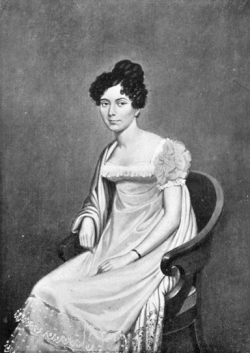
The area's colonial history began in 1847 when Boers purchased land from the Zulu king Mpande to establish the Republic of Klip River. This republic was annexed by the British that same year, and on June 20, 1850, it was proclaimed as a township named Windsor. By October 11, 1850, the name was changed to Ladysmith in honor of Juana María de los Dolores de León Smith, the Spanish wife of Sir Harry Smith, who served as the Governor of the Cape Colony.
The Second Boer War and the Great Siege
Ladysmith gained international fame during the Second Boer War. Under Lieutenant-General Sir George White, the town became a center of operations for the protection of Natal. On November 2, 1899, Boer forces surrounded the town, initiating a grueling 118-day siege that lasted until February 28, 1900.
The siege is noted for the presence of two world-altering figures: Winston Churchill, who served as a war correspondent for The Morning Post, and Mahatma Gandhi, who organized and led a non-White stretcher-bearer service within the Ambulance Corps.
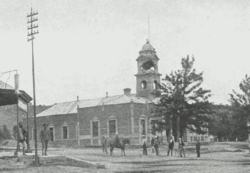
The relief of the town was a hard-fought victory. After three failed attempts by General Sir Redvers Buller at Colenso, Spion Kop, and Vaal Krantz, and a failed Boer attempt to take the town at the Battle of Platrand (Wagon Hill), the British finally broke the siege through the coordinated use of infantry and artillery.
Geography and Climate
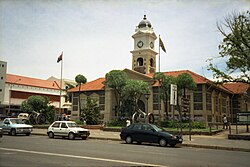
Ladysmith is situated on the banks of the Klip River (meaning "stone river") at the foothills of the Drakensberg mountains. Its location makes it susceptible to severe flooding; between its founding and 1997, the town experienced 29 serious floods. The most devastating occurred in 1996, causing R 500 million in damages.
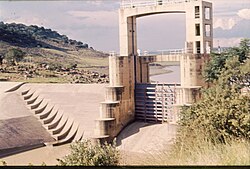
The town features a subtropical highland climate (Cwb), characterized by warm summers and cool, dry winters. Most of the annual precipitation, which averages 639 mm, falls during the summer months.
Town Statistics Summary
| Category | Details |
|---|---|
| Total Area | 84.13 km² |
| Population Density | 770.9/km² |
| Primary Languages | Zulu (64.3%), English (22.8%), Afrikaans (6.3%) |
| Racial Makeup (2011) | Black African (73.3%), Indian/Asian (15.0%), White (8.3%) |
| Coordinates | 28°33′35″S 29°46′50″E |
Transport and Infrastructure
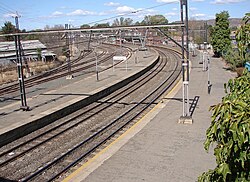
Ladysmith is accessible via the N11, which connects it to Newcastle in the north and the N3 Freeway in the southwest. While it was once a primary transit point between Durban and Johannesburg, the completion of the N3 Toll Highway in the late 1980s bypassed the town, significantly reducing traffic volumes. The town is also served by a small airport (IATA: LAY) and a railway station.
Society and Culture
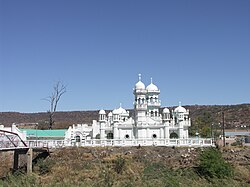
The town is a tapestry of religious and cultural heritage. It is home to the Soofie Mosque, built in 1969 and regarded as one of the finest in South Africa, and the Sanathan Dharma Sabha, a Hindu temple declared a national monument in 1990.
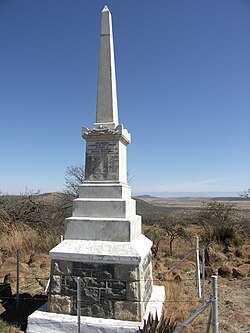
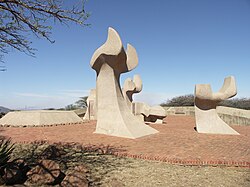
Military history remains visible throughout the town. The Siege Museum, opened in 1995, houses 60,000 documents related to the Boer War. Memorials on Wagon Hill, including the Burgher Memorial and the Imperial Light Horse Memorial, commemorate those who fell during the conflict.
Ladysmith is also the birthplace of several notable figures, including Joseph Shabalala, the founder of the world-renowned musical group Ladysmith Black Mambazo, champion boxer Thulani "Sugar Boy" Malinga, and soccer player Thamsanqa Gabuza.
Frequently Asked Questions
Why was Ladysmith renamed to uMnambithi?
The renaming was proposed in 2023 and officially implemented in March 2024 as part of a broader effort to reflect local identity and heritage.
Who were the famous figures present during the Siege of Ladysmith?
Winston Churchill was present as a war correspondent for The Morning Post, and Mahatma Gandhi served as a leader of the non-White stretcher-bearer service.
What is the significance of the Soofie Mosque?
Built in 1969, it is considered one of the finest mosques in South Africa and represents the strong Islamic presence in the town, dating back to the arrival of Hazrath Soofie Saheb in 1895.
How has the N3 Toll Highway affected the town?
The highway bypassed Ladysmith by 15 kilometers to the west, leading to a dramatic drop in traffic volumes that previously flowed through the town center between Durban and Johannesburg.
What can visitors see at the Siege Museum?
The museum, which originally served as a marketplace in 1884, contains approximately 60,000 documents and artifacts detailing the battles and history of the Second Boer War.