Kuwaiti Oil Fires: Environmental Impact and Aftermath
In 1991, the world witnessed one of the most dramatic man-made environmental disasters in history. As Iraqi military forces retreated from Kuwait following their conquest and subsequent expulsion by Coalition forces, they implemented a scorched earth policy—a military strategy of destroying any assets that could be useful to the enemy. This resulted in the ignition of approximately 700 oil wells, creating a landscape of fire and smoke that persisted for nearly a year.
The fires began in January and February 1991. Extinguishing them was a perilous task; the Iraqi military had planted land mines around the wells, necessitating a comprehensive military cleaning of the areas before firefighting crews could safely enter. Eventually, privately contracted teams managed to put out the last of the fires by November 1991.
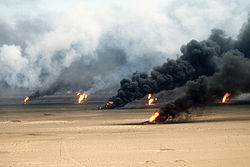
Key Facts
- Number of wells ignited: Approximately 700.
- Duration: January/February 1991 to November 1991.
- Oil loss: Roughly 6 million barrels (950,000 m³) per day.
- Financial cost: US$1.5 billion for extinguishing operations.
- Peak radiation blockage: Smoke absorbed 75% to 80% of solar radiation.
The Debate Over Global Climate Impact
As the threats to blow up the wells first emerged, scientists and policymakers feared a global catastrophe. At the World Climate Conference in Geneva, speculation ranged from heavy acid rain to immediate global warming and even a "nuclear winter" scenario.
The Nuclear Winter Theory
In January 1991, Paul Crutzen published calculations in the journal Nature suggesting that the fires could produce a nuclear winter. He predicted a smoke cloud covering half of the Northern Hemisphere within 100 days, dropping temperatures by 5-10 degrees Celsius. This view was supported by renowned scientist Carl Sagan and colleagues, who feared that igniting 300 to 500 pressurized wells would lead to continental-sized "sub-freezing" temperatures.
Sagan further hypothesized a process called self-lofting. He believed that black soot particles would absorb solar heat, lifting them into the stratosphere (the atmospheric region starting around 43,000 feet above sea level in Kuwait). Once in the stratosphere, the soot would remain for years, potentially mirroring the 1815 eruption of Mount Tambora, which caused the "Year Without a Summer" in 1816.
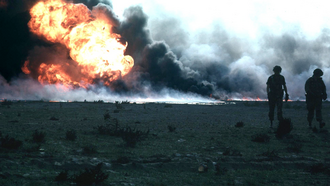
Scientific Counter-Arguments
Other experts, including Dr. S. Fred Singer and Richard D. Small, challenged these catastrophic predictions. Singer argued that the smoke would only reach an altitude of about 3,000 feet (910 m) and would be "rained out" within three to five days, limiting its atmospheric lifetime.
Ultimately, the reality fell closer to Singer's prediction. While the smoke did block significant sunlight locally, it did not reach the stratosphere in quantities sufficient to cause global cooling. Carl Sagan later conceded in his book The Demon-Haunted World that while temperatures dropped 4–6 °C over the Persian Gulf and noon became pitch black, Asia was spared from the predicted disaster.
Regional Environmental Consequences
Although a global nuclear winter was avoided, the regional impact was severe. Smoke plumes generally reached 10,000 feet (3,000 m), occasionally hitting 20,000 feet (6,100 m). Lower atmospheric winds carried this pollution across the eastern Arabian Peninsula, affecting cities like Riyadh and Dhahran, as well as the country of Bahrain, where residents experienced soot-filled skies and carbon fallout.
This led to a dramatic decrease in air quality, causing widespread respiratory problems for people in Kuwait and neighboring nations.
Emission Data and Analysis
Scientific studies provided a detailed look at the chemical output of the fires. A 1992 study by Peter Hobbs and Lawrence Radke revealed the following daily emissions:
- Sulfur dioxide: 57% of the total emissions produced by all electric utilities in the United States (a gas known to generate acid rain).
- Carbon dioxide: 2% of total global emissions.
- Soot: 3,400 metric tons per day.
Further research published in 2000 indicated that combustion efficiency was approximately 96% for carbon dioxide production. Of the remaining fuel, 2% became smoke particulate matter (of which 0.4% was soot), while 2% did not undergo initial combustion.
| Category | Detail/Value |
|---|---|
| Total Wells Ignited | ~700 |
| Daily Oil Loss | 6 million barrels |
| Extinguishment Cost | US$1.5 billion |
| Max Smoke Altitude | 20,000 feet (6,100 m) |
| Daily Soot Emission | 3,400 metric tons |
Frequently Asked Questions
Why were the oil fires so difficult to extinguish?
The primary obstacle was the presence of land mines placed by the Iraqi military around the oil wells. These areas had to be cleared by military teams before firefighting crews could safely access the wells to put out the fires.
Did the fires cause a global nuclear winter?
No. While some scientists, including Carl Sagan, predicted a nuclear winter-like effect with global temperature drops, the smoke did not reach the stratosphere in sufficient quantities. The cooling effects were limited to the Persian Gulf region.
What were the primary health impacts of the fires?
The fires caused a dramatic decrease in regional air quality. The resulting smoke and carbon soot fallout led to respiratory problems for many people in Kuwait and neighboring countries across the Arabian Peninsula.
How much oil was lost during the disaster?
Approximately 6 million barrels (950,000 m³) of oil were lost every single day while the fires burned.
What was the total cost to Kuwait to stop the fires?
Kuwait spent a total of US$1.5 billion to hire privately contracted crews to extinguish the wells.