Korean Independence Movement: The Struggle Against Japanese Rule
The Korean independence movement, often referred to as the Korean Revolution, was a prolonged series of diplomatic and militant efforts aimed at liberating the Korean peninsula from Japanese colonial rule. Spanning from the late 19th century until the surrender of Japan in 1945, this movement encompassed a diverse array of strategies, from peaceful protests and intellectual resistance to guerrilla warfare and targeted assassinations.
Because the Empire of Japan heavily suppressed activism within the peninsula, much of the movement's momentum was sustained abroad. The Korean diaspora, supported by sympathetic non-Koreans, played a critical role in maintaining the fight for sovereignty from exile.
Key Facts
- Duration: Late 19th century to August 15, 1945.
- Catalyst: The 1919 March First Movement served as a major spark for international activism.
- Exile Government: The Provisional Government of the Republic of Korea (KPG) was established in Shanghai in 1919.
- Key Allies: Republican China provided significant support and sanctuary for independence fighters.
- Outcome: Liberation followed Japan's surrender in World War II, though the peninsula was subsequently divided into North and South Korea.
The Path to Colonization
In the mid-19th century, East Asia saw a shift as the West forced Joseon Korea, Tokugawa Japan, and Qing China to abandon their policies of isolationism. Japan modernized rapidly, seeking to establish regional hegemony. After defeating Qing China in the First Sino-Japanese War (1894–1895) and the Russian Empire in the Russo-Japanese War (1904–1905), Japan effectively removed foreign influence from the peninsula.
Japan forced Joseon to sign the unequal Japan–Korea Treaty of 1876, beginning a decades-long process of absorption. By 1905, Korea became a Japanese protectorate, and in 1910, it was formally annexed into the Japanese Empire.
Resistance Before and During Japanese Rule
Early Resistance and the Righteous Armies
Anti-Japanese sentiment manifested early through events like the 1882 Imo Incident and the 1894 Donghak Peasant Rebellion. In 1896, the Independence Club was formed as the first political organization to advocate for independence and a constitutional monarchy. Between 1905 and 1912, volunteer guerrilla forces known as Righteous Armies fought the Japanese military; however, despite the sacrifice of approximately 20,000 volunteers, they could not prevent colonization.
The March First Movement and the KPG
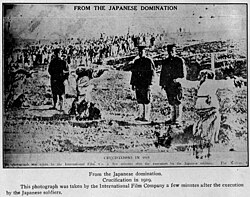
The oppressive nature of colonial rule led to nationwide resistance, culminating in the 1919 March First Movement. While these protests were violently suppressed domestically, they acted as a catalyst for the movement abroad. In April 1919, the Provisional Government of the Republic of Korea (KPG) was founded in Shanghai as a government-in-exile.
Militant Actions and Guerrilla Warfare
Throughout the 1920s, Korean independence units operated in Manchuria, utilizing guerrilla warfare. Notable victories included the Battle of Bongodong (June 1920) and the Battle of Cheongsanri, where combined forces killed roughly 1,500 Japanese soldiers. In retaliation, the Imperial Japanese Army carried out the Gando massacre, killing between 5,000 and tens of thousands of Korean civilians.
World War II and the Road to Liberation
The outbreak of the Pacific War in 1941 shifted the geopolitical landscape. China, as an Ally of World War II, pushed for the recognition of the KPG and Korean independence. This effort led to the Cairo Declaration of 1943, where the Allies agreed that Korea would become independent "in due course."
Despite this agreement, the United States remained skeptical of Korean political unity and initially preferred a trusteeship solution. This ambiguity persisted until the Soviet–Japanese War of 1945, which resulted in a de facto division of the peninsula into Soviet and American zones, eventually forming North and South Korea.
Tactics and Ideologies of the Movement
Resistance took many forms, often fragmented to avoid Japanese surveillance. Militant tactics included high-profile assassinations and bombings, such as An Jung-geun's 1909 killing of Itō Hirobumi and Yun Bong-gil's 1932 bombing in Shanghai.
Intellectual and social resistance also flourished. From 1910 to 1919, the circulation of Korean grammar and spelling textbooks fostered a nationalist consciousness among students. Additionally, economic grievances fueled the movement; between 1911 and 1937, there were over 159,000 labor disputes regarding wages and over 1,000 disputes involving tenant farmers.
Summary of Resistance Groups
| Group Type | Notable Examples | Primary Focus/Role |
|---|---|---|
| Religious | Korean Presbyterian Church, Korean YMCA | Early leadership and spiritual resistance; suffered martyrdoms. |
| Militant | Righteous Army, Korean Volunteer Corps | Guerrilla warfare and direct military confrontation. |
| Expatriate | Korean National Association, Willows Aviation School | Diplomacy, training, and support from the diaspora. |
| Political | Provisional Government of the Republic of Korea (KPG) | Government-in-exile and international diplomatic lobbying. |
Frequently Asked Questions
What was the significance of the March First Movement?
The March First Movement of 1919 was a series of nationwide protests that, while violently suppressed by Japan, served as a critical catalyst for the international independence movement and led to the creation of the Provisional Government of the Republic of Korea in Shanghai.
Who were the Righteous Armies?
The Righteous Armies were volunteer guerrilla forces that fought against Japanese military police and infantry primarily between 1907 and 1918, though some elements continued their resistance until the end of World War II.
How did the Cairo Declaration affect Korea?
The Cairo Declaration of 1943 was a pivotal diplomatic victory where the Allied powers (including the US and China) formally agreed that Korea would eventually achieve independence after the defeat of Japan.
Why was the Korean peninsula divided after liberation?
The division occurred due to the Soviet–Japanese War of 1945, which led to the Red Army occupying the north and the United States occupying the south, creating two distinct zones of influence that eventually became separate states.
What role did religion play in the independence movement?
Christian missionaries and organizations like the Korean Presbyterian Church and the YMCA were active in the movement from the late 19th century, providing leadership and support, often at the cost of severe persecution and martyrdom.