Korea's Names: From Ancient Dynasties to Modern Identities
The names used to describe the Korean Peninsula are far more than simple labels; they are reflections of deep historical shifts, political complexities, and cultural evolution. Depending on the language spoken, the specific region being discussed, or even the political perspective of the speaker, the name for "Korea" can change significantly. From the ancient Samhan confederacies to the modern distinction between Hanguk and Chosŏn, the terminology provides a window into the peninsula's storied past.
The English exonym "Korea" is derived from Goryeo (or Koryŏ), a prominent historical dynasty. While both North and South Korea are referred to as "Korea" in English, the linguistic landscape within the peninsula is divided by the modern geopolitical split.
![The name of Korea was first recorded in Chinese classic Shanhaijing vol.12. As shown in the picture, “Korea is located on the east of Lieyang (列陽, lit. 'Yang side of the Lie River'), south of Haibei Mountains; Lieyang belongs to the state of Yan."[1]](/images/bd/1a/bd1aabe3f3f9a821e690263ab8b179b0832dc6b5ed45eda6e598d81efa4d0f3a.jpg)
Key Facts
- The name "Korea" is an English exonym derived from the Goryeo dynasty.
- In South Korea, the nation is officially known as Hanguk (Republic of Korea).
- In North Korea, the nation is officially known as Chosŏn.
- The nickname "Land of the Morning Calm" was coined by Percival Lowell in 1885.
- Historically, the term Samhan was used to refer to the Three Kingdoms of Korea.
Historical Evolution of Korean Names
Ancient Foundations and the Samhan Era
In ancient times, the term Samhan became synonymous with the Three Kingdoms of Korea starting in the 7th century. Historical records such as the Samguk sagi and Samguk yusa describe how the Silla kingdom implemented a policy of "Samhan Unification" to integrate refugees from the Baekje and Goguryeo kingdoms. By the Goryeo period, Samhan had evolved into a common name used to refer to the entirety of Korea.
This terminology was also recognized by neighboring powers. During the Tang dynasty in China, the Three Kingdoms were collectively called Samhan. Historical documents and epitaphs from this era frequently used the term to describe people from the region, including those of Goguryeo origin.
The Rise of Joseon and Goryeo
The Goryeo period left a lasting mark on the world's perception of the peninsula, as it provided the root for the modern English name. However, in 1392, a new dynasty established by a military coup revived the name Joseon (Chosŏn), drawing inspiration from the ancient state of Gojoseon. While some suggested the name Hwaryeong, the founder, Taejo of Joseon, ultimately chose Joseon.
The name Joseon is often associated with the poetic English nickname, "The Land of the Morning Calm." This phrase was popularized by Percival Lowell in his 1885 book. While "morning calm" and "morning radiance" are common translations, scholars note that "morning freshness" is a more direct interpretation of the original characters.
Modern Usage and Political Nuance
The Divided Peninsula
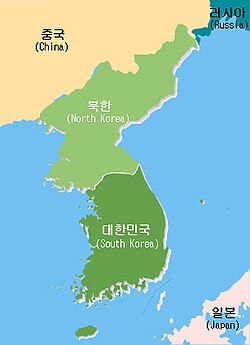
Following the end of World War II in 1945, Korea was divided, leading to the distinct naming conventions used today. In 1948, the South adopted the name Daehanminguk (Republic of Korea). Many South Koreans use this term as a metonym to refer to the entire Korean nation.
In the North, the primary term is Chosŏn. North Koreans also use Namjosŏn (South Chosŏn) and Pukchosŏn (North Chosŏn) to distinguish the two sides. However, a significant shift occurred in January 2024; following North Korean leader Kim Jong Un's decision to stop pursuing reunification, North Korea began referring to South Korea as Hanguk and Daehanminguk instead of Namjosŏn.
International Variations
Naming conventions vary widely across East Asia and beyond:
- Vietnam: People use Triều Tiên for North Korea and Hàn Quốc for South Korea.
- Japan: There has been historical tension regarding the term Kita-Chōsen (North Korea), which some pro-North organizations claim is derogatory. Most Japanese media use the full official title as a compromise.
- Russia and Central Asia: Ethnic Koreans in these regions often refer to themselves as Koryo-saram or Goryeoin.
Spelling Shifts: Korea vs. Corea
In the 19th and early 20th centuries, both Korea and Corea were used in English-speaking countries. While "Corea" was common in 19th-century publications and early Korean postage stamps, the spelling "Korea" became the preferred standard. This shift was influenced by figures like Horace Newton Allen and was officially noted at the 1893 World's Columbian Exhibition, where Korean commissioners stated that while both were correct, "Korea" was preferred.
A popular theory in South Korea suggests that the standardization of "Korea" was an intentional move by Japanese occupiers to ensure "Japan" appeared first alphabetically, though evidence for a deliberate orchestration remains circumstantial.
Summary of Naming Conventions
| Context | Term Used | Notes |
|---|---|---|
| English (General) | Korea | Derived from Goryeo |
| South Korea (Official) | Daehanminguk / Hanguk | Republic of Korea |
| North Korea (Official) | Chosŏn | Used in North Korean context |
| Ancient Era | Samhan | Refers to the Three Kingdoms |
| Vietnamese | Triều Tiên / Hàn Quốc | Refers to North / South |
Frequently Asked Questions
Where does the name "Korea" come from?
The name "Korea" is an English exonym derived from Goryeo, a historical Korean dynasty.
What is the difference between Hanguk and Chosŏn?
Hanguk is the term used in South Korea to refer to the nation, while Chosŏn is the term used in North Korea.
Why was the spelling "Corea" used in the past?
Both "Korea" and "Corea" were used in the 19th century. "Corea" was common in early English publications and stamps, but "Korea" eventually became the preferred international standard.
What does "Land of the Morning Calm" mean?
It is a poetic nickname for Korea, coined by Percival Lowell in 1885, based on interpretations of the hanja for Joseon.
How do North Koreans refer to South Korea now?
As of January 2024, North Korea has begun referring to South Korea as Hanguk or Daehanminguk, moving away from the previous term Namjosŏn.