Kokstad and East Griqualand: A History of Migration and Settlement
The story of Kokstad is one of resilience, displacement, and the complex intersection of diverse cultures in South Africa. From the migration of the Griqua people across the rugged Drakensberg mountains to the establishment of a bustling municipality, the region known as East Griqualand has a rich tapestry of historical events that shaped its modern identity.
The Griqua Migration and the Search for a Homeland
The origins of the settlement date back to 1820, when the Griqua tribe in Griquatown, located in central South Africa, experienced a split. Under the leadership of Adam Kok III—a descendant of the cook who originally established the tribe—one section of the population first migrated to Philippolis in the southern Free State.
By 1861, escalating tensions with the Voortrekkers (Dutch settlers who moved north of the Orange River to avoid British law) forced several hundred Griquas to seek a new home. The Voortrekkers had secured leases on Griqua land but frequently refused to return it upon the lease's expiration. This land dispute was notably central to the controversy surrounding the Big Hole of Kimberley.
To escape this confrontation, the Griquas embarked on a grueling journey across the Drakensberg mountains via the Ongeluks Nek. They entered a region previously devastated by the Zulu King Shaka, which was then referred to as "Nomansland." The journey took eighteen months, leaving the people exhausted and most of their livestock dead.
Upon settling, Adam Kok renamed the territory East Griqualand. The settlers named their primary mountain Mount Currie in honor of Sir Walter Currie, who had supported their settlement efforts.
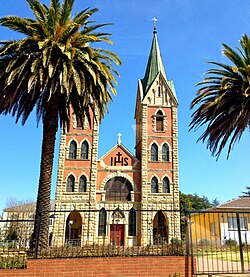
Establishing the Community of Kokstad
In the early days of East Griqualand, every male Griqua settler was granted a farm of 3,000 acres (approximately 1,200 hectares). However, many settlers sold these lands cheaply to white colonists and quickly spent their earnings. This period of land loss was documented in detail by the Rev William Dower in his 1902 publication, The Early Annals of Kokstad.
In 1869, the Griqua requested that Reverend William Dower establish a mission. Dower agreed to the request on the condition that the community resettle in a more suitable location on the banks of the Mzimhlava river, laying the groundwork for the town's growth.
Economic Development and Indigenous Currency
The early development of Kokstad was significantly influenced by European settlers George Brisley and Donald Strachan. Their business, Strachan and Co, became a cornerstone of the local economy. In 1874, they introduced one of South Africa's first indigenous currencies: a set of trade tokens. These tokens circulated across a vast region roughly the size of Ireland, a fact confirmed by the managing director of Strachan and Co and the local Standard Bank at Kokstad.
Political Transition and Urban Growth
The administrative status of the region shifted in 1878 when East Griqualand was incorporated into the Cape Colony. During this era, the town saw an influx of diverse entrepreneurs, including an African-American settler who opened the town's first hotel, The Royal, and founded the Kokstad Advertiser newspaper in 1881.
Kokstad officially became a municipality in 1892. By 1904, the population had reached 2,903, with Griquas making up one-third of the residents. In 1978, the town was transferred to the Natal province. Today, Kokstad has grown into a significant center with a population exceeding 50,000 people.
Key Facts
- Founder: Adam Kok III led the Griqua migration to the region.
- Land Grants: Original Griqua male settlers were granted 3,000-acre farms.
- Currency: Strachan and Co introduced trade tokens in 1874 that circulated over an area the size of Ireland.
- Administrative Shifts: The area moved from the Cape Colony (1878) to Natal province (1978).
- Population Growth: Increased from 2,903 in 1904 to over 50,000 today.
| Year | Event | Significance |
|---|---|---|
| 1861 | Migration across Drakensberg | Establishment of East Griqualand |
| 1869 | Mission establishment | Resettlement on the Mzimhlava river |
| 1874 | Introduction of trade tokens | First indigenous currency in the region |
| 1878 | Annexation by Cape Colony | Shift in political administration |
| 1892 | Municipal status | Official recognition as a municipality |
| 1978 | Transfer to Natal | Change in provincial jurisdiction |
Frequently Asked Questions
Why did the Griqua people move to East Griqualand?
The Griquas moved to avoid growing confrontations with the Voortrekkers, who had occupied Griqua land through leases and then refused to return the property.
Who was Adam Kok III?
Adam Kok III was the leader of the Griqua section that migrated from Philippolis across the Drakensberg mountains to establish East Griqualand.
What was unique about the currency used in early Kokstad?
In 1874, the trading store Strachan and Co introduced trade tokens, which served as an indigenous currency circulating across a region the size of Ireland.
What was "Nomansland"?
Nomansland was the name given to the region where the Griquas settled, as it had been previously devastated by the Zulu King Shaka.
How has the population of Kokstad changed over time?
The population grew from 2,903 residents in 1904 (one-third of whom were Griquas) to more than 50,000 people today.