Knorkator: The Chaotic World of Germany's Most Band
Hailing from Berlin, Knorkator is far from your typical musical act. Blending the crushing weight of heavy metal with an absurdist sense of humor, they have carved out a unique niche in the German music scene. Eschewing the traditional pursuit of being the "best," the group cheekily proclaims themselves to be "Germany's most band in the world" (Deutschlands meiste Band der Welt), a nod to the fact that the title of "best" was already claimed by the famous band Die Ärzte.
The name itself is a play on the word knorke, a dated Berlin and Ruhr basin slang term meaning "great" or "fabulous," effectively personifying the adjective into a band identity. Since their inception in 1994, Knorkator has evolved from a local Berlin/Brandenburg act into a notorious force of comedic industrial metal.
Key Facts
- Origin: Berlin, Germany.
- Genres: Heavy metal, Neue Deutsche Härte (a style of industrial metal), and comedy rock.
- Active Years: 1994–2008 and 2011–present.
- Core Style: Industrial metal with bombastic choruses and humorous, often explicit lyrics.
- Notoriety: Known for chaotic live shows involving instrument destruction and audience interaction.
Musical Style and Artistic Approach
Musically, Knorkator aligns with the industrial metal sound, drawing comparisons to acts like Ministry and White Zombie. Their compositions typically feature crushing guitars and subtle samplers, often escalating into falsetto vocals and over-the-top anthemic choruses. While their technical and artistic merit is significant, it is frequently overshadowed by the band's commitment to comedy.
Their lyrical content is predominantly in German and is known for being humorous and occasionally explicit. However, the band is linguistically adventurous, incorporating English, Thai, Latin, and French into their songs. Their track "Wir werden alle sterben" ("We're all going to die") has even been translated into Arabic. Additionally, the band often creates extreme covers of well-known hit songs in English.
The Spectacle of Live Performances
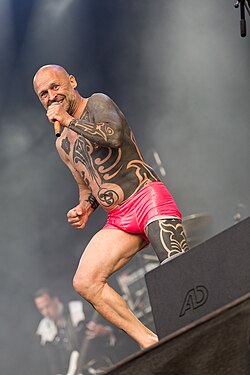
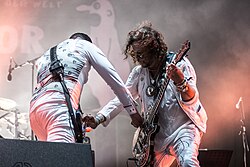
A Knorkator concert is less of a recital and more of a chaotic event. The band's visual identity is equally eccentric: singer Stumpen is known for having half of his body tattooed black and performing in minimal clothing, such as women's bathing suits or goofy underpants. Guitarist Buzz Dee is often noted for his resemblance to Big Jim Martin.
The stage shows are legendary for their unpredictability. Keyboardist Alf Ator has been known to attack the audience with foam clubs or throw toast and wet autumn leaves. The band has even utilized modified shredders to blast "vegetarian airway-catering" (shredded fruits and vegetables) over the crowd.
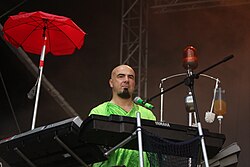
Destruction is a central theme of their performance. Alf Ator frequently deconstructs electronic organs using toilet brushes, while Stumpen is known for smashing television sets. This penchant for destruction once resulted in a glass splinter becoming lodged in Stumpen's thigh, which required surgery and was later auctioned online. The band also engages the crowd in extreme activities, including "Wall of Death" maneuvers, piggyback moshing, and surfing their overweight sound engineer from the mixing desk to the stage.
Band History and Evolution
After gaining notoriety in 2000 during the German national qualification for the Eurovision Song Contest with the song "Ick wer zun Schwein," the band continued to build their following. However, in June 2008, they announced their breakup via MySpace, citing Alf Ator's desire to move to Thailand. This hiatus lasted until 2010, when Stumpen announced a reunion.
The band returned in 2011 with the "77 minutes tour," where a digital countdown clock on stage ensured the set lasted exactly 77 minutes. This was followed by the release of the album Es werde Nicht, a pun on the phrase "Let there be light."
The "We Want Mohr" Controversy
In 2014, the band faced backlash over their album We Want Mohr. The title uses a dated German term for Black people. The accompanying promotional poster, which reenacted a scene from the 19th-century children's book Struwwelpeter, was condemned as racist and degrading by the Initiative Schwarze Menschen in Deutschland (ISD). While the band stopped using the poster, they maintained that the content was "profoundly anti-racist" and refused to change the album cover.
Band Overview
| Category | Details |
|---|---|
| Current Members | Gero Ivers (Stumpen), Alexander Thomas (Alf Ator), Sebastian Baur (Buzz Dee), Rajko Gohlke, Philipp Schwab |
| Key Labels | Tubareckorz, Nuclear Blast |
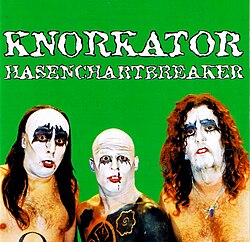
| Notable Albums | Hasenchartbreaker (1999), Ich hasse Musik (2003), Es werde Nicht (2011), Sieg der Vernunft (2022) |
| Literary Works | Various books and comics published by Eulenspiegel-Verlag |
Frequently Asked Questions
What does the name Knorkator mean?
The name is a personification of the word "knorke," which is an old-fashioned slang term used in Berlin and the Ruhr region meaning "great" or "fabulous."
Why did Knorkator break up in 2008?
The official reason for the band's split in 2008 was that keyboardist Alf Ator wanted to leave Germany to start a new life in Thailand.
What is the "77 minutes tour"?
It was the band's 2011 reunion tour where the setlist was strictly timed to be exactly 77 minutes long, monitored by a digital countdown clock on stage.
What languages are used in Knorkator's lyrics?
While most of their songs are in German, they have also recorded lyrics in English, Thai, Latin, French, and Arabic.
What happened during the "We Want Mohr" controversy?
The band was accused of racism due to a promotional poster reenacting a scene from Struwwelpeter. They eventually stopped using the poster but defended the album cover as being anti-racist.