King Arthur: From Post-Roman Warrior to Global Legend
King Arthur remains one of the most enduring figures in Western culture. Known as a legendary king of Britain, he serves as the central pillar of the Matter of Britain, a vast body of medieval literary traditions. While he is often remembered as a chivalrous monarch in a shining castle, his origins are rooted in the misty landscape of post-Roman Britain, where he evolved from a folk hero into a symbol of national identity and romantic idealism.
Key Facts
- Origins: First appears in early medieval Welsh sources like the Annales Cambriae and Historia Brittonum.
- Historicity: Most historians do not consider him a real historical figure, as early sources date to 300 years after his supposed life.
- Key Literary Influence: Geoffrey of Monmouth's 12th-century Historia Regum Britanniae transformed him into a world-conquering king.
- French Contribution: Chrétien de Troyes introduced the concepts of Lancelot and the Holy Grail, creating the Arthurian romance genre.
- Core Elements: Famous motifs include the sword Excalibur, the magician Merlin, and the mystical isle of Avalon.
The Early Welsh Traditions
Before he was a king of a grand court, Arthur was portrayed in Welsh sources as a leader of the post-Roman Britons. In these early accounts, he fought against the Anglo-Saxons during the late 5th and early 6th centuries. He appears in early poetic works such as Y Gododdin, where he is depicted as a formidable warrior defending Britain from both human invaders and supernatural threats.
In these early myths, Arthur was sometimes linked to Annwn, the Welsh otherworld, blending the lines between a military leader and a magical figure of folklore.
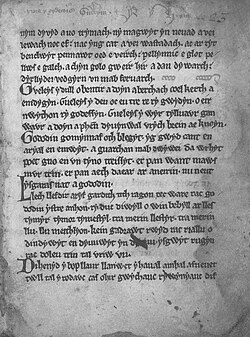
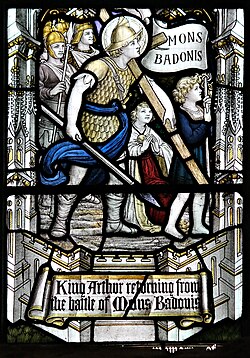
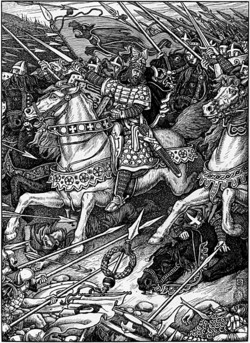
Early depictions often focus on his military prowess, such as his leadership during the Battle of Mount Badon, a pivotal clash against Saxon forces.
The Influence of Geoffrey of Monmouth
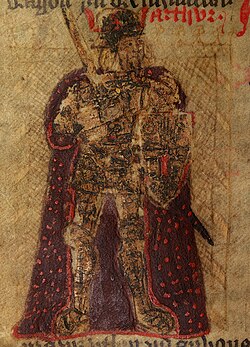
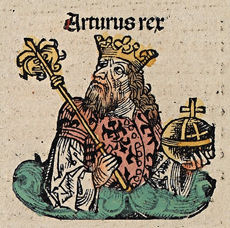
The transition of Arthur from a local Welsh hero to an international icon occurred largely due to Geoffrey of Monmouth. In the 12th century, Geoffrey wrote the Historia Regum Britanniae (History of the Kings of Britain), a highly imaginative work that presented Arthur as a king who established a vast empire.
Geoffrey introduced many of the elements that define the modern legend, including:
- Uther Pendragon: Arthur's father.
- Merlin: The legendary magician.
- Guinevere: Arthur's queen.
- Excalibur: The legendary sword.
- Tintagel: The site of Arthur's conception.
- Camlann: The site of his final battle against Mordred.
The Rise of Arthurian Romance
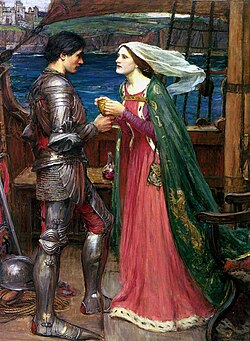
Following Geoffrey, the French writer Chrétien de Troyes expanded the narrative in the 12th century. He shifted the focus from Arthur's military conquests to the personal adventures and moral dilemmas of his knights, effectively inventing the Arthurian romance. This era introduced the quest for the Holy Grail and the tragic love triangle involving Lancelot and Guinevere.
As these stories grew in popularity, the narrative focus often drifted away from King Arthur himself, centering instead on the various Knights of the Round Table and their individual trials.
![The Round Table experiences a vision of the Holy Grail, an illumination by Évrard d'Espinques (c. 1475)[108]](/images/e2/20/e22032dcd736b1bd437024d0c84b1a695b0846771926354aa7cbc1ef443c260c.jpg)
The Evolution of Symbols
Over time, specific motifs became synonymous with the legend. The image of Arthur drawing a sword from a stone, popularized in Robert de Boron's 13th-century Merlin, became a powerful symbol of divine right and destiny.
![The story of Arthur drawing the sword from a stone appeared in Robert de Boron's 13th-century Merlin. By Howard Pyle (1903)[99]](/images/f2/90/f2907eb2d06b4bb8cc87e11bec9f8036e1374c03022b41cbc2c6030a996ba98a.jpg)
Legacy and Modern Interpretations
The legend of Arthur has survived through centuries of decline and revival. From the late medieval works of Thomas Malory to the Victorian poetry of Alfred Lord Tennyson, each era has reshaped Arthur to fit its own values. In the modern age, the legend persists in everything from serious historical inquiries to satirical adaptations like Spamalot.
![Tapestry showing Arthur as one of the Nine Worthies, wearing a coat of arms often attributed to him.[1] c. 1385](/images/b7/1c/b71c17f004afbebda925c8eb68a3218a965b54de8a63b6268350e2687e3d545a.webp)
![Culhwch entering Arthur's court in the Welsh tale Culhwch and Olwen. An illustration by Alfred Fredericks for an 1881 edition of the Mabinogion[64]](/images/9d/0c/9d0c76f88e821415dc43fb2226a8f7ddfb16c816fd1af883ee559ec4b3212639.jpg)

Whether viewed as a symbol of lost British glory or a blueprint for chivalry, Arthur continues to capture the imagination of audiences worldwide.
| Period/Source | Primary Focus | Key Contributions |
|---|---|---|
| Early Welsh Sources | Post-Roman Warfare | Warrior leader, battles against Saxons, folklore ties. |
| Geoffrey of Monmouth | Imperial Kingship | Merlin, Uther Pendragon, Excalibur, Avalon. |
| French Romances | Chivalry and Quest | Lancelot, the Holy Grail, Knights of the Round Table. |
| Modern Era | Cultural Symbolism | Victorian revival, cinematic and theatrical adaptations. |
Frequently Asked Questions
Was King Arthur a real person?
Most historians do not consider him a historical figure. While he appears in early sources like the Annales Cambriae, these were written roughly 300 years after the period he is said to have lived in, suggesting he is a legendary or composite figure.
Who first introduced the Holy Grail to the legend?
The 12th-century French writer Chrétien de Troyes is credited with adding the Holy Grail and the character of Lancelot to the Arthurian tradition, moving the stories toward the genre of romance.
What is the "Matter of Britain"?
The Matter of Britain is the collective term for the medieval literary tradition centered on King Arthur and the legendary history of Britain.
Where is Avalon in the legend?
Avalon is depicted as a mystical isle where King Arthur was taken to find final rest and healing after his last battle at Camlann.
What is the significance of the sword Excalibur?
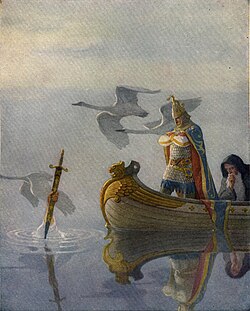
Excalibur is Arthur's legendary sword, symbolizing his authority and power as the rightful king of Britain, though its origins vary between the "sword in the stone" and a gift from the Lady of the Lake.