Kimberley: The Diamond City of the Northern Cape
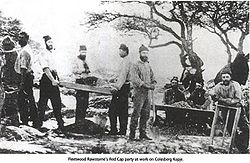
Located in the heart of South Africa's Northern Cape province, Kimberley (known in Khoekhoe as ǃ’Ās) is a city defined by its glittering geological history and its resilience through political upheaval. Established on July 5, 1873, the city grew from a chaotic rush of prospectors into a sophisticated administrative hub and the capital of the Northern Cape.
The city's identity is inextricably linked to the discovery of diamonds, which transformed a quiet landscape into a global center of mining and commerce. Today, Kimberley balances its rich heritage with modern educational and governmental infrastructure.
Key Facts
- Established: July 5, 1873.
- Primary Industry: Historically centered on diamond mining.
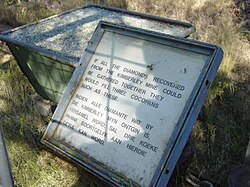
- The Big Hole: A massive hand-dug excavation yielding 2,722 kg of diamonds.
- Administrative Role: Capital of the Northern Cape Province.
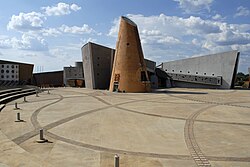
- Notable Institution: Home to Sol Plaatje University.
- Elevation: 1,184 meters (3,885 feet) above sea level.
The Diamond Rush and the Big Hole
The rise of Kimberley was fueled by the discovery of kimberlite pipes—volcanic structures containing diamond-bearing "blue ground" situated beneath yellow soil. As thousands of miners arrived, they excavated the earth with picks and shovels, eventually creating the iconic Big Hole (or Kimberley se Gat).
From mid-July 1871 to 1914, approximately 50,000 miners worked the site. The Big Hole covers 17 hectares (42 acres) and reaches a width of 463 meters. While it was originally excavated to a depth of 240 meters, debris and a 40-meter deep pool of water now leave 175 meters visible. Beneath the surface, mining extended to a depth of 1,097 meters.
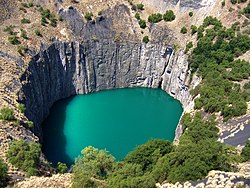
While the Big Hole is the most famous, four other major holes were dug, including Dutoitspan, Wesselton, and Bultfontein. The influence of De Beers was pivotal in the amalgamation and management of these mines, though most closed by 2005.
War and Political Evolution
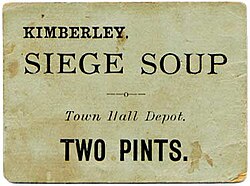
Kimberley played a significant role during the Second Boer War. On October 14, 1899, the city was besieged, enduring a blockade until February 15, 1900. Following the conflict, the British established a concentration camp in the city to house Boer women and children.
During the apartheid era, the city remained a site of political tension and activism. Notable figures like Benny Alexander (later known as Khoisan X), general secretary of the Pan Africanist Congress, grew up in the city. Following the end of apartheid in 1994, Kimberley became the capital of the newly formed Northern Cape Province, leading to significant urban development and the construction of the Northern Cape Legislature to bridge previously divided areas of the city.
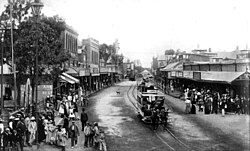
Economy, Transport, and Infrastructure
Historically, Kimberley was a pioneer in aviation. In 1913, South Africa's first aviation school, Paterson's Aviation Syndicate School of Flying, was established here to train pilots for the South African Aviation Corps (SAAC). By the 1930s, the city possessed the best night-landing facilities in Africa.
Road and rail networks developed rapidly to support the diamond fields. While the N1 highway now bypasses the city via Bloemfontein, Kimberley was once the primary axis for British colonial expansion into the north, serving as the starting point for the Pioneer Column to Rhodesia in 1890.
Modern Kimberley: Education and Culture
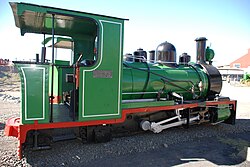
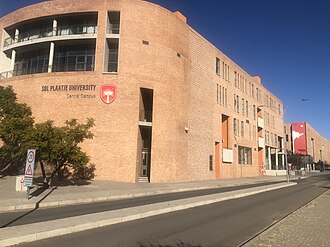
Today, the city is a center for higher learning, anchored by Sol Plaatje University. The city also maintains a diverse cultural landscape with museums such as the Alexander McGregor Memorial Museum and the Transport Spoornet Museum.
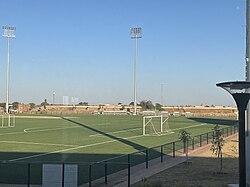
Sports are a vital part of local life. The Griquas rugby team is a point of pride, having won the Currie Cup four times (1899, 1911, 1970, and 2025). The city also has a history of world-class athletics, including swimming records set by Karen Muir and hosting the Maloof Money Cup World Skateboarding Championships in 2011 and 2012.
Geography and Climate
Kimberley experiences a climate characterized by significant temperature swings and moderate annual precipitation. It is known for hot summers and cold winters, with record lows reaching -9.9°C.
| Metric | Summer (Jan) | Winter (Jul) | Annual Average |
|---|---|---|---|
| Mean Daily Max Temp | 32.7°C | 22.2°C | - |
| Mean Daily Min Temp | 17.3°C | 1.4°C | 10.0°C |
| Average Precipitation | 72.9 mm | 2.6 mm | 404.3 mm |
| Sunshine Hours | 291.1 | 278.7 | 3,360 |
City Landmarks
- Government: The provincial legislature is located in the Galeshewe township.
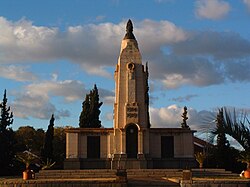
- Memorials: The Sol Plaatje Statue and the World War I memorial.
- Architecture: The Neo-classical Kimberley City Hall and the Old School of Mines.
Frequently Asked Questions
What is the Big Hole in Kimberley?
The Big Hole is a massive open-pit mine created by hand between 1871 and 1914. It is one of the most famous landmarks in South Africa and yielded over 2,700 kg of diamonds.
Who is Sol Plaatje?
Sol Plaatje was a prominent intellectual and co-founder of the African National Congress. The city's university and a major statue at the Civic Centre are named in his honor.
What is the significance of the Griquas rugby team?
The Griquas are the local professional rugby team and have a storied history, winning the Currie Cup four times.
How did the Second Boer War affect Kimberley?
Kimberley was the site of a significant siege from October 1899 to February 1900, and later served as the location for a British concentration camp for Boer women and children.
What is kimberlite?
Kimberlite is a type of volcanic rock that often contains diamonds. The city of Kimberley is named after these diamond-bearing pipes.