Kansai International Airport: A Masterpiece of Engineering in Osaka Bay
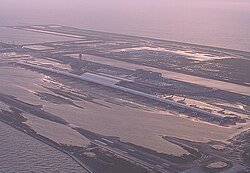
Located in the heart of Osaka Prefecture, Kansai International Airport (KIX) stands as a testament to modern engineering and global connectivity. Built on a massive artificial island in Osaka Bay, this airport serves as a vital gateway for the Keihanshin region, connecting travelers to destinations across Asia, Europe, North America, and beyond. Since its opening in 1994, it has evolved into a major international hub, known for its unique architecture and 24-hour operational capabilities.
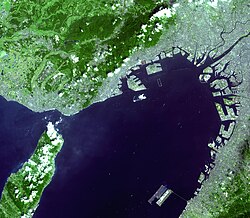
Key Facts
- IATA Code: KIX
- Opened: 4 September 1994
- Location: Osaka Prefecture (Izumisano, Sennan, & Tajiri)
- Type: Public international airport
- Key Hubs: All Nippon Airways, Japan Airlines, FedEx Express
- Runways: Two asphalt runways (3,500m and 4,000m)
Engineering and Construction History
The creation of Kansai International Airport was a monumental task involving extensive land reclamation—the process of creating new land from the sea. The total cost of construction, including the terminals and two runways, reached approximately $20 billion by 2008. One of the most significant challenges faced by engineers was the sinking of the artificial island due to the soft soil of Osaka Bay.
Designers anticipated this settlement, and while the sink rate was initially 50 cm (20 in) per year in 1994, it slowed to 7 cm (3 in) per year by 2008. This ongoing management of the island's elevation is a critical aspect of the airport's maintenance.
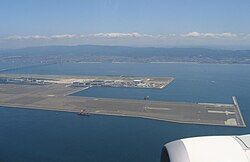
Runway Specifications
To accommodate a wide variety of aircraft, from regional jets to heavy cargo planes, the airport features two primary asphalt runways:
- 06R/24L: 3,500 meters (11,483 ft)
- 06L/24R: 4,000 meters (13,123 ft)
The second runway, measuring 4,000 m × 60 m, was officially opened on 2 August 2007.
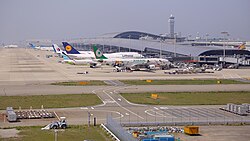
Airport Terminals and Layout
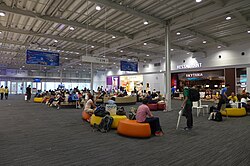
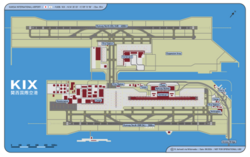
Kansai International Airport utilizes a multi-terminal system to manage its high volume of passengers and diverse airline requirements.
Terminal 1
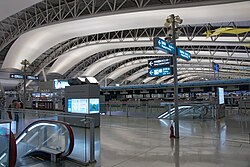
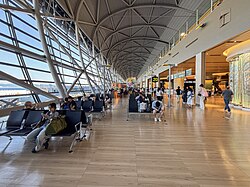
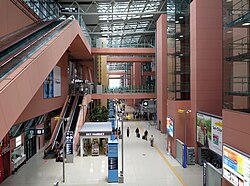
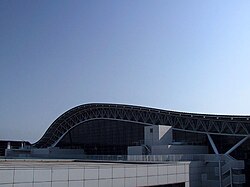
Terminal 1 is the primary facility, featuring a distinctive airfoil roof design. This terminal handles the majority of international and domestic traffic. The interior is designed for efficiency, featuring large boarding lobbies and extensive shopping and dining options.

Terminal 2
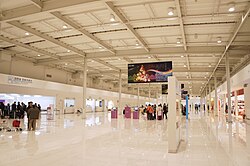
Specifically designed to accommodate Low-Cost Carriers (LCCs), Terminal 2 provides a streamlined experience for budget-conscious travelers. It offers essential services and dedicated departure areas for airlines like Peach and Jetstar Japan.
Resilience and Recovery
The airport has demonstrated remarkable resilience in the face of natural disasters. In 2018, Typhoon Jebi caused significant damage, including flooding and damage to the Sky Gate Bridge R, which connects the airport to the mainland. Following extensive repairs to the rail lines and bridge, regular operations resumed fully by April 2019, ensuring the airport's continued role as a vital transport link.
Statistical Overview
In the calendar year 2025, the airport saw significant activity, reflecting its status as a major Asian hub. The following table summarizes the key performance indicators for the airport.
| Category | Volume/Movement | Growth/Change |
|---|---|---|
| Total Passenger Movements | 34,102,723 | +11% |
| International Passenger Movements | 27,531,416 | +15% |
| Aircraft Movements | 212,224 | +10% |
| Total Freight Volume (tonnes) | 786,814 | +4% |
| International Freight Volume (tonnes) | 777,780 | +4% |
Frequently Asked Questions
Is Kansai International Airport open 24 hours?
Yes, Kansai International Airport was the first airport in Japan to operate 24 hours a day, a feature it has maintained since its opening in 1994.
How do I get to the airport from Osaka?
The airport is accessible via rail services, including the Kansai Airport Line and the Nankai Airport Line, as well as by bus services.
What is the difference between Terminal 1 and Terminal 2?
Terminal 1 is the main terminal for most full-service airlines, while Terminal 2 is a dedicated facility primarily used by Low-Cost Carriers (LCCs).
Is the airport built on land?
No, the airport is built on an artificial island created through land reclamation in Osaka Bay.
Which airlines use KIX as a hub?
Major airlines using the airport as a hub include All Nippon Airways (ANA), Japan Airlines (JAL), and FedEx Express.