Kamehameha I: The Unifier of the Hawaiian Islands
Known to history as Kamehameha the Great, Kamehameha I was the visionary conqueror and first official ruler of the unified Kingdom of Hawaii. Through a combination of military brilliance and political strategy, he transformed a collection of warring chiefdoms into a single, sovereign nation. His legacy remains a cornerstone of Hawaiian identity, symbolized today by his presence in the National Statuary Hall Collection in Washington, D.C.
Born as Paiʻea, his journey from a young warrior to the supreme ruler of the islands is a saga of ambition and endurance. His reign established the House of Kamehameha, a dynasty that would lead the islands through a period of intense global contact and transformation.
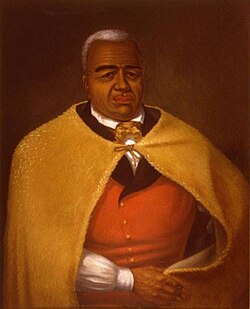
Key Facts

- Full Name: Kalani Paiʻea Wohi o Kaleikini Kealiʻikui Kamehameha o ʻIolani i Kaiwikapu kauʻi Ka Liholiho Kūnuiākea.
- Reign: Ruled as King of the Hawaiian Islands from 1795 until his death in May 1819.
- Achievement: First ruler to unify the Hawaiian Islands into a single kingdom.
- Predecessor: Served as Aliʻi nui (supreme chief) of Hawaii Island from 1782 to 1795 before becoming King.
- Successor: Succeeded by his son, Kamehameha II (Liholiho).
Early Life and Origins
Birth and Paternity
The exact date of Kamehameha's birth is a subject of historical debate. Records suggest he was born between 1736 and 1761 in Kapakai, Kohala, on the island of Hawaiʻi. Some historians, such as Ralph Simpson Kuykendall, narrow this window to 1748–1761. While an early dating of 1758 was once popular—partly because it coincided with the appearance of Halley's Comet—modern analysis suggests this may be too late, as it would conflict with his early years as a warrior and the timing of his first children.
Family Lineage
Kamehameha was born into a high-ranking lineage. His father was Keōua Kalanikupuapaʻīkalaninui Ahilapalapa, and his mother was Kekuʻiapoiwa II. His family connections provided him with the social standing necessary to claim leadership, though his path to power was fraught with conflict and the need for strategic concealment during his youth.
The Conquest of the Islands
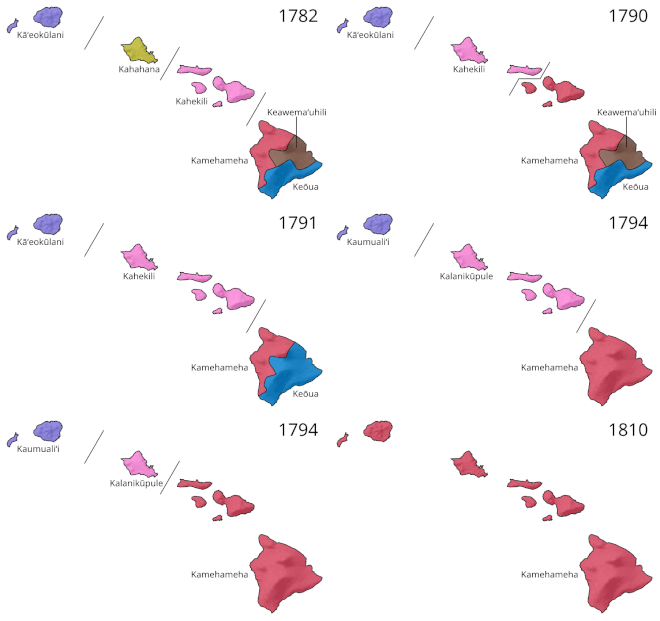
Kamehameha's rise to power was marked by a series of decisive military campaigns. He began by consolidating power on the island of Hawaiʻi, eventually becoming the Aliʻi nui in 1782. From this power base, he launched an ambitious campaign to bring the other islands under his control.
His conquests included the invasion of Maui and the strategic capture of Oʻahu. These campaigns were not merely about force; they involved complex alliances and the navigation of internal rebellions, such as the uprising of Nāmakehā on Kauaʻi. By 1795, he had established himself as the primary authority over the majority of the archipelago.
Divine and Political Authority
Kamehameha's authority was bolstered by both political legitimacy and spiritual symbols. One such symbol was the feather sculpture of the god Kūkaʻilimoku, a powerful deity of war, which was passed to him by his uncle, Kalaniʻōpuʻu.

Later Reign and Diplomacy
After achieving unification, Kamehameha transitioned from a conqueror to a statesman. He managed the Kingdom's interactions with foreign powers, including Russian naval expeditions and European traders. His ability to balance traditional Hawaiian customs with the pressures of Western influence helped stabilize the new kingdom.
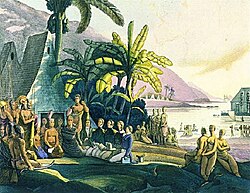
His later years were spent governing the unified islands and ensuring a stable succession for his children. He died in May 1819 at Kamakahonu in Kailua-Kona, leaving behind a legacy of unity that would persist through the subsequent Kamehameha monarchs.
Summary of Kamehameha I's Life
| Attribute | Details |
|---|---|
| Birth Range | c. 1736 – c. 1761 |
| Death Date | May 8 or 14, 1819 |
| Primary Title | King of the Hawaiian Islands |
| Reign as King | 1795 – 1819 |
| Parents | Keōua and Kekuʻiapoiwa II |
| Notable Successor | Liholiho (Kamehameha II) |
Frequently Asked Questions
When was Kamehameha I born?
Historical accounts vary, but his birth is generally placed between 1736 and 1761. Some historians suggest a date closer to 1748, while others have previously cited 1758.
How did Kamehameha I unify the islands?
He used a combination of military conquest, strategic alliances, and political maneuvering to bring the islands of Hawaiʻi, Maui, and Oʻahu under his rule, eventually establishing the Kingdom of Hawaii.
Who succeeded Kamehameha I?
He was succeeded by his son, Liholiho, who became known as Kamehameha II.
What was the significance of the god Kūkaʻilimoku?
Kūkaʻilimoku was the god of war. A feather sculpture of this deity was left to Kamehameha I by his uncle Kalaniʻōpuʻu, serving as a symbol of spiritual power and authority during his conquests.
Where is Kamehameha I's legacy visible today?
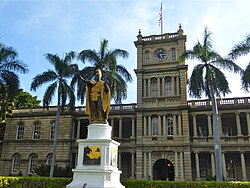
His legacy is honored through various statues, including one in the National Statuary Hall Collection in Washington, D.C., and the prominent statue at Aliʻiōlani Hale in Honolulu.