Johnson Solids: Naming Conventions and Geometric Construction
The Johnson solids are a distinct group of convex polyhedra that are neither Platonic solids (regular polyhedra with identical faces) nor Archimedean solids (semi-regular polyhedra). Because of their variety, the naming of these solids follows a flexible yet precise descriptive formula. This system allows a single solid to be described in multiple ways while maintaining absolute geometric accuracy.
Key Facts
- Total Count: There are 92 distinct Johnson solids.
- Construction Methods: They are created through the combination of pyramids, cupolas, and rotundas, or by modifying existing uniform polyhedra.
- Exclusions: Solids that result in coplanar faces, or those that are already classified as Platonic or Archimedean, are excluded from the Johnson list.
- Naming Logic: Prefixes like ortho-, gyro-, and elongated describe exactly how components are joined.
Pyramids, Cupolas, and Rotundas
The first 48 Johnson solids are constructed by combining basic building blocks—pyramids, cupolas (a dome-like structure with a polygon base), or rotundas (a similar structure with a pentagonal base)—with prisms or antiprisms. To describe these combinations, specific prefixes are used:
- Bi-: Indicates two copies of a solid joined base-to-base.
- Ortho-: Used for cupolas and rotundas when like faces meet.
- Gyro-: Used for cupolas and rotundas when unlike faces meet.
- Elongated: Indicates a prism is joined to the base or inserted between two bases.
- Gyroelongated: Indicates an antiprism is joined to the base or inserted between two bases.
For example, a pentagonal bipyramid is formed by attaching two pentagonal pyramids at their bases, while a triangular orthobicupola consists of two triangular cupolas joined along their bases.
| Prefix | Geometric Meaning | Example Solid |
|---|---|---|
| Bi- | Two solids joined base-to-base | Pentagonal bipyramid |
| Ortho- | Like faces meet | Triangular orthobicupola |
| Gyro- | Unlike faces meet | Square gyrobicupola |
| Elongated | Prism added to base(s) | Elongated square pyramid |
| Gyroelongated | Antiprism added to base(s) | Gyroelongated pentagonal pyramid |
Modified Uniform Polyhedra
The next 35 Johnson solids (numbers 49 through 83) are created by modifying uniform polyhedra, such as prisms, Platonic solids, or Archimedean solids. These modifications involve adding, removing, or rotating specific components:
- Augmented: A pyramid or cupola is added to one or more faces.
- Diminished: A pyramid or cupola is removed from one or more faces.
- Gyrate: A cupola is rotated so that different edges match up.
For larger solids, these operations can be repeated. The prefixes Bi- and Tri- indicate double or triple operations. Additionally, the orientation of the altered faces is specified: Para- indicates the altered faces are parallel, while Meta- indicates they are oblique. An example of this is a parabiaugmented solid, where two parallel faces have been augmented.
Non Cut-and-Paste Solids
The final nine Johnson solids (84 through 92) are assembled from specific polygon complexes rather than by modifying existing polyhedra. These are defined by unique nomenclature:
Lune Complexes
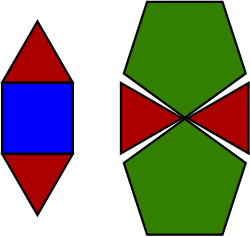
A lune is a figure consisting of two triangles attached to opposite sides of a square. Complexes of lunes are named as follows:
- Spheno-: A wedgelike complex of two adjacent lunes.
- Dispheno-: Two spheno-complexes.
- Hebespheno-: A blunt complex of three adjacent lunes.
Triangle and Rotunda Complexes
Certain suffixes describe crownlike or belt-like arrangements of triangles:
- -corona: A crownlike complex of eight triangles.
- -megacorona: A larger crownlike complex of twelve triangles.
- -cingulum: A belt of twelve triangles.
- -rotunda: A complex of two or three pentagons with triangles between them, resembling a pentagonal rotunda.
Frequently Asked Questions
What is the difference between an orthobicupola and a gyrobicupola?
The difference lies in the alignment of the faces. In an orthobicupola, the like faces of the two cupolas meet, whereas in a gyrobicupola, the unlike faces meet due to a rotation of one cupola relative to the other.
What does it mean for a Johnson solid to be "augmented"?
Augmentation occurs when a pyramid or cupola is added to one or more faces of a base solid, such as a prism or a Platonic solid, increasing the overall complexity of the shape.
What is a lune in the context of polyhedra?
A lune is a specific geometric building block consisting of a square with two triangles attached to its opposite sides.
How do "para-" and "meta-" prefixes differ in naming?
These prefixes describe the spatial relationship between modified faces on a solid. "Para-" means the modified faces are parallel to each other, while "meta-" means they are oblique (not parallel).