John C. Stennis: A Legacy of Senate Power and Controversy
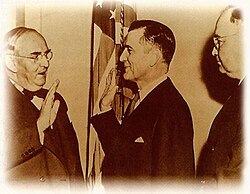
John C. Stennis was a towering figure in the United States Senate, serving Mississippi for decades with a career defined by immense institutional power, a deep commitment to national defense, and a contentious record on civil rights. From his entry into the Senate in 1947 to his tenure as President pro tempore, Stennis navigated the complexities of the Cold War and the social upheavals of the mid-20th century.
Key Facts
- Senate Tenure: Served from 1947 until the late 1980s, including 31 years as Mississippi's junior senator.
- Leadership Roles: Chaired the Armed Services, Appropriations, and Select Committee on Standards and Conduct.
- Defense Legacy: A primary architect of U.S. military spending and strategic arms treaties.
- Civil Rights: An ardent supporter of racial segregation who opposed the landmark Civil Rights and Voting Rights Acts of the 1960s.
- Honors: The nuclear-powered aircraft carrier CVN-74 was named the USS John C. Stennis in his honor.
Early Senate Career and Institutional Influence
Stennis entered the U.S. Senate in 1947 after winning a special election to fill the vacancy left by Senator Theodore Bilbo. He secured a full term in 1952 and was subsequently re-elected five more times. For 31 years, he served alongside James Eastland, forming what was then the longest-serving Senate duo in American history.
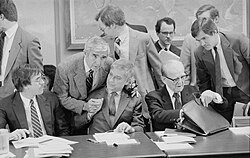
Beyond his seniority, Stennis was instrumental in shaping the internal governance of the Senate. He wrote the first Senate ethics code and served as the first chairman of the Senate Ethics Committee. His influence extended to high-profile disciplinary matters, such as the 1954 condemnation of Senator Joseph McCarthy and the 1967 misconduct charges against Senator Edward V. Long.
National Defense and Cold War Strategy
Stennis was a central figure in U.S. military policy during the Cold War. He focused heavily on the speed of production for intercontinental missiles and supported the development of the PGM-17 Thor. His commitment to military strength was evident in his advocacy for nuclear-powered aircraft carriers and his role on subcommittees studying naval expansion.
The Vietnam War and Foreign Policy
During the Vietnam War, Stennis's positions evolved. In 1967, he advocated for expanded bombing in North Vietnam to hasten the war's end. By 1969, he proposed dividing South Vietnam into two zones to facilitate a U.S. exit strategy. Following his recovery from gunshot injuries in 1973, he called for legislation to prevent the President from restoring troops in Vietnam without congressional approval.
In the realm of strategic arms, Stennis was a key player in the Strategic Arms Limitation Treaty (SALT) negotiations. While he sought to stabilize global tensions through SALT II, he often balanced this with a demand for robust defense appropriations to maintain the "muscle of America's military."
The Panama Canal and Arms Control
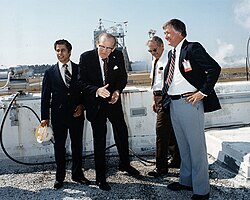
Stennis provided critical leadership in resolving the difficult issues surrounding the Panama Canal Act of 1979, earning praise from President Jimmy Carter. Despite his influence, his authority was occasionally challenged, as seen when he eventually yielded to pressure from treaty opponents regarding a report on the nuclear arms treaty with the Soviet Union.
Civil Rights and Social Conflict
Stennis's legislative record reflects a staunch adherence to racial segregation. He signed the Southern Manifesto of 1956 and voted against both the Civil Rights Act of 1964 and the Voting Rights Act of 1965. This occurred during a period when Mississippi had the highest percentage of Black citizens of any state (42%).
In the 1970s, Stennis attempted to challenge what he viewed as a "double standard" in school integration. He sponsored measures to ensure that Northern schools, which remained segregated due to residential patterns, were held to the same integration standards as Southern schools. While he later supported the 1982 extension of the Voting Rights Act and campaigned for Mike Espy—the first Black Congressman from Mississippi since Reconstruction—he continued to oppose measures like the establishment of Martin Luther King, Jr. Day as a federal holiday.
Final Years and Presidential Recognition
In his later years, Stennis faced significant health challenges, including the loss of his left leg to cancer in 1984, which necessitated the use of a wheelchair. Despite this, he remained active in the Senate, serving as President pro tempore from 1987 to 1989.
His career culminated in a high-profile tribute in June 1988. During a dinner in his honor, President Ronald Reagan praised his public service and announced that the Navy's next nuclear-powered aircraft carrier, CVN-74, would be named the USS John C. Stennis.
| Category | Key Details |
|---|---|
| Years of Service | 1947 – Late 1980s |
| Major Committees | Armed Services, Appropriations, Senate Ethics |
| Key Defense Focus | ICBMs, Nuclear Carriers, SALT II Treaty |
| Civil Rights Stance | Opposed 1964/1965 Acts; supported 1982 Voting Rights extension |
| Highest Office | President pro tempore (1987–1989) |
Frequently Asked Questions
What was Stennis's role in the U.S. Senate's ethics rules?
Stennis wrote the first Senate ethics code and served as the first chairman of the Senate Ethics Committee, establishing the framework for misconduct charges and standards of conduct within the chamber.
How did Stennis view the integration of schools in the North?
Stennis argued that there was a double standard where Southern schools were forced to integrate or lose federal aid, while Northern schools remained segregated due to residential patterns. He sponsored legislation to enforce desegregation in those Northern areas.
What was Stennis's position on the Vietnam War?
His positions shifted over time; he initially advocated for expanded bombing to end the war quickly and later supported legislation to limit the President's power to commit troops to foreign hostilities without congressional consent.
Which major civil rights legislation did Stennis oppose?
Stennis voted against the Civil Rights Act of 1964 and the Voting Rights Act of 1965, and he signed the Southern Manifesto of 1956 to block or delay such legislation.
How was Stennis honored by the U.S. government?
President Ronald Reagan announced in 1988 that the Navy's nuclear-powered aircraft carrier CVN-74 would be named the USS John C. Stennis in recognition of his long career of public service.