Jewish Star: A History of Legal Battles and Ethical Crusades
The Jewish Star, a prominent Chicago-based publication, has frequently found itself at the center of significant legal and ethical disputes. From fighting for the right to distribute newspapers on public streets to challenging journalistic malpractice and advocating for religious freedom in housing, the publication has played a pivotal role in defending First Amendment rights and community standards in Illinois.
First Amendment Rights and Newspaper Distribution
Following World War II, the U.S. Supreme Court recognized the right of newspapers to distribute single copies via news boxes on public streets, a precedent solidified in the 1988 case City of Lakewood v. Plain Dealer Publishing Co. In March 1991, the Jewish Star became the only Chicago Jewish newspaper to utilize its own street-corner news boxes—also known as news racks, honor boxes, or vending machines—for free distribution.
Conflict arose in January 1992 when Mayor Richard M. Daley's administration launched a beautification program. While Chicago previously had no permit requirements for news boxes, the city pressured publishers to re-align their boxes along North Michigan Avenue. The Jewish Star soon reported mysterious damage to its equipment. Despite city denials that any employee was authorized to move the boxes, the Jewish Star conducted surveillance to uncover the truth.
On the night of June 22, 1994, the publication captured photographic evidence of a City of Chicago Streets and Sanitation employee using bolt cutters to remove a legally positioned news box at the corner of Michigan Avenue and Adams Street.

The Jewish Star sought support from the American Civil Liberties Union (ACLU), the Illinois Press Association, a state senator, and local aldermen. Although the city initially denied the claims, the evidence led to a resolution. After an incident in September 1994 where a news box on the near north side was blown up, the city eventually paid $1,600 in damages to the publication.
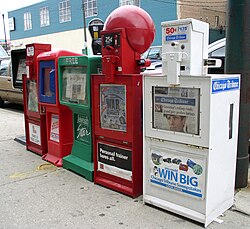
In subsequent years, the city implemented ordinances restricting news box placement. The Jewish Star criticized the Daley administration for viewing these essential distribution tools as mere "visual clutter" and lamented that other publishers did not fight the restrictions on First Amendment grounds.
Journalistic Ethics and Industry Accountability
Beyond legal battles with the city, the Jewish Star has actively challenged unethical behavior within the Jewish press. In March 1995, Editor Douglas Wertheimer submitted a detailed complaint to the Ethics Committee of the American Jewish Press Association (AJPA), alleging plagiarism and circulation falsification by two other Chicago publications: the Chicago Jewish News and The Sentinel.
The AJPA Ethics Committee upheld the claims in August 1995, issuing the following findings:
- Chicago Jewish News: Censured for a pattern of failing to obtain permission or properly credit sources.
- The Sentinel: Found to have claimed circulation figures substantially higher than its official records.
While the editors of the accused papers dismissed the charges as "absurd" or "underhanded," the Jewish Star pursued the matter further. Wertheimer filed a complaint with the Illinois Attorney General's Consumer Fraud Bureau regarding The Sentinel. Consequently, in December 1995, The Sentinel paid $1,000 to the state to cover investigative costs as part of an assurance of voluntary compliance regarding the Illinois Consumer Fraud and Deceptive Business Practices Act.
This controversy led the AJPA to amend its by-laws in December 1995 to more clearly define and address such journalistic violations.
Legislation Affecting the Jewish Community
The Jewish Star also utilized its reporting to influence legislation regarding the mezuzah (a parchment scroll enclosed in a decorative case and affixed to doorposts). In 2004, Jewish residents at Shoreline Towers Condominium in Chicago faced demands from the association to remove all exterior objects, including mezuzot.
Detailed reporting by the Jewish Star in July 2005 caught the attention of local lawmakers. Alderman Burton Natarus quickly drafted an ordinance amending the Chicago Municipal Code to prohibit condo associations from banning mezuzot on exterior doorposts. Similarly, Illinois State Senator Ira Silverstein introduced a state bill to prevent such restrictions, which became law in January 2007.
The legal battle with Shoreline Towers continued, resulting in several legal milestones: the Jewish Star successfully defended its records against a subpoena, an Illinois law against intimidating lawsuits was applied for the first time, and a Federal Appeals Court ruled that the Fair Housing Act prohibits discrimination occurring after homeowners have occupied a dwelling.
Key Facts
- Legal Precedent: The right to use street news boxes was upheld by the Supreme Court in City of Lakewood v. Plain Dealer Publishing Co. (1988).
- City Conflict: The Jewish Star proved the City of Chicago illegally removed news boxes via photographic evidence in 1994.
- Ethics Victory: The AJPA censured the Chicago Jewish News for plagiarism and The Sentinel for circulation fraud.
- Legislative Impact: Reporting by the Jewish Star led to both Chicago city and Illinois state laws protecting the right to affix mezuzot to condo doorposts.
- Financial Settlement: The City of Chicago paid $1,600 to the Jewish Star for damages to its news boxes.
| Issue | Opposing Party | Outcome | Key Result |
|---|---|---|---|
| News Box Removal | City of Chicago | Settlement | $1,600 payment to Jewish Star |
| Journalistic Fraud | The Sentinel / Chicago Jewish News | AJPA Censure | AJPA by-law amendments |
| Mezuzah Bans | Condo Associations | Legislation | City and State laws protecting mezuzot |
| Circulation Claims | The Sentinel | State Compliance | $1,000 payment to Illinois State |
Other Notable Controversies
The publication has also provided coverage on a wide array of sensitive community and political issues, including:
- The expulsion of five students from the Ida Crown Jewish Academy.
- The Chicago Jewish Federation's legal pursuit of the Sol Goldstein estate for an unpaid pledge.
- The presence of a Nazi-looted Edgar Degas painting at the Art Institute of Chicago.
- A whistleblower lawsuit by surgeon Raymond Pollak against Chicago-area hospitals.
- The city of Chicago's alleged sponsorship of anti-Israel activities during Arab Heritage Month.
- Jewel-Osco's aggressive expansion into the kosher food market.
Frequently Asked Questions
Why did the Jewish Star fight the City of Chicago over news boxes?
The publication fought the city because employees of the Streets and Sanitation department were illegally removing or damaging news boxes, which the Jewish Star argued was a violation of First Amendment distribution rights.
What were the ethics complaints against the other Jewish newspapers?
The Chicago Jewish News was accused of a pattern of plagiarism (failing to credit sources), and The Sentinel was accused of falsifying its circulation figures to appear larger than it was.
How did the Jewish Star help protect the use of mezuzot?
Through detailed reporting on condo associations banning mezuzot, the paper prompted Alderman Burton Natarus and Senator Ira Silverstein to pass city and state laws prohibiting such bans on exterior doorposts.
What was the result of the Consumer Fraud Bureau complaint?
The Sentinel entered into an assurance of voluntary compliance with the State of Illinois and paid $1,000 to cover the costs of the investigation into its deceptive circulation claims.
Did the Fair Housing Act play a role in the condo disputes?
Yes, a Federal Appeals Court determined that the Fair Housing Act can prohibit discrimination that occurs even after homeowners have already occupied their dwellings.