Jean-Baptiste Lamarck and the Philosophy of Zoological Evolution
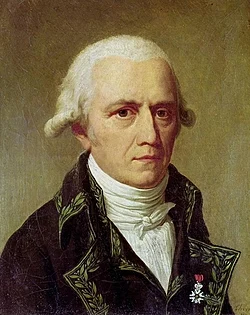
Long before Charles Darwin published his groundbreaking work on natural selection, a French naturalist named Jean-Baptiste Lamarck (1744–1829) was already challenging the static view of nature. A member of the French Academy of Sciences and a professor at the Muséum national d'Histoire naturelle, Lamarck is best remembered for his early theories on how species change over time to survive in their environments.
In 1809, Lamarck published Philosophie zoologique (Zoological Philosophy), a seminal text that outlined his vision of evolution. While his specific mechanisms were later contested, his work established the critical idea that species are not fixed entities but are subject to continuous modification.
Key Facts
- Author: Jean-Baptiste Lamarck, a pioneer in invertebrate taxonomy.
- Core Work: Philosophie zoologique, published in 1809 in France.
- Central Theory: Known as Lamarckism, it proposes that organisms acquire traits based on environmental needs.
- Mechanism: Based on two laws: the law of use and disuse, and the inheritance of acquired characteristics.
- Legacy: Recognized by Charles Darwin as a significant forerunner to the theory of evolution.
The Mechanics of Lamarckism
Lamarck proposed that animals adapt to their surroundings through two primary laws. The first is the law of use and disuse, which suggests that if an animal uses a particular organ or body part frequently, that part will grow or strengthen. Conversely, if a part is not used, it will shrink or disappear over several generations.
The second law is the inheritance of acquired characteristics. Lamarck asserted that these physical changes—acquired during an individual's lifetime due to environmental pressure—could be passed down to their offspring. Together, these laws imply that species are in a state of constant adaptation, forming a branching series of evolutionary paths.
Speciation and the Tree of Life
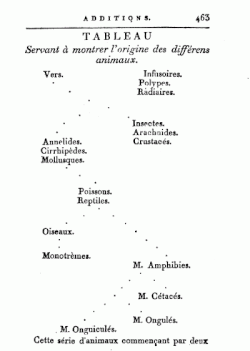
Lamarck described speciation (the formation of new and distinct species) as a result of individuals being transported to new environments. Once submitted to different influences, these individuals assume new forms, eventually constituting a new species. He viewed this process as a branching series, arguing that gaps in the fossil record were simply the result of extinct intermediate forms.
Foundational Beliefs and Complexity
Unlike Darwin, Lamarck did not believe all living things shared a single common ancestor. Instead, he proposed spontaneous generation, the idea that simple life forms are created continuously. He believed an innate life force, which he described as a "nervous fluid," drove these organisms to become more complex over time, moving up a linear ladder of complexity.
| Concept | Lamarck's View |
|---|---|
| Driver of Change | Environmental conditions and the "nervous fluid" |
| Mechanism | Use/Disuse and Inheritance of acquired traits |
| Origin of Life | Continuous spontaneous generation of simple forms |
| Pattern | Branching paths moving toward greater complexity |
Scientific Reception and Criticism
During his lifetime, Lamarck's ideas were largely ignored or rejected by the French scientific establishment, most notably by the zoologist Georges Cuvier. However, his work gained more traction abroad. While Charles Darwin acknowledged Lamarck as an important precursor, other 19th-century scientists were more critical.
The geologist Charles Lyell argued that Lamarck lacked evidence for the development of entirely new functions, noting that he only proved that the size and strength of existing parts could change. Lyell famously mocked the idea that webbed feet in otters or beavers were created because the animals "stretched out" their toes to swim. Later, Thomas Henry Huxley dismissed much of Lamarck's work as obsolete or erroneous when compared to the advancements in histology and embryology of the late 1800s.
Frequently Asked Questions
What is the main difference between Lamarckism and Darwinism?
Lamarckism proposes that organisms change their traits during their lifetime based on use or disuse and pass those acquired traits to offspring. Darwinism proposes that individuals with naturally occurring advantageous traits are more likely to survive and reproduce (natural selection).
What was Lamarck's example of a vestigial structure?
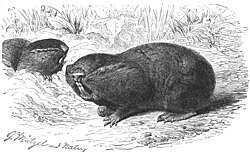
Lamarck pointed to the blind mole rat (Spalax), noting that because it lives underground and does not use its sight, the organ has diminished to a vestige covered by skin.
Did Lamarck believe in a common ancestor for all life?
No. Lamarck believed that simple life forms were continuously created through spontaneous generation and then evolved independently toward greater complexity.
How did Charles Lyell criticize Lamarck's theory?
Lyell argued that Lamarck's theory relied on "fictions" rather than induction, claiming that behavior does not determine the physical form of an animal, but rather the animal's form enables its behavior.
What was the "nervous fluid" in Lamarck's theory?
The nervous fluid was an innate life force that Lamarck believed drove species to evolve toward higher levels of complexity over time.