Japanese Rock: The Evolution of J-Rock from Group Sounds to Global Stages
Japanese rock, commonly known as J-rock, is a vibrant and diverse musical genre that has evolved from Western adaptations into a global cultural phenomenon. From the early days of English-lyric bands to the theatrical spectacle of Visual Kei and the viral success of Kawaii metal, J-rock has consistently pushed the boundaries of sound and style.
The genre's journey began in the 1960s, heavily influenced by American and British rock. While early acts mirrored Western trends, the 1970s saw a pivotal shift when the folk rock band Happy End became the first to perform rock music using the Japanese language, paving the way for a distinct national identity in rock music.
Key Facts
- B'z is the best-selling artist in Japan, with over 86 million confirmed records sold.
- Happy End is credited as the first rock band to sing in the Japanese language in the early 1970s.
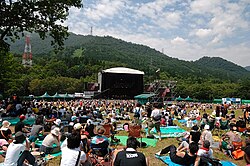
- Fuji Rock Festival is the largest outdoor music event in Japan, with peak attendances of 200,000 people.
- L'Arc-en-Ciel was the first Japanese act to headline Madison Square Garden in 2012.
- Babymetal achieved significant international success, becoming the first Japanese act to headline London's Wembley Arena.
The 1960s: The Era of Group Sounds
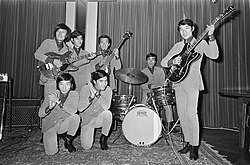
During the 1960s, Japan experienced a phenomenon known as Group Sounds (G.S.). These bands were deeply influenced by the Beatles, the Rolling Stones, Bob Dylan, and genres like psychedelic rock and mod. Most G.S. lyrics were written in English to emulate their Western idols.
Popular acts of this era included The Tigers—the most successful band of the period—alongside The Tempters, the Golden Cups, and the Spiders. This era eventually led to the creation of Pyg, Japan's first rock supergroup, formed by members of The Tigers, The Tempters, and the Spiders.
Diversification in the 1970s and 1980s
Hard Rock and Heavy Metal
The 1970s marked the birth of Japanese heavy metal. The Flower Travellin' Band, led by Yuya Uchida, released Satori in 1971, an album now regarded as a progenitor of heavy metal and doom metal. By the late 70s, pioneers like Bow Wow, 44 Magnum, and Earthshaker emerged. Bow Wow notably supported Aerosmith and Kiss during their Japanese tours in 1977.
The 1980s saw the rise of Loudness, formed in 1981. They became the first Japanese metal act signed to a major US label (Atco Records), with albums like Thunder in the East charting on the Billboard charts. The era also featured all-female bands such as Show-Ya, whose album Outerlimits reached number 3 on the Oricon chart in 1989.

Electronic and Folk Rock
Experimentation with electronic rock began in the early 1970s, led by Isao Tomita. His 1972 album Electric Samurai: Switched on Rock utilized synthesizers to reinterpret rock and pop. This movement influenced Haruomi Hosono, who later founded the influential techno-pop group Yellow Magic Orchestra in 1977.
The Rise of the Band Boom and Visual Kei
The Band Boom
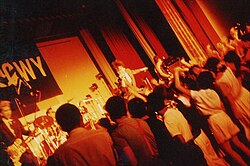
In the 1980s, the "Band Boom" (Bando Būmu) encouraged a surge in the formation of rock groups, inspired by acts like Boøwy. This period saw the emergence of alternative rock bands such as Shonen Knife, who gained the admiration of Nirvana's Kurt Cobain, leading to a US tour collaboration in 1991.
Visual Kei
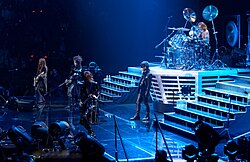
Visual Kei is a movement characterized by elaborate costumes, striking makeup, and theatrical performances, drawing influence from Western glam rock. Pioneered by bands like X Japan, Buck-Tick, and Dead End, the movement reached mainstream heights in the late 80s and 90s.
X Japan became a powerhouse of the genre; their album Jealousy (1991) sold over 1 million copies. Other successful Visual Kei acts included Luna Sea, Glay, and L'Arc-en-Ciel, who dominated the charts throughout the 1990s.
Mainstream Dominance and the Festival Era
The 1990s and 2000s saw J-rock reach its commercial peak. B'z and Mr. Children became some of the best-selling music acts in Japanese history. B'z specifically holds the record as the best-selling artist in Japan and was the first Asian band inducted into Hollywood's RockWalk.
The landscape shifted toward large-scale events with the launch of the Fuji Rock Festival in 1997, followed by the Rising Sun Rock Festival (1999), Summer Sonic (2000), and Rock in Japan Festival (2000).
During this time, the influence of anime on music sales grew, and new successful bands like Bump of Chicken, Asian Kung-Fu Generation, and ONE OK ROCK emerged. Additionally, the all-female band Scandal gained global recognition, eventually earning a Guinness World Record in 2023 as the longest-running all-female rock band with its original founding members.
![L'Arc-en-Ciel performing at Madison Square Garden in 2012, the first Japanese act to headline the venue[49]](/images/c3/f6/c3f6638ce250997f1bd297351a85b115b804b5e1ee996b1c2d70e0a51a4a8fb5.jpg)
Modern Trends and Global Recognition
In the 2010s, J-rock expanded its international footprint. One OK Rock sold out major arenas across Asia, and the slap-guitarist Miyavi performed hundreds of concerts worldwide. The decade also witnessed the "Girls Metal Band Boom," initiated by Aldious and furthered by bands like Cyntia.
One of the most viral exports was Babymetal, who pioneered "kawaii metal" (a fusion of idol pop and heavy metal). They opened for Lady Gaga in 2014 and became the first Japanese act to headline Wembley Arena in 2016.

| Era/Movement | Key Characteristics | Notable Artists |
|---|---|---|
| Group Sounds (1960s) | Western influence, English lyrics | The Tigers, The Spiders |
| Early Metal (1970s-80s) | Hard rock, Doom metal roots | Flower Travellin' Band, Loudness |
| Visual Kei (1980s-90s) | Theatrical makeup and costumes | X Japan, L'Arc-en-Ciel, Buck-Tick |
| Modern/Global (2000s-Present) | Festival culture, Kawaii metal | ONE OK ROCK, Babymetal, Scandal |
Frequently Asked Questions
What is Visual Kei?
Visual Kei is a Japanese rock movement that emphasizes striking visual aesthetics, including elaborate costumes and makeup, influenced by Western glam rock and glam metal.
Who was the first Japanese rock band to sing in Japanese?
The folk rock band Happy End is credited as the first to sing rock music in the Japanese language in the early 1970s.
What is "Kawaii Metal"?
Kawaii metal is a fusion genre that combines the aesthetics and sound of Japanese idol pop with heavy metal, most famously popularized by the group Babymetal.
Which Japanese rock band has the highest sales?
B'z is the best-selling artist in Japan, with confirmed sales of over 86 million records.
What is the significance of the Fuji Rock Festival?
Launched in 1997, it is the largest outdoor music event in Japan, with peak attendances reaching 200,000 people per festival.