ISMN: The Global Standard for Printed Music Identification
In the world of music publishing, precision is essential for cataloging, distribution, and archiving. The International Standard Music Number (ISMN), governed by the ISO 10957 standard, serves as a unique thirteen-character alphanumeric identifier specifically designed for printed music. By providing a universal language for identifying musical scores, the ISMN ensures that publishers, libraries, and musicians can locate specific editions of works without ambiguity.
The Evolution of the ISMN
The concept of a standardized music number originated from the UK Branch of the International Association of Music Libraries, Archives and Documentation Centres (IAML). The initial proposal was spearheaded by Alan Pope of Blackwell's Music Department in Oxford, along with music librarians Malcolm Lewis from Nottingham and Malcolm Jones from Birmingham.
The path to international standardization began at the 1987 IAML conference in Amsterdam, where a draft structure was first presented. Following further deliberations at the 1989 IAML conference in Oxford, the UK, French, and German branches collaborated through their national standards bodies—BSI, AFNOR, and DIN—to submit the ISMN as an official ISO work project. After a series of meetings in Ottawa and Paris in 1993, the ISO finalized and published the standard.
Technical Structure and Format
The ISMN has undergone a significant transition in its formatting to align with global commercial standards. Originally, the identifier consisted of four elements: a distinguishing prefix "M", a publisher ID, an item ID, and a check digit (for example, M-2306-7118-7).
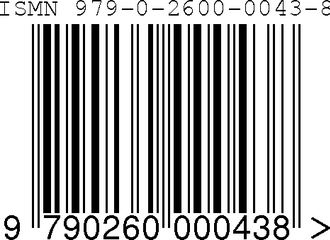
Effective January 1, 2008, the format was updated to a thirteen-digit identifier starting with the prefix 979-0. In this new system, the zero replaced the original "M". This change made the ISMN identical to its EAN-13 number, which is the standard 13-digit barcode used globally for retail products. The 979 Unique Country Code prefix is colloquially referred to as "Musicland".
Current Composition
The modern ISMN is managed by TC 46/SC 9 and is divided into four distinct blocks:
- Prefix: The 979-0 sequence reserved for ISMNs (though it is expected that ISMNs may eventually occupy the rest of the 979 space, which is currently shared with ISBNs).
- Publisher Identifier: A block that uniquely identifies the publishing entity.
- Item Identifier: A block that identifies the specific musical work or edition.
- Check Digit: A final digit used to verify the accuracy of the number.
Comparing ISMN and ISBN
While both the ISMN and the ISBN (International Standard Book Number) are used for printed materials, they serve different primary purposes. A single publication may be assigned both an ISBN and an ISMN if it meets the criteria for both a book and a piece of printed music.
A key technical difference is that the ISMN does not segregate publishers by country, whereas the ISBN system traditionally incorporates geographic or language-group identifiers.
| Feature | ISMN | ISBN |
|---|---|---|
| Primary Use | Printed Music | Books/Monographs |
| ISO Standard | ISO 10957 | ISO 2108 |
| Prefix | 979-0 ("Musicland") | 978 or 979 |
| Country Segregation | No | Yes |
Key Facts
- The ISMN is defined by the ISO 10957 standard.
- It is a 13-digit identifier that matches the EAN-13 barcode format.
- The current prefix for all ISMNs is 979-0.
- Unlike ISBNs, ISMNs do not categorize publishers by their country of origin.
- The standard is currently maintained by TC 46/SC 9.
Frequently Asked Questions
What is the difference between an ISMN and an ISBN?
The ISMN is specifically for printed music, while the ISBN is for books. While a publication can have both, the ISMN does not use country-based segregation for publishers, unlike the ISBN.
When did the ISMN change to the 13-digit format?
The transition to the thirteen-digit identifier beginning with 979-0 took place on January 1, 2008.
What is "Musicland" in the context of ISMN?
"Musicland" is the nickname for the 979 Unique Country Code prefix used to identify ISMNs.
Who was responsible for the original proposal of the ISMN?
The proposal was made by the UK Branch of the IAML, specifically by Alan Pope, Malcolm Lewis, and Malcolm Jones.
Can a piece of music have both an ISBN and an ISMN?
Yes, a publication may be assigned both identifiers if it qualifies as both a book and a printed music score.