Islamic Republic of Iran Political Structure and Governance
The political system of the Islamic Republic of Iran is a complex framework that blends democratic elements with a strict theocratic hierarchy. At its core, the system is governed by the Constitution of the Islamic Republic of Iran, which establishes a unique balance of power between elected officials and appointed religious authorities.
Central to this structure is the concept of the Guardianship of the Islamic Jurist (Velayat-e Faqih), which grants ultimate authority to a high-ranking religious scholar to ensure the state adheres to Islamic law.
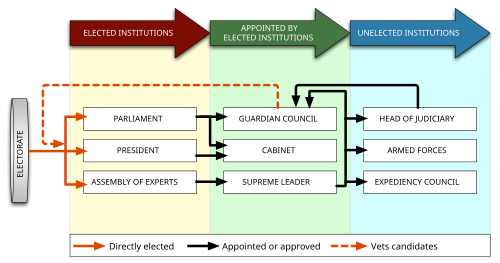
Key Facts
- Supreme Leader: The highest authority and commander-in-chief, holding a life tenure post.
- Assembly of Experts: A body of 88 Mujtahids (Islamic legal scholars) responsible for electing and removing the Supreme Leader.
- Legislature: Comprised of the Islamic Consultative Assembly (lower house) and the Guardian Council (upper house).
- President: The head of government, elected by popular vote for a maximum of two four-year terms.
- Guardian Council: A 12-member body that ensures all legislation is compatible with Islam and the Constitution.
The Supreme Leadership
Established by Article 5 of the Constitution, the Supreme Leader (officially the Supreme Leadership Authority) is the most powerful figure in the state. According to Article 110, the Supreme Leader defines the general policies of the republic and serves as the commander-in-chief of the Armed Forces. Under Article 57, the executive, legislative, and judicial branches all operate under the Supreme Leader's superintendence.
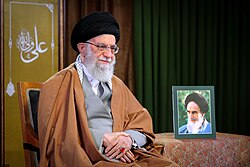
The position is held for life. The Islamic Republic has been led by three individuals: Ayatollah Ruhollah Khomeini (1979–1989), Ayatollah Ali Khamenei (1989–2026), and Mojtaba Khamenei, who assumed the role following his father's assassination.
The Assembly of Experts
The Assembly of Experts is a deliberative body consisting of 88 Mujtahids—scholars capable of independent legal reasoning. Members are elected by direct public vote every eight years. Their primary constitutional duties, outlined in Articles 107, 109, and 111, are to elect and, if necessary, remove the Supreme Leader. The Sixth Assembly of Experts convened on May 21, 2024, with Mohammad-Ali Movahedi Kermani serving as chairman.
The Legislative Branch
The legislature is divided into two distinct bodies: the Islamic Consultative Assembly and the Guardian Council.
Islamic Consultative Assembly
This is the primary legislative body, consisting of representatives elected directly by the people via secret ballot. While the Constitution originally set the membership at 270, it allows for increases of up to 20 members every ten years. Currently, the assembly consists of 290 representatives. This body has the authority to establish laws on all matters within its constitutional competence.
The Guardian Council
Acting as an upper house, the Guardian Council reviews all legislation passed by the Consultative Assembly to ensure it aligns with the Constitution and Islamic principles. It consists of 12 members: six faqihs (Islamic jurists) appointed by the Supreme Leader, and six jurists elected by the Consultative Assembly from a list nominated by the Chief Justice.
The Executive and Judicial Branches
The executive branch is led by the President, who serves as the head of government. While the President is the highest nominally popularly elected official, they answer directly to the Supreme Leader, who remains the head of state.
The President is elected for a four-year term and is limited to two consecutive terms (eight years total). Key responsibilities include administering the national budget, signing international treaties, and appointing ministers subject to parliamentary approval.
The Judicial System
The judiciary is an independent power tasked with protecting the rights of individuals and society. According to Article 156, its duties include resolving litigation, prosecuting crimes, enforcing the Islamic penal code, and taking measures to reform criminals and prevent future offenses.
Other Governing Institutions
Expediency Discernment Council
Created in 1988, this administrative assembly is appointed by the Supreme Leader every five years. While its original purpose under Article 112 was to resolve conflicts between the Consultative Assembly and the Guardian Council, it primarily serves as an advisory body to the Supreme Leader. Sadiq Amoli Larijani currently serves as chairman.
Local Councils
To facilitate local development and public welfare, Iran utilizes a system of village, division, city, municipality, and provincial councils. These members are elected locally to supervise administration while maintaining national unity and the sovereignty of the central government.
Islamic Republic of Iran Broadcasting (IRIB)
The IRIB is the sole provider of radio and television services in the country. The head of the IRIB is appointed and dismissed by the Supreme Leader, with supervision provided by a council representing the President, the judiciary, and the Consultative Assembly.
| Institution | Role | Selection Method | Key Authority |
|---|---|---|---|
| Supreme Leader | Head of State / Commander-in-Chief | Appointed/Life Tenure | Ultimate Authority |
| Assembly of Experts | Elects/Removes Supreme Leader | Direct Election (8 years) | Theocratic Oversight |
| Consultative Assembly | Primary Lawmaking | Direct Election | Legislative Power |
| Guardian Council | Constitutional/Islamic Review | Mixed Appointment/Election | Veto Power |
| President | Head of Government | Direct Election (4 years) | Executive Administration |
Frequently Asked Questions
Who holds the ultimate power in Iran?
The Supreme Leader holds the ultimate power, serving as the head of state and commander-in-chief, with the authority to oversee the executive, legislative, and judicial branches.
How is the Supreme Leader chosen?
The Supreme Leader is elected and can be removed by the Assembly of Experts, a body of 88 Mujtahids elected by the public.
What is the role of the Guardian Council?
The Guardian Council acts as a check on the legislature, reviewing all laws passed by the Islamic Consultative Assembly to ensure they are compatible with the Constitution and Islamic law.
Can the President of Iran serve indefinitely?
No. According to Article 114, the President is elected for a four-year term and may not serve more than two consecutive terms or more than eight years in total.
What does the Expediency Discernment Council do?
While originally designed to resolve disputes between the Guardian Council and the Consultative Assembly, it now functions primarily as an advisory body to the Supreme Leader.