ISBN: The Global Standard for Book Identification
The International Standard Book Number (ISBN) is a unique numeric commercial book identifier used worldwide. Managed by the International ISBN Agency, this system ensures that every published edition of a book can be identified without ambiguity, facilitating efficient inventory management, sales tracking, and library cataloging.
Originally devised in 1967 based on the 9-digit Standard Book Numbering (SBN) system, the ISBN was formalized as an international standard (ISO 2108) in 1970. While it began as a 10-digit format, the system evolved to a 13-digit format to align with global retail standards.
Key Facts
- Current Format: 13 digits (formerly 10 digits).
- Governing Body: International ISBN Agency.
- Standard: ISO 2108.
- Barcode Integration: ISBN-13 is a subset of the EAN-13 (European Article Number) barcode system.
- Core Purpose: To provide a unique identifier for books and their specific editions.
The Structure of an ISBN-13
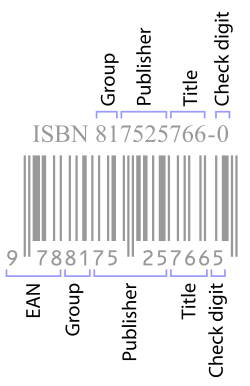
A modern 13-digit ISBN is composed of five distinct elements that categorize the book from a global level down to the specific publication.
- GS1 Prefix: A prefix (currently 978 or 979) that identifies the number as part of the global trade item system.
- Registration Group Element: Identifies the country, geographical region, or language area.
- Registrant Element: Identifies the specific publisher within the registration group.
- Publication Element: Identifies the specific edition and format of the work.
- Check Digit: A final single digit used to mathematically validate the rest of the number.
Global Issuing Process
ISBNs are issued by national agencies. These agencies vary by country; some are government-run libraries, while others are private organizations or NGOs.
| Country/Region | Issuing Agency |
|---|---|
| United States | R. R. Bowker |
| United Kingdom & Ireland | Nielsen Book Services Ltd |
| Australia | Thorpe-Bowker |
| Brazil | Câmara Brasileira do Livro (since March 2020) |
| Canada | Library and Archives Canada |
| Spain | Spanish ISBN Agency |
| Hong Kong | Books Registration Office (BRO) |
The Mathematics of Check Digits
To prevent data entry errors, both ISBN-10 and ISBN-13 use a check digit—a final number calculated using a weighted sum of the preceding digits.
ISBN-10 Calculation
In the 10-digit system, each of the first nine digits is multiplied by a weight descending from 10 to 2. The check digit is the number (0-10) that, when added to this sum, makes the total a multiple of 11. If the required value is 10, the symbol 'X' is used.
ISBN-13 Calculation
The 13-digit system uses a different algorithm consistent with EAN-13 barcodes. Digits are alternately multiplied by 1 and 3. These products are summed modulo 10. The result is subtracted from 10 to determine the final check digit (where a result of 10 is replaced by 0).
ISBN-10 vs. ISBN-13
The transition from 10 to 13 digits was necessary to increase the pool of available numbers and integrate books into the Global Trade Item Number (GTIN) system. It is important to note that the check digits for the 10-digit and 13-digit versions of the same book are generally different. Additionally, while most ISBN-13s begin with 978, the 979 prefix is also available, though it has different registration group assignments (e.g., 979-8 for the USA and 979-10 for France).
Frequently Asked Questions
What is the difference between ISBN, ISSN, and ISDN?
ISBN (International Standard Book Number) is used for books. ISSN (International Standard Serial Number) is used for serial publications like magazines or journals, and ISDN is a separate identifier entirely.
Can a 10-digit ISBN be converted to a 13-digit ISBN?
Yes, ISBN-10 numbers can be converted to ISBN-13 by adding the appropriate GS1 prefix (usually 978) and recalculating the check digit.
Why does some ISBN-10 numbers end with an 'X'?
The 'X' represents the number 10. Because the ISBN-10 check digit is based on a modulo 11 calculation, a single character is needed to represent the value of 10 to keep the ISBN at exactly 10 digits.
Who manages the ISBN system globally?
The system is coordinated and supervised by the International ISBN Agency, which works with national agencies to assign numbers to publishers.