Irony: From Ancient Rhetoric to Metaphysical Philosophy
At its core, irony is the juxtaposition of surface appearance and actual reality. While many use the term loosely in everyday conversation, it began as a sophisticated rhetorical device and literary technique. Over centuries, it has evolved from a tool of deception into a complex metaphysical stance on the human condition.
The concept traces its roots to ancient Greece, where it described a specific type of character who feigned ignorance to outwit arrogant opponents. Today, irony is recognized as the deliberate use of language to convey a meaning opposite to the literal words, creating a rhetorical effect that relies on the audience's ability to perceive the contradiction.
Because irony requires a shared understanding to be effective, it acts as a powerful social mechanism. It can strengthen bonds among those "in the know" while simultaneously creating divisions by excluding those who fail to grasp the underlying meaning.
Key Facts
- Origin: Derived from the Greek eironeia, referring to the eiron (a character who pretends to be less intelligent than they are).
- Core Mechanism: A "double-layered" phenomenon where the surface meaning differs from the intended meaning.
- Social Impact: Functions as a tool for both social bonding and social exclusion.
- Distinction from Sarcasm: While irony is a contrast between literal and intended meaning, sarcasm is specifically defined as aggressive humor intended to poke fun or ridicule.
The Evolution and Etymology of Irony
The term dates back to the 5th century BCE. In Old Comedy, such as the plays of Aristophanes, the eiron was a stock character who triumphed over the alazon—a vain braggart—by dissimulating their own intelligence.
By the Renaissance, the Latin ironia was categorized as a branch of rhetoric and a form of allegory, following the traditions of Cicero and Quintilian. It entered the English language in the 16th century, mirroring the French ironie.
A significant shift occurred at the end of the 18th century through Friedrich Schlegel and the early German Romantics. They transformed irony from a mere artistic playfulness into a "conscious form of literary creation." For them, irony became a metaphysical stance involving the constant alternation between affirmation and negation.
Defining the Indefinable
Defining irony is notoriously difficult. Philosopher Richard J. Bernstein noted that different authors often seem to be discussing entirely different subjects when they use the term. Even popular culture, such as Alanis Morissette's 1996 song "Ironic," is often cited as an example of how the word's specific meaning has blurred in common usage.
However, Henry Watson Fowler argued in 1906 that any valid definition must acknowledge that the surface and underlying meanings are not the same. This creates a "double audience": those who hear only the surface meaning and those who recognize the deeper intent.
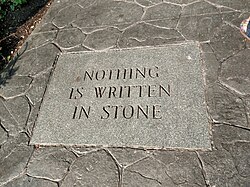
Literary theorist Douglas C. Muecke further refined this by identifying three core characteristics of verbal irony:
- Double-Layering: There is a lower level (the deceptive presentation) and an upper level (the reality known to the ironist or reader).
- Exploitation of Innocence: The irony relies on a victim who is unaware of the upper level, or an ironist who pretends to be unaware.
- Rhetorical Complexity: As noted by Wayne Booth, this duality makes irony a tool that can either tighten social bonds or exacerbate divisions.
Types of Irony
Irony manifests in several distinct forms, ranging from intentional speech to the perceived cruelty of fate.
Verbal Irony
This occurs when a speaker intentionally employs a meaning sharply different from the one ostensibly expressed. For example, Samuel Johnson cited the phrase "Bolingbroke was a holy man" to describe someone who was the opposite of holy. This category often includes hyperbole (extreme exaggeration) and litotes (understatement).
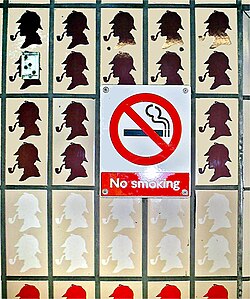
Cosmic Irony
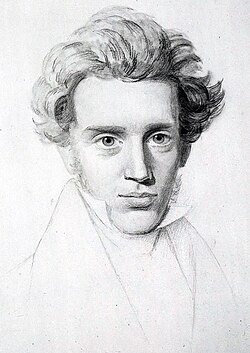
Also known as the irony of fate, this form depicts human agents being thwarted by forces beyond their control. This is a recurring theme in the works of Thomas Hardy and was given metaphysical weight by Søren Kierkegaard.
Romantic Irony
Closely linked to cosmic irony, Romantic irony differs in that the author or narrator assumes the role of the controlling cosmic force. This technique was central to early German Romanticism and later influenced mid-20th-century New Criticism.
The Muecke Typology: Grades and Modes
To better categorize ironic phenomena, D.C. Muecke proposed a system based on the degree of concealment and the relationship between the speaker and the irony.
Three Grades of Irony
- Overt Irony: The contradiction is blatant and obvious to all parties. Sarcasm often falls into this category, though its effect diminishes with repetition.
- Covert Irony: The irony is intended to be detected but not immediately seen. It requires the audience to use context or prior knowledge to spot the incongruity.
- Private Irony: The irony is not intended for anyone else to perceive; it exists solely for the internal satisfaction of the ironist.
Four Modes of Irony
- Ingénue Irony: The speaker assumes a convincing ignorance to expose hypocrisy, as seen in The Emperor's New Clothes.
- Dramatized Irony: The ironist remains hidden, simply presenting ironic situations for the audience's enjoyment, a technique frequently used by Gustave Flaubert.
- Impersonal Irony: Irony used without a specific personal target.
- Self-disparaging Irony: Irony directed at oneself.
Irony as a Way of Life
Beyond literature, irony has been viewed as a philosophical framework. Friedrich Schlegel used it to describe the human struggle of striving toward an infinite truth that can never be fully possessed.
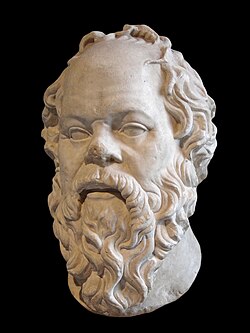
Søren Kierkegaard expanded on this in his analysis of Socrates. He portrayed Socrates as the embodiment of "ironic negativity"—someone who could dismantle the illusory knowledge of others without offering a positive replacement of his own.
| Type/Grade | Primary Characteristic | Example/Key Figure |
|---|---|---|
| Verbal Irony | Literal meaning $\neq$ Intended meaning | Samuel Johnson |
| Cosmic Irony | Thwarted by forces beyond control | Thomas Hardy |
| Romantic Irony | Author acts as the cosmic force | Friedrich Schlegel |
| Overt Grade | Blatant contradiction | Sarcasm |
| Covert Grade | Intended to be detected via context | Subtle social commentary |
| Private Grade | Internal satisfaction only | Mr. Bennet (Pride and Prejudice) |
Frequently Asked Questions
What is the difference between irony and sarcasm?
While both involve a discrepancy between literal and intended meaning, sarcasm is specifically a form of aggressive humor used to poke fun at or ridicule someone. Verbal irony is a broader category that does not necessarily require an aggressive or ridiculing intent.
How does cosmic irony differ from romantic irony?
Cosmic irony suggests that an impersonal fate or higher power thwarts human plans. Romantic irony is similar, but the "power" is the author or narrator, who consciously manipulates the narrative to create ironic effects.
What is "ingénue irony"?
Ingénue irony is a mode where the speaker pretends to be innocent or ignorant. This assumed simplicity is used as a tool to break through the hypocrisy or foolishness of others' established ideas.
Why is irony considered a tool for social bonding?
Irony creates an "in-group" of people who are capable of perceiving the hidden meaning. When people share the ability to recognize an ironic utterance, it reinforces their mutual understanding and shared perspective, effectively separating them from "outsiders" who only see the surface meaning.
How did Socrates use irony?
According to Kierkegaard, Socrates used irony as a form of absolute negativity. He would pretend to be ignorant to lead his opponents into contradictions, dismantling their false claims of knowledge without necessarily providing a definitive answer himself.