Ioras: The Vibrant Passerines of South and Southeast Asia
The ioras are a small but striking family of passerine (perching) birds known as Aegithinidae. Found exclusively across south and southeast Asia, these birds are characterized by their bright plumage and musical songs. While they may resemble bulbuls at first glance, ioras possess distinct physical traits and a unique taxonomic history that sets them apart in the avian world.
Key Facts
- Family: Aegithinidae, consisting of a single genus, Aegithina.
- Species: Four distinct species distributed across Asia.
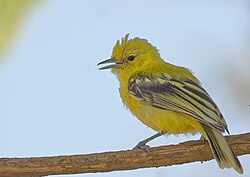
- Appearance: Small to medium birds (11.5 to 15.5 cm) with bright yellow and green plumage in males.
- Diet: Primarily insectivorous, feeding on insects and spiders.
- Habitat: Highly arboreal, preferring tree canopies in forests, scrub, and gardens.
- Conservation: Most are stable, though the Green iora is listed as near threatened.
Taxonomy and Systematics
The genus Aegithina was established in 1816 by French ornithologist Louis Pierre Vieillot. The name is derived from the Ancient Greek aigithos or aiginthos, referring to a mythical bird mentioned by classical authors like Aristotle. The type species, the common iora, was first described by Carl Linnaeus in 1758 as Motacilla tiphia.
The classification of ioras has historically been a subject of debate. Early taxonomists struggled to place them, variously categorizing them as warblers, flycatchers, finches, or babblers. In the 1850s, Edward Blyth linked them to leafbirds and fairy-bluebirds, and by 1869, G. R. Gray formally erected the family Aegithinidae. While they were previously grouped with the Irenidae family, they are now recognized as their own distinct lineage.
Species and Distribution
There are four recognized species within the Aegithinidae family, each occupying specific regions of Asia.
| Common Name | Scientific Name | Distribution |
|---|---|---|
| Common iora | Aegithina tiphia | Indian subcontinent and Southeast Asia |
| Marshall's iora | Aegithina nigrolutea | India and Sri Lanka |
| Green iora | Aegithina viridissima | Thai-Malay Peninsula, Sumatra, and Borneo |
| Great iora | Aegithina lafresnayei | Cambodia, China, Laos, Malaysia, Myanmar, Thailand, and Vietnam |
Physical Characteristics
Ioras are small to medium-sized birds, typically measuring between 11.5 and 15.5 cm in length. They exhibit sexual dimorphism, meaning males and females differ in appearance; males are generally larger and possess more vivid yellow and green plumage compared to the more muted tones of the females.
Compared to leafbirds, ioras have thinner legs and proportionately longer bills. Their vocalizations are a mix of strident whistles and songs that are considered musical to human listeners.
Habitat and Distribution
These birds are primarily lowland species, rarely ascending beyond submontane forests. Their preferred habitats include acacia scrub, forest edges, closed forests, and agricultural lands. The common iora is particularly adaptable, often residing in residential gardens.
Ioras are highly arboreal, spending the vast majority of their time in the tree canopy; sightings of them on the ground are extremely rare. While the family is overwhelmingly non-migratory, some evidence suggests that common ioras and Marshall's ioras in West India may be partly migratory within the seasonal semi-desert fringe.
Behavior and Ecology
Feeding and Foraging
Ioras are insectivores that feed on spiders and insects. They are nimble foragers, gleaning their prey from the leaves of the slenderest outer twigs of trees.
Courtship and Breeding
Courtship displays in some species are elaborate. Males perform a distinctive descent that resembles a "green ball of fluff," falling in a parachute-style motion to attract mates.
Their nests are compact, open cups that are felted to branches using spiderwebs. A female typically lays 2 to 3 eggs, which feature red and purple lines with pinkish speckles. The parents share incubation duties, with females incubating at night and males during the day. The incubation period lasts approximately 14 days, after which both parents brood and feed the chicks.
Relationship with Humans
Ioras are generally comfortable around human populations and can be found in the suburbs of major cities, such as Singapore. Unlike many other passerines, they are not frequently traded in the cage bird market.
Most species are not currently threatened by human activity. However, the Green iora is listed as near threatened by the IUCN, primarily due to the loss of its natural habitat.
Frequently Asked Questions
What do ioras eat?
Ioras primarily eat insects and spiders, which they find by gleaning from the outer twigs of trees.
How do ioras differ from bulbuls?
While similar in size, ioras are more brightly colored (especially the males) and have longer bills and thinner legs than bulbuls.
Are ioras migratory birds?
Most ioras are non-migratory, although there is evidence that Common and Marshall's ioras in West India may be partly migratory in semi-desert regions.
Which iora species is most at risk?
The Green iora is listed as near threatened by the IUCN due to habitat loss.
How do ioras build their nests?
They build compact open cups that are attached to branches using spiderwebs.