Understanding Invasive Species: The Global Challenge of Biological Invasions
In the complex web of global biodiversity, an invasive species is an introduced species that causes harm to its new environment. These organisms do not simply occupy new territory; they adversely affect habitats and bioregions, leading to significant ecological, environmental, and economic damage. While the movement of organisms into established ecosystems is a natural phenomenon, the scale of the problem has shifted dramatically in recent history.
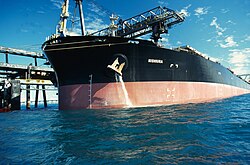
Since the 20th century, invasive species have evolved into serious worldwide threats. While nature has its own pace of migration, human activity has acted as a catalyst, greatly increasing the rate, scale, and geographic range of these invasions. For millennia, humans have served as dispersal agents—both accidentally and deliberately. This process began with early human migrations, accelerated during the Age of Discovery, and has reached a peak with the expansion of modern international trade.
The Process of Invasion: From Introduction to Dominance
Biological invasion is not an overnight event but a progression of stages. Scientists use specific terminology to describe how a species moves from its home range to becoming a dominant force in a new environment.
| Stage | Characteristic |
|---|---|
| 0 | Propagules residing in a donor region |
| I | Traveling |
| II | Introduced |
| III | Localized and numerically rare |
| IVa | Widespread but rare |
| IVb | Localized but dominant |
| V | Widespread and dominant |
Notable Invasive Species Around the World
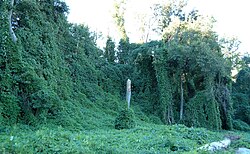
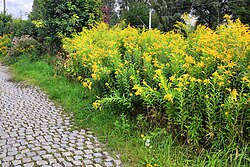
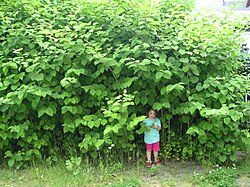
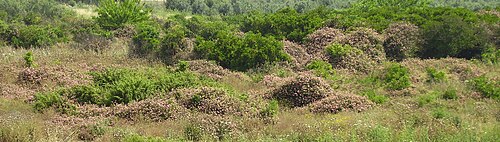
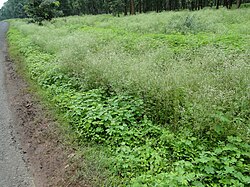
Invasions occur across all kingdoms of life, with both plants and animals causing widespread disruption. Some of the most notorious invasive plants include the kudzu vine (Pueraria), water hyacinth (Pontederia crassipes), common ragweed (Ambrosia artemisiifolia), and yellow starthistle (Centaurea solstitialis).
![Vinca in a garden[1]](/images/7e/07/7e079ce374a68fc337436307a647b7445d72a85e6d88d70f57299324f2d0ea83.jpg)
![Invasive water hyacinths (Pontederia crassipes) clog the Pasig River in Manila, Philippines in October 2020.[131]](/images/c2/dc/c2dc89b1f12099827ecd85f044aaa1754b97e7c253c30683dc13adc348054cbb.jpg)
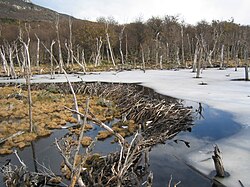
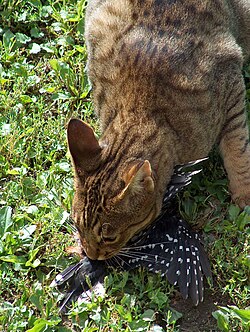
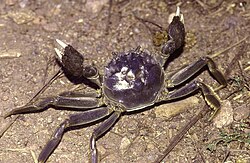
Animal invasions are equally impactful. Notable examples include European rabbits (Oryctolagus cuniculus), domestic cats (Felis catus), and red swamp crayfish (Procambarus clarkii). These animals often prey on native wildlife or outcompete them for essential resources.
![Argentine ants (Linepithema humile), which form supercolonies across continents, are ranked among the world's 100 worst invasive animal species.[121]](/images/64/de/64de10834b0b36b28ccc46caddb68c0d75fb78d37a00c3eeafc3e1a67871cc7b.jpg)
The High Cost of Biological Invasions
The impact of invasive species is not only ecological but also financial. Globally, the management and control of these species represent a staggering economic burden, with annual expenditures reaching approximately $1.4 trillion. As of 2019, the direct economic impact of invasive species alone was estimated to exceed $423 billion annually.
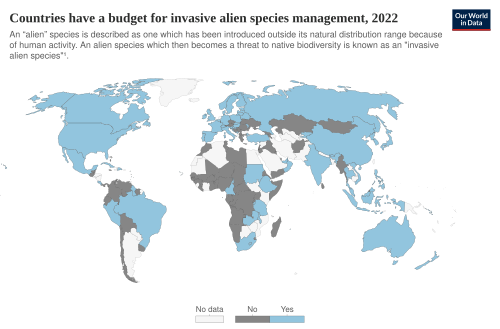
This financial strain is accelerating; the costs have quadrupled every decade since 1970. Regional data highlights the severity of the issue:
- Europe: Between 1960 and 2020, the economic cost of invasive alien species was estimated between $78 billion (observed costs) and $140 billion (including potential costs). By 2020, models suggested the true annual cost reached around $140 billion.
- Italy: One of Europe's most invaded nations, Italy hosts more than 3,000 alien species. Between 1990 and 2020, the estimated economic cost was $819.76 million (EUR 704.78 million), though this is likely an underestimate as only 15 species had reliably estimated costs.
Ecological Consequences and Wildlife Loss
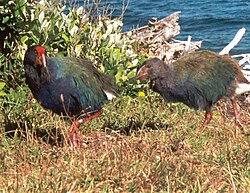
Beyond the balance sheets, invasive species devastate local biodiversity. They can lead to the decline or extinction of native species through predation and competition.
![The Kākāpō is a threatened species partially because of predation by invasive species (mostly rats and cats), there are only ≈240 individuals left worldwide [118]](/images/52/00/5200e7f9792182c0da991b89abcf0de559471041a0b7bb2cd7a03abf668f2094.jpg)
Management, Control, and Restoration
Combating invasive species requires a multi-faceted approach, ranging from prevention to active eradication.
Prevention and Containment
The first line of defense involves cargo inspection and strict quarantine measures to stop species from entering new regions. Public awareness also plays a role, such as encouraging campers not to move firewood to prevent the spread of hitchhiking species.

Active Control Methods
Once a species has established itself, various methods are used to manage the population:
- Chemical Control: The use of pesticides and herbicides.
- Biological and Genetic Tools: The exploration of gene drives and other genetic methods to control alien species.
- Repatriation: Returning invasive species to their country of origin.
- Human Consumption: Using some invasive species as food sources to reduce their numbers.
Ecological Restoration
In some cases, conservationists work to reestablish native species or use taxon substitution—introducing a species that fills a similar ecological niche to a lost native species to restore equilibrium.
Key Facts
- Global Management Cost: Approximately $1.4 trillion spent annually on control and management.
- Economic Impact: Exceeded $423 billion annually as of 2019.
- Cost Trend: Economic damages have quadrupled every decade since 1970.
- European Impact: Annual costs in Europe were estimated at $140 billion by 2020.
- Italy's Burden: Over 3,000 alien species have invaded Italy, causing hundreds of millions of dollars in damage.
- Primary Drivers: Human migrations, the Age of Discovery, and international trade.
Frequently Asked Questions
What exactly is an invasive species?
An invasive species is an organism that is introduced to a new environment where it is not native and subsequently causes ecological, environmental, or economic harm.
How do invasive species typically spread?
While some spread naturally, most modern invasions are human-facilitated. This occurs through accidental transport (such as in cargo ship ballast water) or deliberate introductions for commercial or aesthetic reasons.
Can invasive species ever have a positive effect?
In some specific instances, they may fill ecological niches in degraded ecosystems, potentially helping to restore some level of native biodiversity or providing new food sources for humans.
What are some common examples of invasive plants and animals?
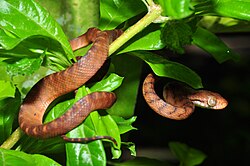
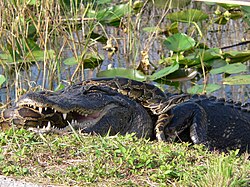
Common invasive plants include kudzu and water hyacinth. Common invasive animals include domestic cats, European rabbits, and the brown tree snake.
How are governments fighting the spread of these species?
Governments use a combination of regulations, cargo quarantines, chemical treatments (pesticides/herbicides), and emerging technologies like gene drives to manage and eradicate invasive populations.