Internet Explorer: The Evolution and Legacy of a Web Pioneer
For nearly three decades, Internet Explorer (IE) served as a cornerstone of the digital age. From its debut in 1995 as a component of Windows 95 to its eventual replacement by Microsoft Edge, the browser played a central role in how the world accessed the World Wide Web. Developed by Microsoft, it navigated through eras of massive market dominance, intense competition, and significant technological shifts.

Key Facts
- Original Release: August 24, 1995.
- Developer: Microsoft.
- Core Engines: MSHTML (Trident) and Chakra.
- Primary Successor: Microsoft Edge.
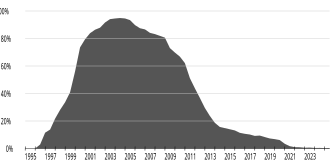
- Peak Market Share: Approximately 95% during 2002–2003.
- Supported Languages: 95 languages.
A Chronological Journey Through Versions
The history of Internet Explorer is marked by a series of major version releases, each attempting to adapt to the growing complexity of the internet.
The Early Years (Versions 1–6)
Internet Explorer 2, released in late 1995, expanded the browser's reach to Apple Macintosh and Windows 3.1. By the time Internet Explorer 5 arrived in 1999, the browser supported a wide array of operating systems, including Solaris and HP-UX. Internet Explorer 6, released in 2001, became a defining version of the era, serving as the default browser for Windows XP.
![Page zoom as seen in IE11. The lowest allowed manual zoom level is 10%, and the highest 1000%.[66]](/images/f7/95/f79518fdd3791cdb6af6398a570e21a5b2d469069838cfd7c0a99c33e04b10b1.png)
Modernization and Competition (Versions 7–11)
As the web evolved, so did IE. Internet Explorer 7 introduced tabbed browsing—the ability to open multiple web pages within a single window—in 2006. Internet Explorer 8 followed in 2009, bringing architectural changes to improve stability. Later versions, such as IE 10 and IE 11, focused on maintaining compatibility within the Windows ecosystem.
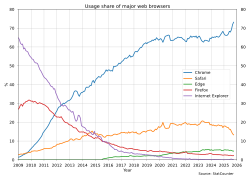
Despite these updates, the browser faced increasing pressure from competitors. While IE peaked with a 95% market share in the early 2000s, its dominance began to wane. In September 2010, its share fell below 50%, and by May 2012, Google Chrome overtook Internet Explorer as the most widely used browser globally.
Technical Architecture and Standards
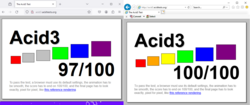
Internet Explorer relied heavily on the MSHTML (also known as Trident) engine to render web content. This engine allowed the browser to interpret various web standards, including HTML5, CSS3, SVG, and RSS. As the browser matured, it also integrated the Chakra engine to handle JavaScript execution.
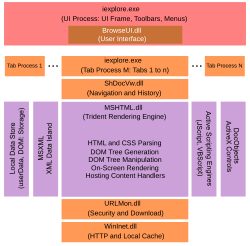
The architecture of the browser underwent significant changes over time. For instance, in IE8, the architecture was updated so that the user interface and tabs were no longer within the same process, a departure from previous versions where each window was tied to a single "tab process." This change was designed to improve overall system stability.
The Transition to Microsoft Edge
The sunsetting of Internet Explorer began in earnest in 2015. Microsoft unveiled Microsoft Edge (originally known as "Project Spartan") to serve as the modern successor. While Internet Explorer was phased out as the default browser for Windows 10, it remained available for enterprise purposes and on specific Windows Server channels until 2021.
Browser Evolution Summary
| Era/Version | Key Milestone | Primary Operating Systems |
|---|---|---|
| IE 1–6 | Initial dominance and Netscape competition | Windows 95, NT, XP |
| IE 7 | Introduction of tabbed browsing | Windows XP, Vista |
| IE 8 | Architectural updates for stability | Windows XP, Vista, 7 |
| IE 11 | Final major version before Edge transition | Windows 7, 8, 10 |
Frequently Asked Questions
What replaced Internet Explorer?
Microsoft Edge is the official successor to Internet Explorer, designed to provide a more modern and secure browsing experience.
What were the main engines used by IE?
Internet Explorer primarily used the MSHTML (Trident) engine for rendering, and later utilized the Chakra engine.
When did Internet Explorer lose its market dominance?
Internet Explorer's market share fell below 50% in September 2010, and it was eventually overtaken by Google Chrome in May 2012.
Did Internet Explorer support non-Windows systems?
Yes, in its earlier iterations, Internet Explorer supported various platforms including Mac OS X, Solaris, and HP-UX.
What is the significance of IE7?
Internet Explorer 7 was a major release that introduced tabbed browsing to the user experience.