International Wrestling Disciplines and Styles
Wrestling is one of the world's oldest and most diverse sports, encompassing a wide array of techniques and cultural traditions. According to the United World Wrestling (UWW), the governing body for the sport, wrestling is broadly categorized into two main groups: international wrestling disciplines and folk wrestling disciplines.
While many styles exist, three specific disciplines hold the prestigious status of being Olympic sports: Greco-Roman, men's freestyle, and women's freestyle wrestling. Beyond the Olympics, the UWW sanctions several other associated styles that blend traditional combat arts with modern competitive frameworks.
Key Facts
- Olympic Disciplines: Greco-Roman, Men's Freestyle, and Women's Freestyle.
- Governing Body: United World Wrestling (UWW), formerly known as FILA.
- Winning Condition: In Olympic styles, a "fall" occurs when both of an opponent's scapula (shoulder blades) are held to the mat.
- Ancient Roots: Pankration dates back to the Ancient Olympic Games in 648 BC.
- Cultural Heritage: Pahlavani wrestling is recognized by UNESCO as one of the world's longest-running sports.
Olympic Wrestling Disciplines
Greco-Roman Wrestling
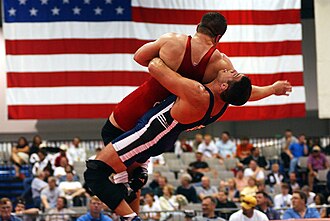
Greco-Roman (GR) wrestling is an international discipline that focuses exclusively on the upper body. The rules strictly forbid attacking the opponent below the belt, meaning holds, trips, and the active use of legs are prohibited. This restriction places a heavy emphasis on explosive, "high amplitude" throws—techniques that launch an opponent high into the air.
Points are awarded based on the amplitude of the throw, the exposure of the opponent's back to the mat, and the passivity of the opponent. One of the most legendary figures in this discipline is the Russian wrestler Alexander Karelin.
Freestyle Wrestling
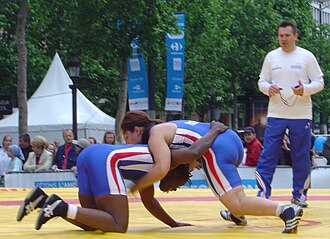
Freestyle wrestling (FS, WW) is practiced by both men and women in the Olympic Games. Unlike Greco-Roman, freestyle allows wrestlers to use their own legs and their opponent's legs for both offensive attacks and defensive maneuvers. This style evolved from catch-as-catch-can wrestling.
Similar to Greco-Roman, points are scored through throw amplitude, back exposure, and opponent passivity. While it shares similarities with American scholastic and collegiate wrestling, freestyle places a greater emphasis on high-amplitude throws. In the United States, collegiate women's wrestling utilizes freestyle rules in the NCAA, while the NCWA uses standard collegiate rules.
Specialized International and Submission Styles
Submission Wrestling and Grappling
Submission wrestling integrates techniques from various disciplines to control an opponent on the ground. This is often categorized as grappling, which is split into two distinct styles based on attire:
- No-gi (GNG): Athletes wear a compression shirt (rashguard) and shorts.
- Gi (GWG): Athletes wear a traditional kimono or gi.
The primary objective is to take down the opponent and secure a victory via submission using joint locks or chokes.
Amateur Pankration
Derived from the Greek words pan (all) and kratos (power), Pankration (PK) was introduced to the Ancient Olympic Games in 648 BC. Modern amateur pankration functions as a form of mixed martial arts (MMA), combining both striking and grappling techniques.
Folk and Traditional Wrestling Styles
Pahlavani Wrestling
Originating in ancient Persia and linked to mythological Iranian heroes, Pahlavani wrestling is a holistic practice combining strength training, calisthenics, music, and martial arts. Originally used to train warriors, it is now recognized by UNESCO for its longevity. Wrestlers strive for the title of pahlevan (hero).
The style is similar to freestyle, but athletes wear a belt and pants extending below the knees. Wrestlers can grip the belt or pants and use leg trips and lifts to touch the opponent's shoulders to the mat.
Alysh Belt Wrestling
Alysh is a Central Asian folk style where competitors wear trousers, jackets, and thick belts. A defining rule of Alysh (BWUWW) is that wrestlers must maintain their grip on the opponent's belt throughout the contest.
Beach Wrestling
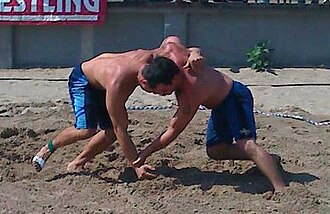
Codified by the UWW (then FILA) in 2004, beach wrestling (BW) is a standing-only discipline. Matches take place in a sand-filled circle 7 meters (23 ft) in diameter. Because it mirrors the rules used before the invention of wrestling mats, it is considered the oldest version of international competitive wrestling.
Athletes wear swimsuits, spandex, or athletic shorts. Since 2015, UWW rules allow points to be scored via takedowns, pushing an opponent out of bounds, or bringing the opponent down to their back. It has been featured in the World Beach Wrestling Championships, the Youth Olympic Games, and the 2019 World Beach Games.
Wrestling Disciplines Summary
| Discipline | Olympic Status | Leg Use Allowed? | Key Characteristic |
|---|---|---|---|
| Greco-Roman | Yes | No | Upper body explosive throws |
| Freestyle | Yes | Yes | Full body offense and defense |
| Submission | No | Yes | Joint locks and chokes |
| Pankration | No | Yes | Combined striking and grappling |
| Beach | No | Yes | Standing wrestling on sand |
| Alysh | No | Yes | Constant belt grip required |
Frequently Asked Questions
What is the main difference between Greco-Roman and Freestyle wrestling?
The primary difference is the use of legs. Greco-Roman wrestling forbids attacking the opponent below the belt and prohibits the use of legs for holds or trips, whereas Freestyle wrestling allows the use of legs for both offense and defense.
What constitutes a "fall" in Olympic wrestling?
A wrestler wins a match instantly by achieving a "fall," which occurs when they hold both of their opponent's scapula (shoulder blades) to the mat.
What is the difference between Gi and No-Gi grappling?
The difference lies in the clothing. Gi grappling requires athletes to wear a traditional kimono (gi), while No-Gi grappling involves wearing a rashguard and shorts.
How is Beach Wrestling different from other styles?
Beach wrestling is conducted standing up inside a 7-meter sand circle. Unlike Olympic styles, it allows points for pushing an opponent out of bounds and is performed in swimsuits or athletic gear rather than standard wrestling uniforms.
What is Pahlavani wrestling?
Pahlavani is an ancient Persian style recognized by UNESCO. It combines martial arts with music and strength training, and wrestlers wear specific pants and a belt which can be used for grips during the match.