Insignia: The History and Evolution of Symbols of Authority
An insignia (from the Latin insignia, the plural of insigne, meaning emblem or symbol) is a distinguishing sign or mark used to identify a specific group, grade, rank, or function. Whether representing personal power or the authority of a governing body, these symbols serve as visual shorthand for status and command.
Typically crafted from metal or fabric, an insignia can exist as a standalone symbol of authority. When combined, various insignias form a decoration that denotes a specific rank or dignity. Common examples include civil and military decorations, crowns, emblems, and coats of arms.
Regarding terminology, "insignia" is versatile; it can be used as a plurale tantum (remaining unchanged in both singular and plural forms) or take the plural form "insignias." The singular term "insigne" is rarely used in modern English.
Key Facts
- Purpose: Distinguishes rank, function, or group affiliation and symbolizes authority.
- Materials: Traditionally made from fabric or metal.
- Ancient Origins: Predates written history, originally using natural objects like tree branches or animal heads on poles.
- Roman Standard: The aquila (eagle) became the definitive symbol of the Roman legions around 100 BCE.
- Cultural Variety: Symbols have ranged from the Persian golden eagle to the Turkish silver half-moon.
Early History and Ancient Civilizations
The use of insignias began before recorded history. In early warfare, simple items—such as dry grass, tree branches, or the heads of beasts—were placed atop poles. These served as vital markers, allowing combatants to recognize their own units during the chaos of battle or to identify meeting points during a retreat.
As military strategy evolved, these markers became more durable and symbolic. The Persians adopted a golden eagle, the Assyrians used a dove, and the Armenians utilized a lion. Among the twelve Tribes of Israel, each tribe possessed an insignia of a distinctive color and symbol; for example, the Tribe of Judah was represented by a lion and the Tribe of Zebulun by a ship.
Other ancient cultures integrated their deities into their symbols. Egyptians used crocodiles and parrots, while the Babylonians and Assyrians used doves, reflecting the meaning of the name "Semiramis" (originally "Chemirmor").
Insignia in Ancient Greece and Persia
In early Greek "Heroic" times, military identification relied on the shield, helmet, or cuirass. However, Homer notes that during the Siege of Troy, Agamemnon used a purple cloth as a rallying point for his troops. By 600 BCE, city-states adopted specific civic symbols: Corinth used Pegasus and the letter koppa, Athens used the owl and olive tree, and Thebes used a sphinx.
The Persians maintained a highly formalized system. Their primary insignia was a golden eagle atop a pike, transported on a wagon and guarded by two high-ranking officers. In some ancient armies, the simple act of raising a purple mantle was sufficient to signal an attack.
The Roman Empire and the Aquila
The Romans initially used simple bundles of hay, later transitioning to figures of horses, boars, wolves, and minotaurs. This changed during the consulate of Gaius Marius, who established the aquila (eagle) as the standard for the legions. The first legion carried a silver eagle with extended wings on a sculptural base.
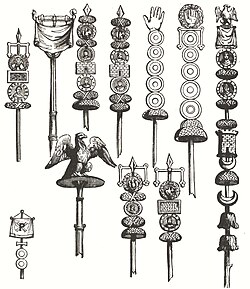
During the Imperial era, the Signum manipuli—a silver open palm known as the manus—symbolized loyalty. These were carried by an officer called the signifer. Other specialized markers included the vexillum (a purple flag) and the labarum, a square standard featuring a Christogram introduced by Constantine the Great.
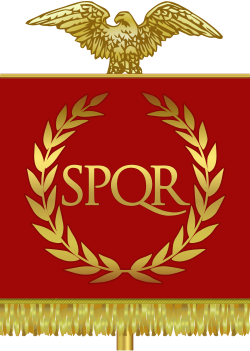
The insigniferos (standard-bearers) often wore the pelts of lions or bears over their armor to demonstrate the courage required to defend the insignia. Below the eagle, medallions were nailed to the spear rod, featuring the portrait of the Emperor and the letters SPQR (Senatus Populusque Romanus).
Medieval and Modern Evolutions
During the Crusades, Christian warriors adopted the cross on their banners, most notably the Maltese cross and the Jerusalem cross.
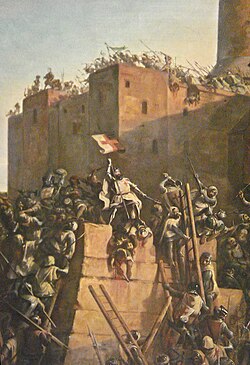
In the Middle Ages, town and village militias carried crests featuring their patron saints for protection. As professional armies formed, princes granted flags adorned with their own coats of arms or those of military leaders to favored units.
In the Ottoman Empire, Turkish standards were made of silk and featured a gold-embroidered scimitar and a silver half-moon. The dignity of a general was indicated by the number of horsehair bundles (tug) attached to the standard; the chief lord's banner bore seven. The most sacred was the standard of Muhammad, kept in a golden ark with the Quran.
In the Americas, the Royal Standard of the Mexicans was a gold filigree adorned with colored feathers. Its capture by Hernán Cortés at the Battle of Otumba was a decisive moment, as the loss of the standard signaled defeat.
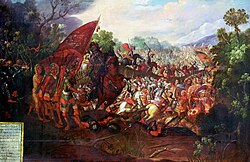
Throughout history, the loss of an insignia has been viewed as a profound dishonor, reflecting the transition of these objects from divine representations to symbols of national and military pride.
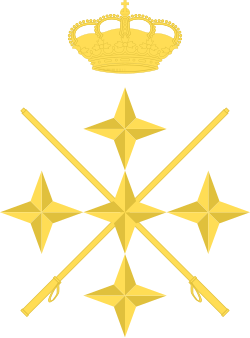
Summary of Historical Insignia
| Civilization | Primary Symbols | Key Characteristics |
|---|---|---|
| Ancient Persia | Golden Eagle | Carried on a wagon; guarded by top officers. |
| Ancient Rome | Aquila (Eagle), Manus (Hand) | Silver eagle for legions; open palm for loyalty. |
| Ancient Greece | Pegasus, Owl, Sphinx | City-specific symbols used on coins and shields. |
| Crusaders | Maltese and Jerusalem Crosses | Religious symbols of the "Christian warrior." |
| Ottoman Turks | Half-moon, Scimitar, Horsehair | Horsehair bundles (tug) indicated rank. |
| Aztec/Mexican | Gold filigree, Colored feathers | High-value gold standard; loss signaled defeat. |
Frequently Asked Questions
What is the difference between an insignia and a logo?
While both are symbols, an insignia specifically denotes rank, authority, or membership within a formal hierarchy (like the military or government), whereas a logo is generally used for corporate branding and commercial identification.
Why was the Roman eagle (aquila) so important?
The aquila was the definitive symbol of a Roman legion's honor and existence. Its loss in battle was considered a catastrophic disgrace, and the standard-bearers (insigniferos) were expected to defend it with their lives.
Is "insignia" singular or plural?
It can be used as both. It is often used as a plurale tantum (the same form for one or many), but "insignias" is also a grammatically valid plural form.
How did the Turks indicate the rank of a general?
The Turks used bundles of horsehair called tug. The number of these bundles attached to the standard indicated the general's or pasha's dignity, with the chief lord using seven.
What were the earliest materials used for insignias?
The earliest insignias were very simple and made from natural materials, including tree branches, dry grass, or the heads of animals placed on top of poles or sticks.