Immanuel Velikovsky: The Controversial Legacy of a Catastrophist
Immanuel Velikovsky (1895–1979) was a Russian-American psychoanalyst, writer, and catastrophist—someone who believes that Earth's history has been shaped by sudden, violent events. While trained in medicine and psychiatry, Velikovsky became a household name not for clinical practice, but for his radical reinterpretations of ancient history and astronomy. His work, most notably the bestseller Worlds in Collision, sparked a firestorm of debate that continues to be studied as a primary example of the demarcation problem, the philosophical challenge of distinguishing science from pseudoscience.
Key Facts
- Born: June 10, 1895, in Vitebsk, Russian Empire (present-day Belarus).
- Died: November 17, 1979, in Princeton, New Jersey.
- Education: Medical degree from the University of Moscow (1921).
- Most Famous Work: Worlds in Collision (1950).
- Core Theory: Proposed that planetary near-collisions caused global catastrophes recorded in ancient myths.
- Scientific Standing: Widely cited as a canonical example of pseudoscience.
Early Life and Academic Foundation
Born into a prosperous Jewish family, Velikovsky was a gifted student from a young age. He excelled in mathematics and the Russian language at the Medvednikov Gymnasium in Moscow, graduating with a gold medal in 1913. His early adulthood was marked by extensive travel through Europe and Palestine, as well as brief medical studies in Montpellier, France, and at the University of Edinburgh.
He eventually returned to Russia, where he enrolled at the University of Moscow and earned his medical degree in 1921. This scientific training provided the foundation for his later career as a psychiatrist and his attempts to apply interdisciplinary research to the study of the cosmos.
The Rise of Velikovskyism
In the 1940s, while living in New York City, Velikovsky shifted his focus toward a radical reconstruction of ancient history. He began publishing his ideas in pamphlets, such as Theses for the Reconstruction of Ancient History (1945), before attempting to publish a full-length book.
The journey to publication was fraught. Eight publishing houses rejected the manuscript for Worlds in Collision before Macmillan accepted it in 1950. The book's release triggered immediate controversy. While popular magazines like Harper's and Reader's Digest praised the work, the academic community reacted with fury. Astronomer Harlow Shapley threatened a textbook boycott of Macmillan, leading the publisher to transfer the book to Doubleday. Despite—or perhaps because of—this conflict, the book became a massive bestseller in the United States.
Radical Theories and Cosmic Catastrophes
Velikovsky's central thesis was that the solar system had undergone violent upheavals. He argued that planetary bodies had collided or passed dangerously close to one another, causing global disasters that were later preserved as myths and religious texts.
His specific postulates included:
- Planetary Near-Misses: He suggested that Venus and Mars were involved in catastrophic encounters with Earth.
- Electromagnetic Gravity: He posited that gravitation is an electromagnetic phenomenon.
- Revised Chronology: In works like Ages in Chaos (1952), he attempted to rewrite the timeline of ancient civilizations, claiming that traditional historical dates were incorrect.
Velikovsky's ideas extended into the realm of mythology, such as his claim in Oedipus and Akhenaten (1960) that the Egyptian pharaoh Akhenaten served as the prototype for the Greek myth of Oedipus.
Reception and Scientific Criticism
For much of the 1950s and 60s, Velikovsky was considered persona non grata on university campuses. However, by the 1970s, public curiosity grew. He began lecturing to record crowds across North America and was featured in television specials by the CBC (1972) and the BBC (1973).
The scientific community remained overwhelmingly critical. Critics like Carl Sagan and James Fitton argued that Velikovsky's use of mythology was unsound, noting that he often cherry-picked data that supported his thesis while ignoring contradictory evidence. By the 1980s, detailed critiques of his literary sources further eroded the credibility of his claims. Even former supporters, such as C. Leroy Ellenberger, eventually became vocal critics of his catastrophism.
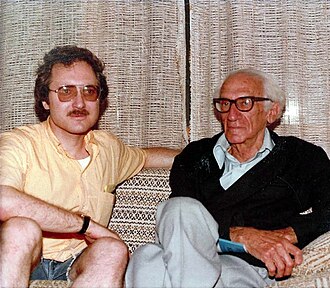
Literary Estate and Legacy
Following his death in 1979, Velikovsky's estate was managed by his daughters, Shulamit and Ruth. For years, they limited the publication of new materials, though a biography and some translations were released. In the late 1990s, much of his unpublished work became available via the Velikovsky Archive website, and in 2005, his entire physical archive was donated to the Princeton University Library.
| Title | Year | Primary Focus |
|---|---|---|
| Worlds in Collision | 1950 | Cosmic catastrophes involving Venus and Mars |
| Ages in Chaos | 1952 | Revised chronology of ancient history |
| Earth In Upheaval | 1955 | Geological catastrophes |
| Oedipus and Akhnaton | 1960 | Connection between Pharaoh Akhenaten and Greek myth |
| Mankind in Amnesia | 1982 | Humanity's forgotten history of catastrophe |
Frequently Asked Questions
What was the main argument of Worlds in Collision?
The book argued that the solar system experienced violent upheavals, specifically that Venus and Mars had near-collisions with Earth, which caused global disasters recorded in ancient myths and religious texts.
Why is Velikovsky associated with the 'demarcation problem'?
The demarcation problem is the challenge of defining the boundary between science and pseudoscience. Velikovsky's work is often used as a case study because he used a scientific-sounding framework to reach conclusions that the established scientific community rejected as unfounded.
Did any scientists support his theories?
While the vast majority of the scientific community rejected his work, he inspired a small group of followers in the 1960s and 70s, and some interdisciplinary journals, such as Kronos, were founded specifically to discuss his ideas.
What happened to his archives?
His daughter, Ruth Sharon, presented his entire archive to the Princeton University Library in 2005, making his manuscripts and correspondence available for research.
How did the academic community react to his publication?
The reaction was overwhelmingly negative. Many scientists viewed his work as pseudoscience, and some academic figures even attempted to boycott publishers who printed his books.