I. A. Richards: Pioneering New Criticism and the Science of Meaning
I. A. Richards was a transformative figure in 20th-century literary theory, bridging the gap between psychology, linguistics, and literary criticism. By treating the act of reading as an empirical process, Richards shifted the focus of criticism from the author's biography or historical context to the text itself. His work laid the essential groundwork for New Criticism, a formalist movement that emphasizes the close reading of literary works to uncover their internal meaning.
Key Facts
- Foundational Influence: His pedagogical experiments at Cambridge University led to the development of "close reading."
- Collaborative Work: Partnered with C. K. Ogden to create the Semantic Triangle and Basic English.
- Cybernetic Contribution: Coined the term feedforward in 1951 to describe the anticipation of a message's effect.
- Educational Impact: Advocated for an international auxiliary language to improve global communication.
- Psychological Approach: Integrated the scientific study of psychology, specifically the work of Charles Scott Sherrington, into literary analysis.
Collaborations with C. K. Ogden
Much of Richards' intellectual output was shaped by his partnership with the linguist and philosopher Charles Kay Ogden. Together, they explored how language influences thought and how meaning is constructed.
The Science of Semiotics and the Semantic Triangle
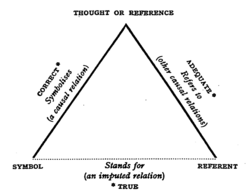
In their 1923 work, The Meaning of Meaning, Richards and Ogden introduced a triadic theory of semiotics (the study of signs and symbols). This theory improved upon the dyadic (two-part) model proposed by Ferdinand de Saussure by adding a psychological dimension.
They developed the semantic triangle to illustrate how words acquire meaning. The triangle consists of three points: the symbol (the word), the referent (the actual object in reality), and the thought (the intangible idea or reference). The meaning of a word is not inherent in the symbol itself but is determined by the individual's unique experience and perception.
Basic English and Global Communication
Richards and Ogden also sought to democratize language through Basic English, introduced in 1930. This system simplified the English language into a vocabulary of only 850 words. Through publications like The Times of India Guide to Basic English (1938), Richards advocated for this system to serve as an international auxiliary language, or interlanguage, to facilitate global understanding.
Aesthetics and the Evolution of Literary Criticism
Richards believed that literary criticism should move away from abstract impressions and toward precision. He argued that the value of poetry lies not in whether the reader believes the statements within it, but in the emotions the poetry provokes.
The Principles of Practical Criticism
In Practical Criticism (1929), Richards conducted an empirical study on how students respond to texts. He removed all authorial and contextual information from thirteen poems and asked undergraduates to interpret them. This experiment revealed a significant gap between the texts and the students' interpretations, demonstrating how easily readers commit textual misreadings when stripped of context.
This approach established the text as an object for close aesthetic interpretation. Richards introduced concepts such as coenesthesia (the awareness of inhabiting one's body caused by various stimuli) and explored the roles of rhythm, value, and form in literary works.
The Theory of Ambiguity
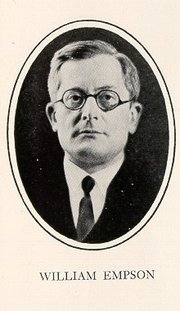
Richards' influence extended to his students, most notably William Empson. Empson expanded on Richards' theories in Seven Types of Ambiguity (1930). Along with The Principles of Literary Criticism and Practical Criticism, this work became a cornerstone of the New Criticism methodology.
The New Rhetoric and Feedforward
Richards reimagined rhetoric—the art of discourse—not as a tool for winning arguments or managing conflict, but as a "study of misunderstanding and its remedies." This New Rhetoric focused on how language actually works and how denotation (literal meaning) and connotation (associated meaning) are perceived by the audience.
The Concept of Feedforward
Later in his career, Richards contributed to the field of cybernetics by coining the term feedforward in 1951. While feedback occurs after an action, feedforward is the act of anticipating the effect of one's words by acting as one's own critic before the message is delivered.
Richards argued that feedforward allows a writer to pretest their text and make necessary changes to avoid appearing dogmatic. This concept was later developed further by his student, Marshall McLuhan.
Summary of Major Contributions
| Work/Concept | Year | Primary Focus |
|---|---|---|
| Foundations of Aesthetics | 1922 | Balance of psychological impulses in aesthetic reception. |
| The Meaning of Meaning | 1923 | Triadic theory of semiotics and the Semantic Triangle. |
| Principles of Literary Criticism | 1924 | Scientific approach to form, value, and rhythm. |
| Practical Criticism | 1929 | Empirical study of textual misreadings and close reading. |
| Basic English | 1930 | Simplified 850-word vocabulary for international use. |
| Feedforward | 1951 | Anticipating the impact of communication to clarify concepts. |
Frequently Asked Questions
What is the difference between the dyadic and triadic theories of semiotics?
The dyadic theory, associated with Ferdinand de Saussure, focuses on two parts. The triadic theory, developed by Richards and Ogden, adds a third element—the psychological thought or reference—to explain how a symbol connects to a real-world referent.
How did Practical Criticism change the way we read literature?
It shifted the focus from the author's intent and historical background to the text itself. By demonstrating that readers often misinterpret texts without context, Richards promoted "close reading" as a way to achieve a more precise aesthetic interpretation.
What is Basic English?
Basic English is a simplified version of the English language created by Richards and Ogden, consisting of only 850 words. It was designed to be an international auxiliary language to facilitate easier communication between people of different native tongues.
What does Richards mean by "feedforward"?
Feedforward is a communication strategy where the speaker or writer anticipates how their audience will react to their words. By acting as their own critic before publishing or speaking, the communicator can refine the message to ensure clarity and avoid dogmatism.
Who were the most prominent critics influenced by I. A. Richards?
Richards mentored William Empson and F. R. Leavis. His work also heavily influenced Cleanth Brooks and Allen Tate, as well as later New Critics like John Crowe Ransom and W. K. Wimsatt, although some later critics rejected his emphasis on psychology.