Huginn and Muninn: The Raven Messengers of Odin
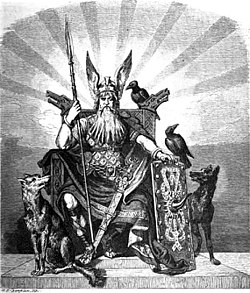
In the vast landscape of Norse mythology, few companions are as iconic as Huginn and Muninn. These two ravens serve as the eyes and ears of the All-Father, Odin, traversing the realm of Midgard (the world of humans) to gather intelligence and gossip from every corner of the earth. More than mere pets, these birds represent the extension of Odin's own consciousness and his insatiable thirst for knowledge.
Their stories are preserved in primary sources such as the 13th-century Poetic Edda and Prose Edda, as well as the Heimskringla and the Third Grammatical Treatise. Through these texts and a wealth of archaeological finds, we gain a glimpse into how the ancient Germanic and Norse peoples viewed the relationship between the divine, the animal kingdom, and the human mind.
Key Facts
- Names: Huginn and Muninn roughly translate to "mind" and "will" (or memory).
- Role: They fly across Midgard daily, returning at dinner-time to report their findings to Odin.
- Titles: Because of his association with them, Odin is known as Hrafnaguð, meaning the "raven-god."
- Abilities: According to the Heimskringla, Odin bestowed the gift of speech upon the ravens.
- Symbolism: They are often interpreted as personifications of Odin's intellectual powers or shamanic extensions of his soul.
Literary Attestations
The Eddas and Sagas
The Poetic Edda, specifically in the poem Grímnismál, reveals a more vulnerable side of Odin. While disguised as Grímnir, he expresses a deep-seated anxiety that his ravens might not return from their daily flights, fearing for Huginn but worrying even more for Muninn.
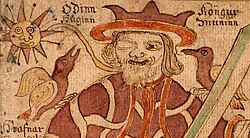
The Prose Edda expands on this, describing the ravens perching on Odin's shoulders and whispering everything they see and hear into his ears. Similarly, the Heimskringla emphasizes that this constant stream of information is what made Odin "very wise in his lore."
The Third Grammatical Treatise
An anonymous verse recorded in the Third Grammatical Treatise adds a darker dimension to their duties. It describes the ravens flying from the shoulders of Hnikar (another name for Odin), with Huginn seeking out hanged men and Muninn searching for slain bodies, linking the birds to Odin's role as a god of the dead and war.
Archaeological Evidence
The presence of Huginn and Muninn extends beyond literature into the physical artifacts of the Migration Period and the Viking Age.
Gold Bracteates and Helmet Plates
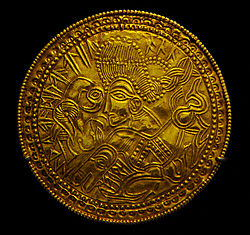
Migration Period gold bracteates (small gold pendants) often depict a human figure—identified as Odin—above a horse and flanked by birds. Some scholars, such as Rudolf Simek, suggest these may represent Odin's veterinary functions, showing the ravens helping to heal a horse.
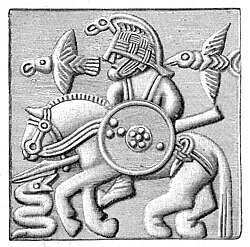
Vendel era helmet plates from Sweden also feature a spear-wielding rider accompanied by two birds, further cementing the iconographic link between Odin and his ravens.
Brooches and Figurines
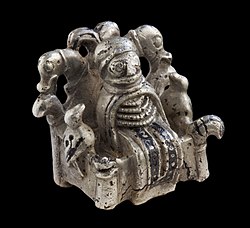
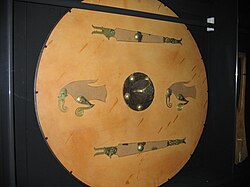
In Denmark, a pair of bird-shaped brooches from Bejsebakke were designed to be worn on each shoulder. Archaeologist Peter Vang Petersen notes that the raven shape and the mask motifs on the brooches strongly suggest a connection to the cult of Odin. More recently, the "Odin from Lejre" silver figurine depicts a seated figure on the throne Hliðskjálf, flanked by two birds.
Other Notable Finds
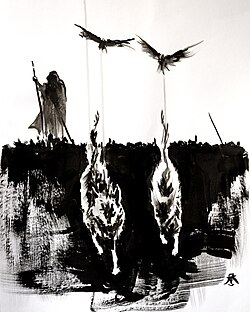
- Oseberg Tapestry: Fragments from Norway show two black birds hovering over a horse and wagon, interpreted as Huginn and Muninn.
- Ribe Moulds: Lead casting moulds from Denmark depict a helmeted man with two head-ornaments, likely representing the ravens.
- Thorwald's Cross: A runestone from the Isle of Man shows a bearded man with a large bird on his shoulder, possibly depicting Odin during Ragnarök.
Interpretations and Theories
Shamanism and the Soul
Many scholars link the ravens to shamanic practices. John Lindow suggests that sending Huginn and Muninn is a metaphor for the shaman's trance-state journey, where the soul leaves the body. This is supported by the concepts of the fylgja (a guardian spirit) and the hamingja (a ghostly double), both of which could appear in animal form.
Biological Symbiosis
Biologist Bernd Heinrich proposes a more naturalistic theory. He suggests the myth reflects a real-world symbiosis between humans, wolves, and ravens during prehistoric hunts. In this view, the ravens acted as the "eyes" (scouts) and the wolves as the "providers," creating a powerful hunting alliance that was later mythologized into the figure of Odin.
Cultural Adaptation
The influence of this imagery reached as far as early Christian adaptations. The 9th-century Old Saxon Heliand depicts a dove on the shoulder of Christ, which scholar G. Ronald Murphy argues was a deliberate attempt to portray Christ as a "new Woden" to make the new religion more appealing to Germanic peoples.
| Aspect | Details |
|---|---|
| Primary Function | Intelligence gathering and messengers for Odin |
| Etymology | Huginn (Mind/Thought) and Muninn (Will/Memory) |
| Key Sources | Poetic Edda, Prose Edda, Heimskringla |
| Physical Symbols | Bracteates, helmet plates, shoulder brooches |
| Associated Animals | Wolves Geri and Freki |
Frequently Asked Questions
What do the names Huginn and Muninn mean?
The names are derived from Old Norse words for abstract mental processes. Huginn is generally associated with "thought" or "mind," while Muninn is associated with "memory" or "will." Together, they represent the cognitive faculties of Odin.
Why did Odin fear for the ravens?
In the Grímnismál, Odin expresses fear that the ravens might not return from their daily flights. This is often interpreted by scholars as a metaphor for the danger a shaman faces when their soul leaves their body during a trance.
Are Huginn and Muninn the only animals associated with Odin?
No, Odin is also famously accompanied by two wolves, Geri and Freki, who are mentioned alongside the ravens in the Poetic Edda.
How are the ravens depicted in archaeology?
They appear as birds flanking a human figure on gold bracteates, as ornaments on helmet plates, and as shoulder brooches. They are often shown perched near the ear of the figure, symbolizing the whispering of secrets.
Do Huginn and Muninn appear in modern culture?
Yes, they appear in various forms, including Marvel Comics. More recently, in January 2024, the European Space Agency named the missions of Danish astronaut Andreas Mogensen and Swedish astronaut Marcus Wandt "Huginn" and "Muninn," respectively.