House of Commons: The Heart of British Parliamentary Democracy
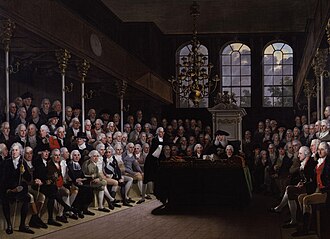
The House of Commons serves as the lower house of the Parliament of the United Kingdom, acting as the primary legislative body where elected representatives debate law and hold the government to account. Evolving from the 13th and 14th centuries, it has transformed from a regional assembly into a global symbol of parliamentary democracy.
The chamber's history is one of expansion. In 1707, it became the House of Commons of Great Britain following the union with Scotland. By 1801, it incorporated Ireland, and in 1922, it transitioned into the House of Commons of the United Kingdom of Great Britain and Northern Ireland after the independence of the Irish Free State.
Key Facts
- Total Seats: 650 Members of Parliament (MPs).
- Voting System: First-past-the-post with single-member constituencies.
- Term Length: Up to five years.
- Current Leadership: Sir Lindsay Hoyle (Speaker) and Andy Burnham (Prime Minister).
- Meeting Place: Palace of Westminster, London.
- MP Salary: £86,584 (effective April 1, 2023).
Governance and Relationship with the Government
The government is solely responsible to the House of Commons. A Prime Minister remains in office only as long as they maintain the confidence of a majority of the Commons. Under the Dissolution and Calling of Parliament Act 2022, Parliament sits for up to five years, though the Prime Minister may request the monarch to dissolve Parliament earlier.
By convention, government ministers must be members of either the House of Commons or the House of Lords. Since 1902, nearly every Prime Minister has been a member of the Commons at the time of their appointment, with the notable exception of Alec Douglas-Home in 1963, who disclaimed his peerage to enter the lower house.
Membership and Qualifications
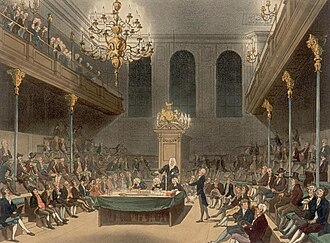
A Member of Parliament (MP) is an elected representative who typically uses the post-nominal letters "MP." To qualify for election, a candidate must be at least 18 years old and a citizen of the UK, a British overseas territory, the Republic of Ireland, or a Commonwealth member state.
Certain disqualifications apply to prevent conflicts of interest or legal impropriety. Individuals cannot sit in the Commons if they are bankrupt, serving a prison sentence of one year or more, or holding high judicial offices. Additionally, members of the Senedd (Welsh Parliament) and the Northern Ireland Assembly have been disqualified since 2014.
The current gender composition of the House reflects a shift toward greater representation, with 387 male members (59.5%) and 263 female members (40.5%).
The Chamber: Design and Evolution
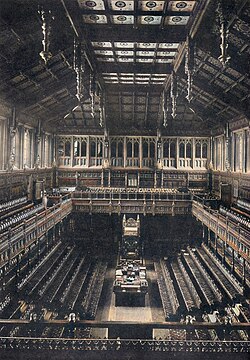
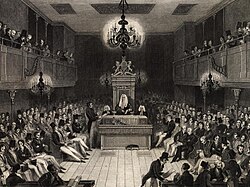
The physical space of the House of Commons has undergone significant changes. The original chamber built by Sir Charles Barry was destroyed by German bombs during the Second World War, though the essential features of his design were preserved during the reconstruction.
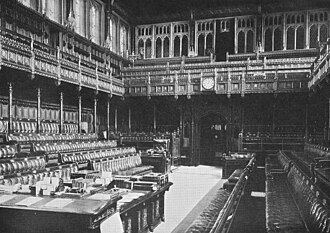
The modern chamber, which opened in 1950, was designed to be significantly brighter than its predecessor, which featured a very dark wood veneer. This reconstruction also introduced microphones to facilitate the recording of debates.
Parliamentary Procedure and Scrutiny
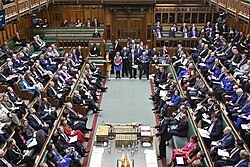
Public debates are meticulously recorded in Hansard, the official report of parliamentary proceedings. While radio broadcasts began in 1975, television coverage via BBC Parliament has been available since 1989.
Voting, or "division," requires a quorum of 40 members to be valid. In the rare event of a tie, the Speaker or Deputy Speaker exercises a casting vote. According to Speaker Denison's rule, this vote is typically used to allow further debate or to avoid a decision without a clear majority.
Summary of Current Parliamentary Structure
| Political Group | Number of Seats |
|---|---|
| Labour Party | 405 |
| Conservative Party | 118 |
| Liberal Democrats | 71 |
| Sinn Féin | 7 |
| Scottish National Party | 8 |
| Reform UK | 7 |
| Other Groups/Independents | 34 |
Frequently Asked Questions
How are Members of Parliament elected?
MPs are elected using the first-past-the-post voting system, where the candidate with the most votes in a single-member constituency wins the seat.
What happens if a vote in the House of Commons ends in a tie?
If a vote is tied, the Speaker or Deputy Speaker provides a casting vote, usually following Speaker Denison's rule to encourage further debate or prevent a decision without a majority.
Can a member of the House of Lords also sit in the House of Commons?
No, members of the House of Lords are prohibited from serving in or voting for the House of Commons, although they are permitted to sit in the chamber during debates.
How often are constituency boundaries redrawn?
Redistricting is proposed by boundary commissions every eight years to ensure fair representation.
What is the role of the Speaker?
The Speaker presides over debates in the House of Commons, ensuring order and neutrality while managing the legislative process.